
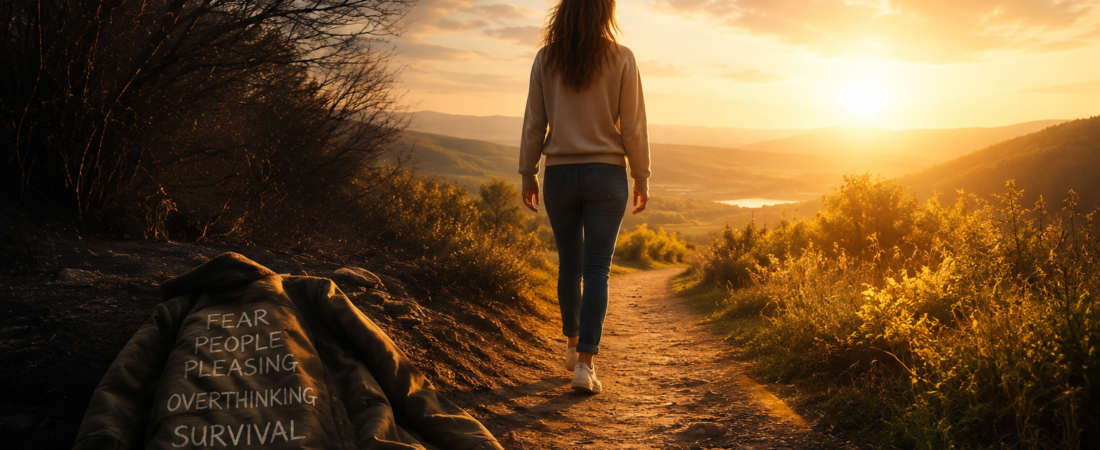
There comes a moment when the version of you that survived no longer feels like the version of you that wants to live. You look around at your life one day and something feels quietly off. Nothing has obviously broken. From the outside, things may even look fine. But the habits that once felt like home now feel heavy. The relationships that once felt essential leave you drained in ways you can’t quite explain. The way you’ve always moved through the world—careful, capable, guarded, always busy suddenly feels like wearing a coat that no longer fits. Beneath it all is a quiet realization: I’m not sure I’m this person anymore.
If you’re standing in that exact place right now not quite who you were, not yet who you’re becoming this is for you. Because what you’re feeling isn’t a breakdown. It’s something far more hopeful than that, even though it rarely feels hopeful while you’re in it.
The Version of You That Helped You Survive
Before we talk about outgrowing it, let’s honor it. Because the version of you that you’re now beginning to release once saved your life.
Maybe you became a people pleaser, reading every room, sensing what others needed before they asked, keeping everyone comfortable so the ground beneath you would stay stable. Maybe you became fiercely, almost painfully independent deciding somewhere along the way that needing people was dangerous, so you’d simply never need anyone again. Maybe you built walls so high that no one could reach the soft parts of you, because the last time someone reached them, it hurt too much. Maybe you became the perfectionist, the constant achiever, the strong one who never fell apart.
Here is what I most want you to understand: none of those were flaws. They were not weaknesses or failures. They were adaptations intelligent, creative responses to circumstances that demanded them. You didn’t become hyper-independent because something was wrong with you. You became hyper-independent because, at some point, depending on someone wasn’t safe, and a wiser-than-you-knew part of you found a way to keep you protected.
That version of you deserves gratitude, not shame. It got you here. It did its job. The trouble is only this: the job is finished, and somewhere inside, you’re starting to know it.
Why the Version of You That Survived Is Hard to Let Go
No one warns you that healing can feel like grief. You expect it to feel like relief, like lightness, like finally arriving. And sometimes it does. But often, especially at the beginning, it feels like mourning and that catches people completely off guard.
Here’s why. The coping mechanisms you’re outgrowing, even the painful ones, are familiar. And the human heart finds a strange comfort in the familiar, even when the familiar hurts. The walls were lonely, but they were yours. The constant productivity was exhausting, but it was reliable. The strong-one role was heavy, but at least you knew exactly who you were inside it.
So when those old patterns start to fall away, there’s a real loss underneath the growth. You are grieving the person you had to become in order to survive — and that grief is valid, even though you’re moving toward something better. You can be relieved to be leaving the old self behind and still miss it. Both can be true. Letting go of who you had to be is its own kind of goodbye, and you’re allowed to feel the weight of it.
When Your Old Life No Longer Fits
As you heal, the change rarely stays contained to your inner world. It spreads. It touches everything.
You may notice your relationships shifting. Friendships that were built around your old role the one who always gave, always listened, never needed anything back start to feel unbalanced now that you have needs of your own. You may find your priorities rearranging themselves, your tolerance for certain things shrinking, your boundaries firming up in ways that surprise even you. Things you once accepted without question suddenly feel unacceptable. People who once fit perfectly into your life now feel like they belong to a chapter you’ve already lived.
This can be deeply lonely. There’s a particular ache in growing in a direction that the people around you didn’t grow toward. You might feel disconnected, even from people you love, because the version of you they knew is quietly dissolving. You’re not becoming cold or difficult you’re becoming honest, and honesty changes the shape of a life. That disorientation isn’t a sign you’re doing something wrong. It’s the natural turbulence of a life rearranging itself around a truer you.
You Are Not Falling Apart
I want to say this as clearly and gently as I can, because you may badly need to hear it: you are not falling apart. You are not losing yourself. You are not broken.
What you’re experiencing has a shape, even if no one’s ever named it for you. The old version of you is fading, but the new version isn’t fully formed yet and so you’re living in the in-between, the uncomfortable middle space where you no longer recognize yourself but can’t yet see who you’re becoming. It feels like being lost. It’s actually being between.
The disorientation you feel is not the absence of a self it’s the gap between two selves. And that gap is not a sign that something has gone wrong. It’s the most honest evidence that something is going right. Caterpillars don’t become butterflies through a tidy, comfortable process. There’s a stage in the middle where the old form completely dissolves before the new one takes shape. If you feel like you’re in that messy, formless middle right now, it’s not because you’re failing. It’s because you’re transforming.
Becoming Someone You No Longer Have to Protect
Here’s the quiet, beautiful destination of all this: you are slowly becoming someone you no longer have to defend every moment of the day.
Imagine it. Trusting yourself enough to stop bracing. Resting without guilt clawing at you. Letting love in instead of holding it at the door. Setting a boundary and feeling steady instead of terrified. Being your real, unperformed self and discovering the world doesn’t end. This is what life beyond survival mode can feel like not the constant vigilance of someone protecting an old wound, but the spaciousness of someone who finally feels safe enough to simply be.
You spent so long protecting yourself that you may have forgotten there’s another way to live one where you’re not always on guard, always managing, always preparing for the next threat. That way is available to you now. You don’t have to earn it by suffering more. You only have to let yourself grow into it.
Gentle Reflection
Take a slow breath, and sit honestly with this:
What did the survivor version of you protect you from and what might become possible now that you no longer have to live entirely in that protection?
You don’t have to answer it all at once. Just let yourself notice the tenderness of how far you’ve come, and the quiet courage it’s taking to keep going.
A Gentle Place to Land
If everything feels uncertain right now if you don’t quite recognize your life, your relationships, or even yourself please be gentle with the part of you that’s afraid. You are not losing who you are. You are meeting who you’re becoming, and meetings like that are rarely tidy.
The version of you that survived was brave and resourceful and exactly what you needed for the season you were in. But you were never meant to stay in survival mode forever. You don’t have to keep being the one who copes, guards, performs, and endures. You are allowed to set that down now. You are allowed to become the person who heals softer, truer, more at home in your own life than the survivor ever had the chance to be.
The old you got you through the storm. The new you gets to live in the calm that came after. Let yourself walk toward it. You’ve already done the hardest part.