Welcome to the Rise Again Healing Library
A place where healing begins with understanding. Explore compassion books, journals, articles, music, and videos created to help you reconnect with yourself one gentle step at a time.
A gentle healing library of emotional articles, affirmations, calm healing songs, and guided journals created to help you rebuild your peace, self-worth, and inner strength
The Quiet Fear of Trusting Again
Sometimes the hardest part isn’t wanting to trust again.
It’s wanting to trust while quietly realizing that some part of you is still waiting for something to go wrong.
You answer the messages. You smile. You let people come a little closer. But not too close. Not yet.
Because somewhere beneath your hope, there is a quiet fear that if you fully open your heart again, you may have to survive another goodbye.
Maybe you have never said this out loud. Maybe you have never needed to. It lives in the pause before you reply, in the way you notice yourself holding a little back even when everything seems fine. You want to believe. You almost do. And still, a part of you stands near the door, coat already on, just in case.
If that feels familiar, you are not broken. You are not cold. You are someone who has been paying attention.
What trust actually feels like
We often talk about trust as if it were a decision. As if one morning you could simply choose it, the way you choose what to wear, and then walk out into the world unguarded.
But trust has never really worked that way, has it?
Trust is not a decision. It is an experience. It is the slow loosening of something in your chest when a person proves, again and again, that they are who they said they were. It is the moment you realize you fell asleep mid-conversation and felt safe enough to do so. It is your body relaxing before your mind gives it permission.
And because trust lives in the body, it cannot be argued into existence. You can list every reason why someone deserves your faith and still feel that quiet resistance. That resistance is not stubbornness. It is memory. Something in you learned, once, that safety could not always be taken at its word.
So perhaps the question was never whether you know how to trust. Perhaps it is why trusting again asks so much of you now.
The quiet fear no one sees
Here is something strange about this kind of fear: it is almost invisible.
From the outside, you may look completely fine. Calm, even. You show up. You laugh. You give good advice to people moving through their own heartbreak. No one watching you would guess that a part of you is quietly scanning the room, gently keeping track of the exits.
That is the thing about emotional self-protection. It rarely looks like fear. It looks like independence. It looks like being low-maintenance, easygoing, the person who never asks for too much. It looks like strength.
And in a way, it is strength. But it can also be tiring, this constant, invisible work of staying one step ahead of your own hope.
Have you ever noticed how much energy it takes to seem okay while quietly protecting yourself? How you can be fully present in a conversation and, at the same time, standing slightly outside it, watching to make sure it stays safe?
Most people carrying a fear of trusting are not asking to be rescued. They are simply tired of being the only one who noticed how carefully they were holding everything together.
Why disappointment teaches the heart to stay alert
The heart is not naturally suspicious. It becomes alert the way anything becomes alert: through experience.
When you have been disappointed enough times, when the people who promised to stay found reasons to leave, when consistency turned out to be temporary, something in you begins to learn. Not with words. With feeling. It learns that hope can be expensive. It learns to hold a little in reserve, so that if the ground shifts again, you will not fall quite so far.
This is not coldness. This is the heart remembering.
It would be easier, in some ways, if betrayal simply made us bitter. Bitterness is at least simple. But for most people, what happens is quieter and more complicated. You still want closeness. You still ache for it. You just also flinch toward it. You reach out and pull back in the same breath.
And then, sometimes, you judge yourself for it. You wonder why you can’t just relax, why you can’t be like the people who seem to love so freely. But those people may simply be carrying different memories. The heart that stays alert is not failing. It is doing exactly what it learned to do to keep you safe.
The question worth sitting with may not be “Why am I like this?” It may be “What was I protecting, and does it still need protecting in the same way?”
Independence and the quiet cost of relying only on yourself
Many people who struggle to trust learned, very early, to rely on themselves.
Not because independence felt empowering. Because at some point, there was no one else. Because the people who were supposed to catch you were busy, or absent, or struggling themselves. And so you became your own safe place. You learned to soothe yourself, solve your own problems, need very little from anyone.
There is real dignity in that. Independence like this is often born of survival, and survival deserves respect, not pity.
But it can leave a quiet residue. When you have spent years being the one who holds everything, letting someone else hold even a small part of it can feel almost dangerous. Depending on another person means trusting that they will still be there when you turn around and that is precisely the thing your history taught you not to assume.
So this is worth saying gently: needing people is not weakness. And self-reliance, however strong, was never meant to be a life sentence. Somewhere between “I can only count on myself” and “I hand my whole heart to anyone” there is a softer, more honest place a kind of emotional safety that includes other people rather than shutting them out. You are allowed to move toward it slowly.
The difference between caution and fear
It can be hard to tell the difference between being wisely careful and being quietly afraid. From the inside, they can feel almost identical.
Caution says: I will pay attention to how this person treats me over time. Fear says: I already know how this ends.
Caution keeps its eyes open. Fear keeps its heart closed.
Caution is a form of self-respect. It honours what you have learned without letting it decide everything in advance. Fear, on the other hand, quietly writes the ending before the story has begun. It borrows an old wound and lays it over a new person, and then wonders why closeness feels impossible.
The tender part is that both are trying to protect you. Neither is the enemy. But one leaves room for life to surprise you, and the other slowly closes that room, door by door.
You do not have to force yourself to choose between them today. You only have to be honest enough to ask, in any given moment: Is this caution? Or is this an old fear wearing caution’s clothes?
When walls stop having gates
Almost every wall begins as protection.
At some point, you needed one. Something happened, and you built a boundary to survive it, and that boundary did its job. There is nothing wrong with a wall that goes up to keep out something that was genuinely hurting you.
The difficulty comes later. Walls, unlike people, do not know when the danger has passed. They stay up. They keep out the harm, yes but they also begin to keep out the warmth, the closeness, the very connection you were hoping to protect for a future that has now quietly arrived.
A wall with a gate is a boundary. A wall without one is a prison, however comfortable it may feel.
This is close to something at the heart of You Were Never Hard to Love: the quiet realization that the walls we build to protect ourselves can start to confirm the very loneliness we feared. We keep people at a distance to avoid being hurt, and then, in that distance, we come to believe that no one really wanted to come closer. The wall does not only protect us from pain. It slowly protects us from being known and, without meaning to, it can begin to erode the very self-worth it was built to defend.
Maybe the gentle work, then, is not tearing the walls down all at once. That would only leave you exposed. Maybe it is simply, quietly, beginning to build a gate.
Trust cannot be demanded
Here is something that resists all our impatience: trust cannot be forced. Not in others, and not in ourselves.
You cannot pressure your way into feeling safe. And no one can pressure their way into your trust, either. In fact, pressure is often the surest way to lose it. When someone demands your trust, insists that you should already feel secure, grows frustrated that you are still careful they are usually telling you something important about whether they can be trusted at all.
Because trust does not grow under pressure. It grows under consistency.
It grows in the small, unglamorous moments. When someone says they will call, and they do. When they stay steady through a disagreement instead of disappearing. When their words on a hard day match their words on an easy one. This is the quiet architecture of healthy relationships built less by grand gestures and more by the steady accumulation of a person simply being who they said they were, again and again, until your nervous system finally believes it.
This is slow work, and it cannot be rushed. But there is something reassuring in that, too. It means trust is not a leap you have to make in the dark. It is something you are allowed to let grow, at the pace of the evidence, in the light.
The courage to trust again
We often imagine that trusting again will require some dramatic moment of surrender. A single leap. A grand decision to throw open the heart.
But it rarely happens that way.
More often, the courage to trust again is quiet. It looks like staying in a conversation a little longer than usual. Letting someone see something you would normally hide. Allowing yourself to be a little more honest than felt safe and then noticing that you survived it.
Emotional resilience is not the absence of fear. It is the willingness to move gently, even while the fear is still present. It is not proof that the old wound has vanished. It is what it looks like to keep living, tenderly, alongside it.
And perhaps the first place this courage is needed is not with someone else at all.
Perhaps, before you can trust another person again, the quieter work is learning to trust yourself. To trust that you will notice if something is wrong. To trust that you can leave if you need to. To trust that you will not abandon yourself the way you were once abandoned. Because when you know you have your own back, other people stop being quite so dangerous. You are no longer trusting them not to hurt you. You are trusting yourself to be okay, whatever they do.
That is a kind of emotional safety no one can take from you.
A quiet ending
Trust does not always return in one dramatic moment.
Sometimes it returns so quietly you almost miss it. One honest conversation. One consistent action. One relationship that turns out to be exactly as safe as it seemed. One morning when you notice the coat is off, the exits forgotten, and you are simply here, present, unguarded, without having decided to be.
It comes back one gentle step at a time. This is how emotional healing often moves not in a single breakthrough, but in a slow return of ease you only recognize in hindsight.
You do not have to force it today. You do not have to have healed by some invisible deadline. Your caution has kept you company through hard things, and it is allowed to soften slowly, in its own time, as you gather new evidence that the world can also be kind. Trust after heartbreak was never meant to be rushed.
And perhaps, before trusting anyone else again, the first person you slowly learn to trust is yourself.
That is not the end of the healing journey. It is often its quiet beginning.
If this conversation resonated with you, you may find something familiar in You Were Never Hard to Love a gentle book about the labels we carry, the walls we build, the fear of being truly known, and the slow, worthy work of discovering that we were never as unlovable as we were taught to believe.
The conversation doesn’t have to end here.
The Loneliness That Had No Name: Healing After Emotional Abandonment

For a long time I didn’t have a word for it. That’s the strange thing about emotional abandonment it rarely comes with an event you can point to. No one moved out. No one stopped showing up for dinner. There was no dramatic exit, no suitcase by the door. From the outside, and sometimes even from the inside, it looked like everything was fine. And that’s precisely why it took so long to understand why I felt so alone in rooms full of people who loved me.
Physical abandonment leaves evidence. You can point to the empty chair, the unanswered calls, the day someone stopped coming back. Emotional abandonment leaves almost nothing you can hold up as proof. The people were there. They were just somewhere else behind their eyes. You grew up, or grew older, beside someone who provided everything except the one thing you actually needed: to be met. To be asked how you were and have them wait for the real answer.
If you’ve felt this the ache of being unseen by people who were technically present I want you to know first that it counts. You don’t need a catastrophe to have been wounded. Sometimes the deepest hurt is the one that never made a sound.
When nothing happened, and that was the problem
Emotional abandonment is the parent who kept the fridge full and the lights on but never once asked what you were afraid of. It’s the partner who sat across the table every night, scrolling, present in body and gone in every way that mattered. It’s the friend who only ever talked about themselves and never noticed you’d stopped talking at all.
Because there’s no single moment to grieve, people who’ve lived through it often end up arguing with their own pain. It wasn’t that bad. They did their best. Other people had it worse. I had food, a roof, clothes what right do I have to feel this? I’ve heard versions of this so many times that I’ve come to think of minimizing as the signature wound of emotional neglect. You weren’t just left alone. You were taught that your loneliness wasn’t real.
So you adapted, the way children always adapt. You became low-maintenance. You learned to need very little, because needing things seemed to make the people around you uncomfortable or absent. You got good frighteningly good at reading a room, at sensing a mood shift before it fully arrived, at being the easy one, the helper, the kid who never caused trouble. These weren’t character traits. They were survival strategies, and they worked. That’s the painful part. They worked so well that you carried them into adulthood, where they quietly run your relationships from the back seat.
How you find out you were starving
Here is how many people discover the truth: someone treats them with ordinary attentiveness, and it nearly knocks them over.
A new friend asks a follow-up question and actually listens to the answer. A partner notices you’ve gone quiet and gently asks why. A stranger remembers something you mentioned weeks ago. And something inside you cracks open, because you realize that this this small, normal warmth is what you’d been missing your whole life without knowing it had a name.
It’s like a person who grew up in a house with the heat always set just a little too low. You don’t know you were cold. You think you simply run cold, that it’s your nature, that everyone feels this faint chill. And then one day you step into a genuinely warm room and your whole body remembers what it was supposed to feel like all along. The grief that follows isn’t really about the warm room. It’s about all the years you spent shivering and calling it normal.
That moment of contrast is disorienting, but it’s also where healing quietly begins. You can’t recover something you don’t know you lost.
The practical part: coming back into the room
I’m hesitant to hand you a method, because emotional abandonment is not a software bug to be patched. But there are real, ground-level practices that help mostly because they slowly undo the lessons you were forced to learn too young.
Stop arguing with your own ache. The next time you catch yourself thinking it wasn’t that bad, try a different sentence: it was hard, and both things can be true. You can hold compassion for the people who couldn’t show up for you and still let yourself grieve the showing-up that never came. Minimizing keeps the wound clean and hidden. Naming it lets it finally start to close.
Practice having a need out loud start absurdly small. If you spent years pretending not to want anything, asking for a real thing can feel almost physically dangerous. So begin where the stakes are low. Tell a friend which restaurant you’d actually prefer. Say “I’d love it if you called me this weekend.” Let someone carry something for you. You are not relearning how to ask; you are learning, maybe for the first time, that asking doesn’t make people leave.
Notice who reaches back. Emotional abandonment trains you to pour yourself into people who give little in return, because that imbalance feels like home. Pay attention instead to the rare people who ask questions, who remember, who notice when you’re off. Move toward them, even though their attentiveness might feel uncomfortable, even undeserved, at first. Comfort and familiarity are not the same thing, and you’re allowed to choose the unfamiliar warmth.
Become the witness you needed. Somewhere in you is a younger version who waited and waited to be asked how they were doing. You can be the one who asks now. Not in a saccharine way just a quiet, regular checking-in with yourself that no one ever modeled for you. How are you, really? And then, the radical part: waiting for the honest answer the way you always wished someone would.
A reframe, offered gently
There’s a temptation, once you name emotional abandonment, to spend years assembling the case against the people who caused it. That’s understandable, and some of that reckoning is necessary. But I’ve noticed that the people who heal most fully eventually shift the question. They stop asking why didn’t they love me the way I needed and start asking what would it mean to give that to myself now, and to find people who can give it too.
This isn’t about excusing anyone. Many of the people who emotionally abandoned us were themselves emotionally abandoned running on empty, handing down a poverty of attention they never knew they had. Understanding that doesn’t erase the harm. But it can loosen the private suspicion that there was something uniquely unlovable about you. There wasn’t. There was a person who couldn’t give what they didn’t have, and a child who understandably assumed the lack must be their own fault.
The wound of feeling invisible has a quiet logic to it: if I am not seen, I must not be worth seeing. Healing is the slow dismantling of that logic. You were always worth seeing. The eyes that failed to see you were simply turned the wrong way.
Reflection
What strikes me most about recovering from emotional abandonment is how undramatic the recovery is. There’s no single breakthrough, no scene where you confront everyone and finally feel whole. Instead it arrives in small, almost unnoticeable moments. The first time you express a need without immediately apologizing for it. The first time someone’s warmth doesn’t make you flinch. The first time you sit with your own feelings and don’t rush to talk yourself out of them.
You will backslide. You’ll find yourself, some tired evening, pouring into someone who gives nothing back, or shrinking yourself to keep the peace, and you’ll wonder if you’ve learned anything at all. You have. Old survival strategies don’t vanish; they just stop being in charge. The goal was never to become a person who never feels alone again. It’s to become a person who, when the loneliness comes, no longer believes it’s a verdict on their worth.
In closing
If you grew up or grew older feeling unseen by the very people who were supposed to see you, please hear this clearly: your need to be known was never too much. It was the most human thing about you. The people around you couldn’t meet it, and you learned to fold yourself small enough to survive the cold. That folding kept you alive. But you don’t live there anymore, and you don’t have to keep yourself small to keep yourself safe.
You are allowed to take up emotional space. You are allowed to be asked how you are and to give the true answer. And until the right people learn to ask and they will arrive, one by one you can be the one who turns toward yourself, sits down, and finally says the words you waited your whole life to hear: I see you. I’m here. Tell me everything.
Need a gentle voice to walk with you?Watch more healing reflections, emotional growth videos, and self-worth guidance on The Healing Voice.
Why Self-Worth Is Not Selfish
A friend once apologized to me for sitting down. We’d spent the whole afternoon helping her move boxes, and when she finally lowered herself onto the one unpacked chair, she said “sorry” to no one in particular, to the room, to the air. She wasn’t sorry for anything she’d done. She was sorry, somehow, for resting. For taking up a chair. For the brief crime of attending to her own tired body while there was still, technically, more she could be doing for everyone else.
I’ve thought about that small moment for years, because I recognized it. So many of us carry a quiet conviction that any attention we turn toward ourselves is attention stolen from someone more deserving. We’ve come to believe that valuing ourselves and being selfish are the same thing that the moment we start treating our own needs as real, we become the kind of person we were raised to look down on.
This is one of the most damaging mix-ups I know of, and untangling it changes lives. So I want to take it apart slowly, because the people who most need to hear that their worth isn’t selfish are usually the very last to believe it.
Two things that were never the same
Here’s the confusion at the root of it: we treat self-worth and selfishness as if they sit on a single sliding scale, where moving toward one means moving away from the other. As though the more you value yourself, the less room there is for anyone else.
But they aren’t on the same scale at all. Selfishness is about how you treat other people it’s taking more than your share, ignoring others’ needs, using people as means to your ends. Self-worth is about how you regard yourself knowing you have value that doesn’t depend on how useful you are this week. These are two completely different measurements. You can be high on both at once. In fact, the most genuinely generous people I’ve ever met were people with deep, settled self-worth. They gave freely precisely because they weren’t giving from fear, or to earn their place, or to quiet a voice telling them they hadn’t done enough yet.
The truly selfish person, interestingly, often has fragile self-worth, not strong worth they grab and hoard because somewhere underneath they don’t believe there’s enough, or that they’re enough. So when someone accuses you of being selfish for the simple act of resting, of saying no, of meeting your own needs, they’ve made a category error. Caring for yourself is not taking from others. It only looks that way to people who benefited from you having no limits.
Where the belief is planted
Almost no one decides on their own that their needs don’t matter. They’re taught it, usually young, usually by people who meant well or knew no better.
Maybe you were the child praised most warmly for being “no trouble at all.” Maybe you learned that love flowed most reliably when you were useful when you helped, soothed, achieved, anticipated what others wanted before they asked. Maybe you grew up somewhere that dressed up self-erasure as virtue, where the highest compliment was that you never thought of yourself. Maybe you simply watched a parent give until they were hollow and absorbed, without a word being spoken, that this is what love is supposed to cost.
However it arrived, the lesson lands the same way: your value is conditional, and the condition is your usefulness to others. So you become fluent in self-neglect. You give past the point of having anything left. And then this is the part that fools everyone you feel virtuous about it, because depletion has been rebranded in your mind as goodness.
What empty giving actually costs
We tell ourselves that putting everyone else first is the loving choice. But I’ve watched what over-giving does over time, and it isn’t pretty, because you cannot pour endlessly from a cup no one is allowed to refill.
When you give from emptiness, the giving curdles. It becomes tinged with resentment you’d never admit to. You start keeping invisible ledgers after everything I do for them and feeling quietly bitter that no one notices your sacrifice, while also refusing to ask for anything, because asking would mean admitting you have needs, and having needs is the very thing you’ve organized your whole identity around not doing. It’s an exhausting machine, and the people you love can feel it running. What they receive from a depleted giver isn’t really love. It’s obligation wearing love’s clothes.
There’s an old image of someone who waters every garden on the street while their own goes brown and brittle. We’re supposed to find this noble. But a dead garden waters nothing. The most generous thing you can do for the people who depend on you is to stay alive, green, and rooted enough to actually have something to give and that requires tending your own soil without apology.
The practical part: telling the difference in real time
Because the line between self-care and selfishness has been blurred for so long, the work is partly about learning to see it clearly again, in the small moments where it actually shows up.
Watch for the apology reflex. Notice when you do something kind for yourself and immediately justify it I only rested because I’d been sick, I only said no because I really couldn’t, I bought it because it was on sale. That instinct to explain is the old belief surfacing. You don’t owe anyone a defense for meeting a need. Try, just once, doing the kind thing for yourself and saying nothing.
Run the simple test. When you’re unsure whether something is selfish, ask: does this harm someone, or does it just disappoint someone who was counting on me having no limits? Those are wildly different things. Declining a favor so you can sleep is not harm. It might disappoint. Disappointing people is allowed; you are not responsible for managing everyone’s comfort at the cost of your own survival.
Practice receiving. People who think self-worth is selfish are usually generous givers and terrible receivers they deflect compliments, refuse help, insist they’re fine. So let someone do something for you and resist the urge to repay it immediately. Let the imbalance sit. Receiving isn’t taking. It’s letting yourself be a person worth giving to, which is a thing you already are.
Expect the pushback, and read it correctly. When you start honoring your own worth, some people will not like it. The ones who relied on your limitlessness will call your boundaries selfish, cold, changed. This is uncomfortable, but it’s information, not proof you’ve done wrong. A boundary that no one ever pushes against probably wasn’t a boundary. The resistance is often the sign you’ve finally drawn a line in the right place.
A reframe worth keeping
I think we’d all be freer if we stopped imagining self-worth as a fixed pie, where every slice I keep is one I’ve taken from someone else. Worth doesn’t work like a finite resource. My believing I matter takes nothing from your mattering. Two people can both be fully worthy in the same room; there’s no shortage, no rationing, no need to earn your portion by shrinking.
On a website about music, the metaphor that fits is an instrument. A guitar left untuned, unmaintained, played hard and never cared for, doesn’t make richer music for its neglect. It goes flat. It cracks. Tending it restringing it, tuning it, letting it rest in its case isn’t vanity or indulgence. It’s the only way it keeps making sound at all. You are the instrument and the song. Maintaining yourself is not a distraction from the music you’re here to make. It’s the precondition for any of it.
Reflection
The strange grace of finally believing your worth isn’t selfish is how much more you have to give once you stop bleeding yourself dry. The boundaries you feared would make you cold tend to make you warmer, because warmth offered freely is so different from warmth squeezed out of an empty person. You stop keeping ledgers. You stop resenting. You give because you have, not because you’re trying to prove you deserve to exist.
You probably won’t feel entitled to this overnight. The guilt will keep showing up uninvited, especially at first that little “sorry” for sitting down. But notice it, and let it pass through without obeying it. The guilt is just an old lesson firing on reflex. It is not the truth about you.
In closing
You were never selfish for needing things. You were a person, and people have needs, and meeting them is not a betrayal of the people you love it’s what makes you someone who can love them without running out.
So sit down in the chair. Rest in it. Let the boxes wait. The work of taking yourself seriously is not the opposite of generosity; it’s the well that generosity drinks from. Fill it without apology. The people who truly love you don’t want a hollowed-out version of you who gave everything and kept nothing.
They want you tended, tuned, and still here.
💛 Read the next Article
What No Contact Taught Me About Self-Respect
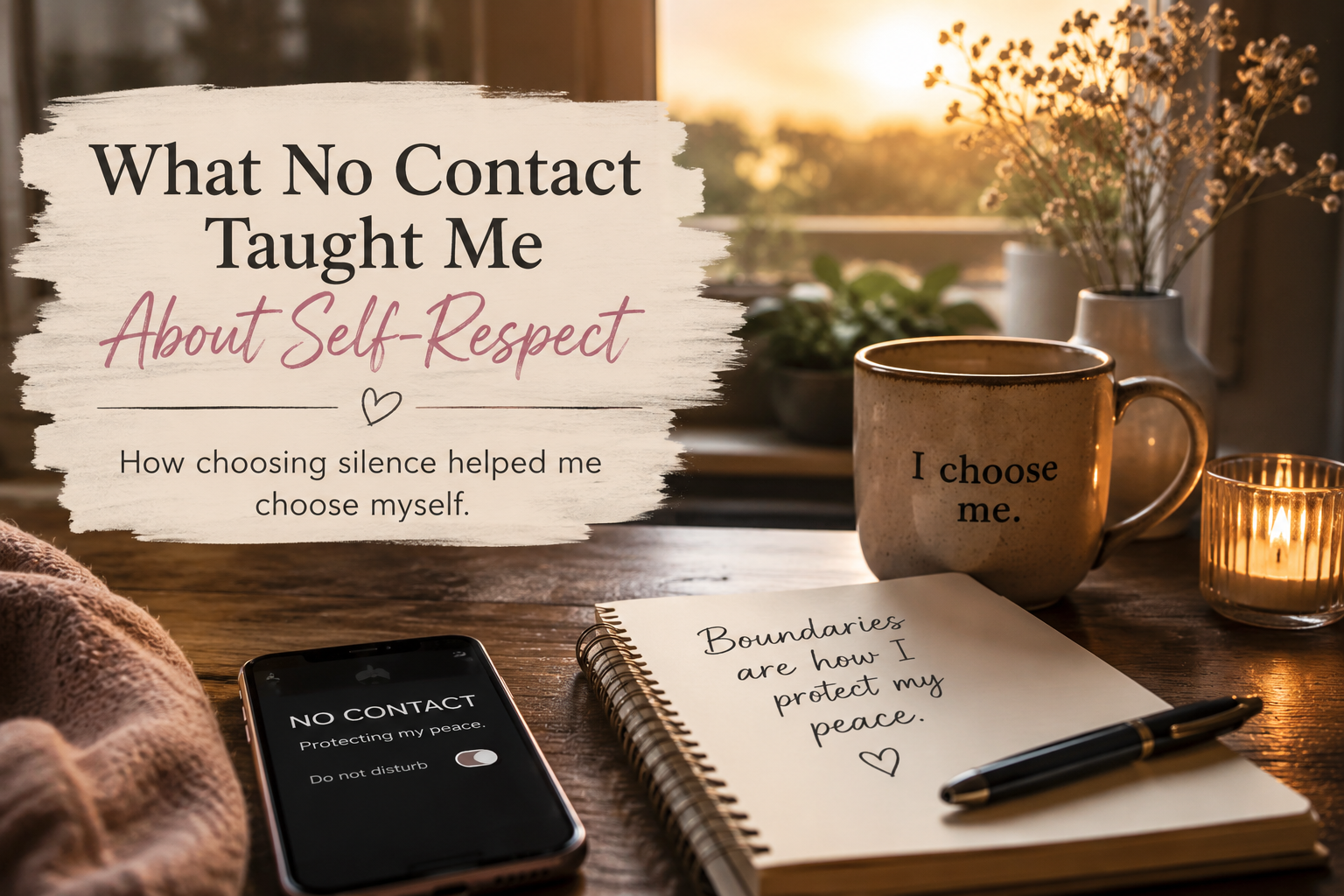
The first thing no contact takes from you is your thumb’s muscle memory. For weeks after I stopped reaching out to a person who’d spent years quietly diminishing me, my hand kept finding the phone on its own. I’d open it to nothing in particular and feel a small, automatic pull toward a conversation that no longer existed. The body remembers a habit long after the heart has decided to break it. That gap between deciding and actually being free is where almost everything I learned about self-respect actually happened.
I want to be careful here, because “no contact” has become a phrase people throw around, sometimes as a threat, sometimes as a trend, sometimes as a way to win an argument by disappearing. That’s not what I mean. I mean the specific, often agonizing decision to stop letting someone reach you because their reaching you kept costing you pieces of yourself. Not as punishment. Not to make them suffer. Simply because you finally understood that you could not keep the relationship and keep yourself at the same time.
It’s one of the loneliest things a person can do. It’s also, in my experience, one of the most clarifying. Because when you remove a voice that has been narrating your worth to you for years, you finally get to hear what your own voice has been trying to say underneath it.
The silence that’s harder than the absence
Everyone assumes the hard part of no contact is missing the person. And yes, you miss them sometimes ferociously, sometimes at the worst possible moments. But that wasn’t the hardest part for me. The hardest part was the silence inside myself: the unbearable urge to explain.
Because I didn’t just want them back. I wanted them to understand. I wanted to send the message that would finally make them see what they’d done, the perfect paragraph that would crack them open and produce the apology I’d been waiting years for. I drafted it a hundred times in my head while making dinner, in the shower, lying awake. And slowly I realized something that reorganized everything: I was still handing my peace to a person who had never once handled it gently. As long as I needed them to understand me, they still ran me. I had left the relationship but kept the leash in their hand.
Self-respect, it turned out, was not the dramatic act of cutting them off. That part was almost easy by comparison a single decision, made once. Self-respect was the quiet, daily refusal to crawl back asking to be understood by someone who had made a career of misunderstanding me on purpose. It was learning to stop auditioning for the approval of a person whose approval had only ever come with conditions I couldn’t afford.
What the relapses taught me
I broke no contact more than once. I’m telling you this because the people who write about boundaries often present a clean, victorious line, and that wasn’t my experience and probably won’t be yours.
Each time I reached back out, I learned the same lesson more deeply through my own body. I’d send the message, feel a flash of relief, and then feel the old, specific awfulness flood right back in the smallness, the bracing, the way I’d start managing my words to avoid setting them off. Within hours I’d remember exactly why I’d left. The relapse wasn’t a failure. It was research. Every time I went back and felt worse, I was learning my own worth experientially instead of theoretically. I stopped having to convince myself the relationship was bad for me. My nervous system had filed the evidence.
This is something I’d gently offer to anyone in the thick of it: if you slip and reach out, you haven’t ruined anything. You’ve just gathered one more piece of proof. The discipline of no contact isn’t built through willpower. It’s built through the slow accumulation of remembering.
The closure I was waiting for didn’t exist
For a long time I told myself I just needed closure one last conversation, an admission, a clean ending I could file away and move on from. I think a lot of us believe we’re owed a final scene where the other person finally gets it, and the credits roll, and we’re released.
But the closure I was waiting for required them to become someone they weren’t. The whole reason the relationship had damaged me was the very reason they could never give me the ending I wanted. I was standing at a dry well demanding water, furious that it wouldn’t pour. The day I understood that closure was not something they could hand me that it was something I would have to give myself by simply deciding the door was closed was the day I actually started to heal. Closure isn’t a conversation. It’s a choice you make alone, often without ceremony, sometimes while doing the dishes.
The practical part: how I actually held the line
I’m wary of turning this into instructions, because no contact is deeply personal and there’s no universal version. But a few practices kept me upright, and they were less about technique than about protecting a fragile new self-respect while it found its feet.
Write the message. Never send it. That paragraph I kept composing in my head? I eventually started writing it down in a notes file and not sending it. Getting it out of my body without putting it into their hands gave the urge somewhere to go. Most of the time, an hour later, I no longer needed to send anything at all.
Mute; don’t monitor. Checking on someone’s life keeps the wound open and aerated. Watching their posts, asking mutual friends how they’re doing, keeping a quiet tab open on their world I told myself it was just curiosity, but it was a way of staying in contact while pretending I wasn’t. Actual no contact meant no contact with the information too. The not-knowing was uncomfortable. The knowing was worse.
Name the loneliness spike. There were predictable moments a hard night, a holiday, a small triumph I had no one to tell when the urge to reach out roared back. Learning to say, plainly, this is the lonely-hour talking, not a change in the facts, let the wave pass without my obeying it. The feeling was real. The conclusion it tried to draw was not.
Let people be disappointed in your boundary. Especially if the person is family, you’ll meet a chorus but that’s your mother, but you only get one, but family is everything. I had to make peace with being seen as the cold one, the dramatic one, the one who couldn’t let it go. Their discomfort with my boundary was not evidence that the boundary was wrong. It was usually just evidence that my limitlessness had been convenient for everyone but me.
A reframe I hold onto
Somewhere in the middle of all this, I stopped thinking of no contact as turning away from someone and started thinking of it as turning toward myself. That sounds like a small semantic trick, but it changed how the silence felt. I wasn’t withholding. I was protecting. The energy I’d spent for years monitoring someone else’s moods, managing their reactions, shrinking to fit their comfort all of it came home to me, and I had no idea, until it returned, how much of myself I’d had outsourced.
I also had to learn that loving someone and choosing not to let them near you are not contradictions. You can grieve a person and still keep the door shut. Missing them is not a reason to go back; missing them is just proof you’re human and that the relationship had real things in it. Both can be true. The missing doesn’t cancel the leaving.
Reflection
What surprised me most is how undramatic self-respect turned out to be. I’d imagined it as something fierce and loud a final confrontation, a mic drop, a door slammed hard enough to be heard. It was none of that. It was the unglamorous, repeated, private act of not reaching for the phone. Of letting an unfair story about me go uncorrected because correcting it would cost me more than the lie. Of being misunderstood and surviving it.
You may not get the clean ending either. You may always, in some quiet corner, miss the person you walked away from. That’s allowed. Self-respect was never about extinguishing the feeling. It was about no longer letting the feeling make my decisions for me.
In closing
No contact taught me that respecting yourself is mostly a series of small refusals no one applauds. No one will throw you a party for the message you didn’t send, the post you didn’t check, the explanation you finally stopped offering to someone who never wanted it. The reward is quieter than that, and better: one ordinary morning you reach for your phone out of habit, and the old pull simply isn’t there anymore. You’re just holding a phone. The leash is in your own hand now.
That’s what it was for, all along not to punish them, not even to forget them, but to take yourself back. And once you have, you tend not to hand yourself over so easily again.
Keep Reading
You Don’t Need Closure to Move Forward
We talk about closure as though it’s a document something that gets signed, stamped, and filed, after which the matter is officially settled and we’re finally free to leave. We imagine an office somewhere with our name on a folder, and we keep going back to the counter asking if our paperwork has come through yet. Just one conversation. Just one honest answer. Just the reason. Then I can move on.
I spent a good portion of my life standing at that counter. After things ended relationships, friendships, the slow fade of people I thought would always be there I would tell myself I was stuck because I never got closure. I’d replay the last conversations looking for the missing piece, certain that if I could just understand why, the ache would dissolve and I’d be released. It felt logical. It felt fair. It was also, I eventually realized, keeping me exactly where I didn’t want to be.
Because the office doesn’t exist. There’s no counter, no folder, no clerk who hands you the resolution you’re owed. And the longer you wait there, the longer you postpone the only thing that actually moves you forward, which is leaving without it.
The shape the mind insists on finishing
There’s a quirk of human perception worth knowing about. Show someone three dots arranged in a rough triangle, and the mind doesn’t see three dots it sees a triangle, drawing the missing lines on its own. Show it an almost complete circle with a small gap, and it perceives a whole circle, quietly closing the opening. The brain hates an unfinished shape. It rushes in to complete what’s incomplete, because openness feels, on some deep level, like a problem demanding a solution.
I think this is what we’re really feeling when we crave closure. It isn’t only grief. It’s the mind doing what minds do refusing to tolerate the open loop, insisting that the story have an ending, that the gap be filled, that the picture make sense. The need for closure is partly just the discomfort of an unfinished shape, dressed up as a moral entitlement.
But here is the thing nobody tells you: a life is not a shape that has to be completed to be whole. Some loops stay open. Some circles keep their gap. And you can live fully, warmly, well inside a story whose ending you never got to read.
Why the answer wouldn’t save you anyway
Underneath the wish for closure is usually a single word: why. Why did they leave. Why did it happen this way. Why wasn’t I enough to make them stay or try or care. We become convinced that the explanation is the cure that understanding the reason will finally let the wound close.
So let me say something that took me years to accept: understanding and peace are not the same thing. They don’t even reliably travel together. I have known exactly why certain things fell apart, understood the reasons in forensic detail, and still hurt for years. And I have, in other cases, never gotten a single answer and healed completely. The why turned out to be far less important than I’d staked my recovery on.
And even if you got it even if the person sat across from you and explained everything would it be enough? The people I’ve known who actually received the closure conversation, the apology, the full accounting, almost always report the same surprising thing: it changed less than they expected. They thought the answer would set them free, and instead they discovered that the freedom had to come from somewhere else entirely. The closure conversation is a story we tell about a future event that will reach back and fix the past. But the past doesn’t get fixed. It only gets carried differently.
There’s also an uncomfortable truth I had to face about myself: sometimes my desperate need for closure was just attachment wearing a respectable disguise. As long as there was an unanswered question, the relationship stayed open as an unfinished project and as long as it was unfinished, I had a socially acceptable reason to keep the door cracked, to keep thinking about them, to keep one foot in a place I claimed to want to leave. The hunger for closure can be a way of not letting go while telling everyone, including yourself, that you’re trying to.
The practical part: living without the final page
I won’t pretend there’s a clean technique for this, because learning to live without closure is less a method than a slow change in posture. But a few things genuinely helped me stop standing at that counter.
Trade the question for a better one. When I caught myself spiraling into why did they do this, I started asking instead what do I need now. The first question sends you backward into a locked room. The second turns you toward a door that’s actually open. The past question has no good answer; the present one always does, even if the answer is just “rest.”
Write your own ending but not to them. At some point I wrote down what the relationship had meant, what I’d learned, what I was grieving and what I was relieved to put down. Not a message to send, not an argument, not a plea. A private accounting, addressed to no one but myself. It turned out I could author the ending I’d been waiting for someone else to provide. Endings don’t have to be granted. They can be written.
Notice when “closure” means “contact.” Whenever the urge for closure got loud, I learned to ask it honestly: do I want understanding, or do I just want a reason to talk to them again? More often than I’d like to admit, it was the second. Naming that took the wind out of it. You can’t get closure from the same source that opened the wound.
Let the question shrink by living, not by solving. I used to think the open loop would close the day I finally got my answer. What actually happened was quieter: I kept living, kept filling my days with people and small ordinary things, and one afternoon I noticed the question had gotten smaller not answered, just less loud, crowded out by an actual life. Time doesn’t deliver the explanation. It just gradually makes you need it less.
A reframe from music
On a site about music, the truest image I can offer is the unresolved chord. Most songs we know move toward resolution they build tension and then return home to the root note, that settled sound that tells your ear the journey is complete. It’s deeply satisfying. It’s also a convention, not a law.
Some of the most beautiful pieces of music ever written end on a chord that never resolves. The tension simply hangs there, unfinished, suspended in the air after the last note fades. At first it feels wrong your ear keeps waiting for the resolution that isn’t coming. And then, if you let it, something shifts, and the unresolved ending becomes its own kind of beauty. It says: not everything returns home. Some things end in the air. And the song was no less worth hearing for it.
Your story can end on an unresolved chord and still be music. The lack of resolution doesn’t unmake everything that came before. You’re allowed to walk away from a song that never returned to its root note and carry the whole melody with you anyway.
Reflection
What I know now is that moving forward without closure isn’t the cold, hardened thing I once feared it would be. I worried that giving up on the answer meant giving up on caring, settling for a loose end, refusing the dignity of understanding. It wasn’t that at all. It was simply learning to hold an open question without letting it hold me.
The question may never fully disappear. Some quiet night, years from now, you might still wonder why. That’s allowed. Healing was never about extinguishing the wondering. It was about no longer organizing your entire life around the wait for an answer that may never come and wouldn’t be enough if it did.
In closing
You do not need closure to move forward. You need permission your own to stop waiting at a counter that was never going to call your name. The folder isn’t coming. The clerk isn’t real. The conversation that would explain everything either won’t happen or won’t deliver what you hoped, and either way, your life is still here, still asking what you need now rather than why you were hurt then.
So let the circle keep its gap. Let the chord hang unresolved. Walk out of the office without the paperwork and into the ordinary, unfinished, entirely livable day in front of you. You were never stuck because you lacked an ending.
You were only stuck because you believed you needed one.
Find More Healing
The Difference Between Loneliness and Solitude
There’s a version of being alone that feels like drowning, and a version that feels like floating. The strange thing is that from the outside they look identical. Same quiet apartment, same empty Friday evening, same single cup on the counter. Nothing in the room tells you which one you’re in. The entire difference lives somewhere invisible in your relationship with the person you’re alone with, which is yourself.
We only have one word for the situation. Alone. But we’re really describing two opposite experiences that happen to share a setting. One of them, loneliness, is the ache of being alone and wishing you weren’t the empty chair that feels like an accusation. The other, solitude, is being alone and somehow at home in it the same empty chair that feels like room to breathe. Same room. Two completely different tenants living in it.
I think a lot of healing comes down to learning to tell these two apart, and then slowly learning how to move from one to the other. Because for many of us especially anyone who’s been left, or who learned early that being alone meant being unsafe solitude doesn’t feel like a peaceful option waiting to be chosen. It feels like a threat. And until that changes, we’ll keep running from our own company straight back into the arms of whatever, or whoever, will fill the silence.
Why being alone can feel like danger
If you’ve survived abandonment of any kind, solitude rarely registers as neutral. The moment the room goes quiet, something old wakes up. The silence doesn’t feel like peace; it feels like confirmation proof of the thing you’ve always feared, that you are someone who ends up alone, that the emptiness around you is a verdict about your lovability rather than just an ordinary evening with no one over.
So you learn to never let the room go quiet. You keep the television on for company. You text someone, anyone, the instant the feeling creeps in. You fill your calendar past the point of rest. And in the worst cases, you reach back toward people who hurt you, because even painful company feels safer than the silence you’ve come to associate with being unwanted. I’ve watched people return again and again to relationships that diminished them, and when I look closely, the engine underneath is almost always the same: they would rather be hurt than be alone, because alone is where the original wound lives.
This is the trap. As long as you can’t be alone without panic, you’re not actually free to choose anything. You’ll keep choosing whatever fills the quiet, and “whatever fills the quiet” is a famously low standard. Learning solitude isn’t about becoming a hermit or pretending you don’t need people. It’s about removing the gun that loneliness holds to your head so that your choices come from desire instead of dread.
The capacity no one taught us to build
Here’s something I find quietly tragic about modern life: we’ve made it nearly impossible to accidentally develop the capacity for solitude. There was a time when waiting in line, riding a bus, lying awake, or sitting in an empty house meant being alone with your own mind, and people built without trying a basic comfort with their own company. Now every one of those gaps gets filled instantly. The phone comes out before the silence can even form.
So we never build the muscle. And then life delivers the real thing a breakup, a death, a move to a new city, a slow drift apart from old friends and genuine aloneness arrives all at once, and we have no idea how to be in it, because we never practiced. We meet involuntary solitude with zero training and experience it as pure loneliness. It’s a little like being asked to swim a long distance having never been allowed in the water. Of course it feels like drowning. No one ever let you learn to float.
The encouraging part of this is that capacity can be built at any age. Comfort with your own company isn’t a personality type you either got or didn’t. It’s a skill, and like the callus a guitarist earns or any other slowly-acquired thing, it comes through gentle, repeated practice not through one heroic night alone, but through many small, survivable ones.
The practical part: learning to float
I want to be careful not to prescribe, because the line between loneliness and solitude is personal and you’ll find your own way across it. But these are the things that genuinely helped people I’ve known move from drowning toward floating.
Notice which question you’re asking. Loneliness and solitude ask different questions in the quiet. Loneliness asks, why is no one here? it’s organized around an absence. Solitude doesn’t ask anything; it’s simply present in the room. When the feeling hits, listen for the question underneath it. Just noticing “ah, I’m in the absence-question right now” creates a small gap between you and the panic, and in that gap you get a little room to choose your next move instead of bolting.
Practice small, deliberate solitude on purpose. Don’t wait for life to force aloneness on you and then try to cope. Build the muscle in low-stakes doses while things are calm. Eat one meal a week alone without your phone, just you and the food and your own thoughts. Take a short walk with nothing in your ears. These tiny reps teach your nervous system, slowly, that being alone is survivable so that when the involuntary version arrives, you’re not meeting it for the first time.
Furnish the time instead of just killing it. There’s a difference between being alone and waiting to stop being alone. The second is just loneliness with a clock. Try doing something in your own company that you’d actually value playing, cooking properly, writing, listening to a whole album the way you used to. You’re not distracting yourself from the aloneness; you’re filling it with a life worth having even when no one’s watching.
Tell the difference between missing a person and needing connection. Sometimes the ache is specific you miss one person. Sometimes it’s general you just need warmth, any warmth, and a coffee with a friend would do. Confusing the two is how people end up reaching for the wrong person to solve a generic loneliness. Ask which kind it is. The general kind has many healthy answers. The specific kind usually just needs to be felt and grieved, not fixed.
A reframe from music
On a site about music, the image I keep returning to is the rest. In any piece of music, the silences are written into the score as deliberately as the notes. A rest isn’t the music failing or stopping; it’s part of the composition the space that lets the notes mean something, the breath that makes the phrase land. A song that never paused would be exhausting and somehow empty. The silence is doing real work.
Loneliness hears the quiet as the music having stopped as proof the song is over, that something has gone wrong, that the absence of sound is a failure. Solitude hears the very same silence as a rest intentional, alive, part of the piece. Nothing about the silence itself changes. What changes is whether you experience it as the song breaking down or as the song breathing.
You’re allowed to hear the quiet in your life as a rest. The pause between people, between chapters, between the love that left and the love that hasn’t arrived yet that’s not the music ending. It’s the space the next phrase will rise out of.
Reflection
What surprised me, the few times I managed to cross from loneliness into solitude, was how little the external situation had to change. I didn’t need more people. I needed a different relationship with the empty room. The same quiet evening that once felt like abandonment slowly became something closer to relief not every time, not reliably, but enough to know the door was there.
You may go back and forth across that line for a long while. Some nights the silence will feel like a rest, and some nights it’ll feel like drowning, and the same apartment will host both within a single week. That’s not failure. It’s just the ordinary weather of someone learning to keep their own company after years of believing they couldn’t.
In closing
The goal was never to stop needing people you’re human, and connection is not a weakness to outgrow. The goal is to become someone who can be alone without it meaning anything terrible. Because once being alone stops feeling like a verdict, you stop choosing company out of fear, and you start choosing it out of genuine wanting. That’s a different, freer life.
So the next time the room goes quiet, listen carefully to what you’re hearing. It might be loneliness, and that’s worth tending gently. But it might be solitude the rest written into your particular song, the breath before whatever comes next. You are allowed to be alone in that silence and discover, to your own quiet surprise, that you were never quite as alone in there as you feared. You had yourself the whole time. It turns out that can be enough to start with.
Keep Moving Forward
5 Signs You’re Finally Healing
How do you know you’re healing? It’s a strange question, but it’s one of the most common ones people quietly carry, usually late at night, usually with a kind of embarrassment, as if they should already know the answer about their own life. The reason it’s so hard to answer is that healing almost never announces itself. It doesn’t arrive with a clear before and after, a single morning where you wake up restored. It tends to show up as an absence a reaction that didn’t happen, a thought that didn’t come, a wound you forgot to check on. And absences are notoriously hard to notice. You can’t see the thing that isn’t there.
I think of it like the tide. If you stand on a beach and watch the water, you can’t actually see it receding. The movement is too slow for the eye. You only know the tide went out by looking back and realizing the water is much farther from where you’re standing than it used to be. Healing recedes from your daily life the same way. You don’t catch it in the act. You just look up one day and notice how much distance has quietly opened up between you and the thing that once soaked everything.
So if you’ve been wondering whether you’re getting better whether all this slow, unglamorous effort is actually working here are five of the quiet signs. Not the loud, cinematic ones. The real, easy to miss ones that tend to mean the tide has been going out longer than you realized.
1. The thing that used to wreck you passes through you
The first sign usually arrives as a non-event, which is exactly why it’s so easy to overlook. You encounter the reminder the place, the date, the song, the name that comes up in conversation and you brace for the familiar collapse. And it doesn’t come. You feel something, yes. A pang, a flicker, a small weight. But it moves through you instead of flattening you, and a few minutes later you’re back in your day.
What’s strange is that you often notice this only in hindsight. Wait that didn’t hurt the way it used to. The absence of the spiral is the whole sign. You didn’t have to white knuckle your way through it; the trigger simply lost some of its voltage. This is healing in its most honest form: not the dramatic absence of all feeling, but the quiet return of proportion.
2. You stop telling the story on a loop
When we’re freshly wounded, the story tells itself through us compulsively. We narrate it to every new person, replay it on every walk, return to it the way a tongue returns to a sore tooth. The pain becomes our introduction the first thing we hand people, the lens we see everything through.
One sign you’re healing is realizing, almost with surprise, that you haven’t told the story in a while. Not because you’re suppressing it or pretending it didn’t happen, but because it has quietly stopped being the center of gravity in your life. It’s still true. It still mattered. It’s just no longer the headline. When the thing that hurt you moves from being your whole story to being one chapter among many, something fundamental has shifted the wound has stopped running the narration.
3. You can hold two feelings at once
Pain tends to make our emotional life all or nothing. In the thick of it, you’re either devastated or fine, the relationship was either everything or a complete lie, you either miss them desperately or you’re over it. There’s no room for the in between, and any return of sadness feels like total relapse.
Healing shows up as the return of the in-between the capacity to hold contradictory things at the same time without either one canceling the other out. You can be grateful for what you learned and still wish it had never happened. You can miss someone deeply and have no desire to go back to them. You can feel a wave of grief on a Tuesday and not take it as evidence that you’ve made no progress. In music, a single note is just a note; it’s only when two or more sound together that you get a chord, something with depth and tension and richness. The return of your ability to feel two things at once is the return of harmony to an emotional life that pain had reduced to one flat note.
4. The future comes back
When you’re in real pain, the future shrinks. It contracts down to getting through today, then this hour, then the next ten minutes. Ask someone in the depths of it where they see themselves in a year and you’ll often get a blank, honest stare they genuinely cannot picture it. The imagination of a future is one of the first things suffering takes, and we rarely notice it’s gone.
So one of the surest signs of healing is the quiet day you catch yourself wanting something again. Making a plan. Picturing a trip, a project, a version of next spring. Idly imagining a life that has good things in it. Desire is one of the last things to return and one of the most reliable, because you cannot want a future while you’re still convinced you don’t have one. When the imagination of tomorrow flickers back on even faintly, even just as a small wish the tide has gone a long way out.
5. You meet your past self with tenderness instead of shame
In the aftermath, we’re often cruelest to the version of ourselves who lived through it. We cringe at who we were the one who stayed too long, who didn’t see the signs, who begged, who believed the promises, who kept hoping past all reason. The memory of that person makes us flush with embarrassment, and we distance ourselves from them as if they were a stranger we’re ashamed to have been.
A deep sign of healing is the moment that shame softens into compassion. You look back at who you were in the hardest stretch and instead of cringing, something in you aches gently for them. You see someone who was doing their best with what they understood at the time, someone who loved hard, who tried, who got hurt and kept going. When you can look at your past self the way you’d look at a struggling friend with warmth rather than contempt you’ve reclaimed something the pain stole: your own self-respect, extended backward across time to include even the version of you that fell apart.
The practical part: how to read your own signs
A gentle word of caution, because “signs of healing” can curdle into one more thing to perform. The point is not to audit yourself daily, anxiously checking which boxes you’ve ticked. That just turns recovery into another exam.
Instead, notice these things the way you’d notice the tide in occasional backward glances rather than constant monitoring. Every so often, look back a few months and ask honestly how far the water has moved. You’ll often be surprised by the distance, because forward progress is invisible up close.
And please don’t mistake a bad day for a relapse. Healing is not a straight line, and a sudden wave of grief or a hard, heavy week does not erase the signs you’ve already seen. The tide goes out, but individual waves still rush back up the sand now and then. One painful afternoon is a wave, not the ocean returning. The overall direction is what matters, and you measure direction over seasons, not over single days.
If it helps, keep some quiet record a note, a journal line here and there. Not to grade yourself, but so that on the days you feel like you’ve made no progress at all, you have evidence from your own hand that you have.
Reflection
What moves me most about these signs is how undramatic they all are. None of them is a triumphant scene. They’re small, easy to miss, almost boring a reaction that didn’t fire, a story you stopped telling, a plan you idly made. We expect healing to feel like a sunrise and instead it feels like ordinary daylight you didn’t notice arriving. I think that’s part of why people doubt they’re healing at all: they’re waiting for a feeling of victory that never comes, and they miss the quiet evidence accumulating in the meantime.
You may not feel healed even as every one of these signs appears in your life. That’s normal. Healing is something you tend to recognize in retrospect, the way you only notice the water has gone out by how far you’d have to walk now to reach it.
In closing
If you came here wondering whether you’re finally healing, the very fact that you can ask the question with some distance rather than being too underwater to wonder at all is itself a quiet sign. The reactions are softening. The story is loosening its grip. The grey is returning, the future is flickering back, and somewhere in you, the harsh voice is starting to speak more kindly to the person you used to be.
You won’t catch the tide in the act of going out. You almost never do. But turn around and look at where the water is now compared to where it was when this all began. Notice the distance. That distance is the healing and you crossed every inch of it yourself.
Continue Your Journey
When Letting Go Is an Act of Self-Love
Anyone who has carried a heavy bag a long way knows the strange moment at the end when you finally set it down and your hand won’t uncurl. The fingers have been gripping so long they’ve forgotten how to open. You have to coax them flat, one at a time, and there’s a soreness there that you didn’t even feel while you were carrying it, because the gripping had become so constant it disappeared into the background of your body.
That’s how holding on usually works in our emotional lives too. We grip something a person, a hope, a version of the future, a grievance we feel entitled to and we hold it so long and so tightly that the holding becomes invisible to us. We stop noticing we’re doing it. And then one day someone says “you should really let that go,” and it lands like the most obvious and most impossible advice in the world. Of course we should. But our hand has forgotten how to open.
I want to talk about letting go not as the loss it’s always made out to be, but as something closer to its opposite an act of profound self-love. Because what most of us were never taught is that holding on is rarely free, and that the thing we’re so loyally refusing to release is often costing us the one person we should be most loyal to: ourselves.
What we’re actually gripping
Here’s something I’ve noticed: the hardest thing to let go of is usually not the person or the situation itself. It’s the hope attached to it. The imagined future where it all worked out. The version of them we believed in. The story of how things were supposed to go.
This is why letting go feels less like releasing a burden and more like a betrayal. To put down the hope feels like admitting we were wrong, that the years were wasted, that the love we gave went nowhere. So we keep gripping not because the thing is still alive, but because letting go would force us to grieve a future that now will never happen. And grieving a future is strange and lonely work, because there’s no funeral for a life you only imagined.
There’s also the quiet arithmetic of sunk cost. I’ve put so much into this so many years, so much love, so much of myself I can’t let go now. But this is a trap dressed as devotion. You cannot recover the years by spending more years. The investment is already gone whether you hold on or release. Continuing to grip a dead hope doesn’t honor what you put in; it just adds the present to the pile of what you’ve lost.
Letting go is not giving up
We conflate two completely different things and then feel ashamed of both. Giving up means abandoning something that’s still alive, still possible, still worth fighting for. Letting go means releasing something that is already gone, that you’ve simply been carrying out of habit. These are not the same act, and the difference is everything.
The skill and it is a skill is learning to tell which one you’re facing. Am I being asked to give up on something that still has a pulse, or am I being asked to stop carrying a body? Because we treat all release as quitting, we sometimes white-knuckle our grip on things long past their death, mistaking our refusal to let go for strength of character. But there’s nothing strong about carrying a corpse up a mountain. The strength is in knowing what’s alive and what isn’t, and having the courage to set down what isn’t.
The loyalty we owe ourselves
This is the part that reframes everything for me. We think of holding on as loyalty to the person, to the relationship, to the version of the story where we never gave up. But I’ve come to see that this loyalty is often pointed in exactly the wrong direction. When you stay faithful to something that is hurting you, you are being disloyal to yourself. You’re choosing the past over the person who has to live in the present. You’re abandoning yourself in order to keep faith with something that already abandoned you.
That’s the hidden cost of holding on: it’s a slow form of self-abandonment. Every day you spend clutching what’s gone is a day you’re not available for what’s here. Your hands are full, so you can’t receive anything new no new love, no new beginning, no new version of yourself. Holding on isn’t noble suffering. It’s just suffering with good branding.
So letting go, seen clearly, is the moment you finally choose your own side. It’s the decision to be loyal to the person who actually has to carry your life forward, instead of staying faithful to a ghost. That’s not loss. That’s love the kind you’ve probably been giving everyone but yourself.
The practical part: how the hand actually opens
I’d be lying if I said there were a clean technique for this, because letting go is less an event than a practice. But these are the things that genuinely helped people I’ve known coax their grip loose.
Stop expecting to let go once. We imagine letting go is like dropping a stone one decisive release and it’s done. It almost never is. It’s more like setting down a heavy bag that you keep absent-mindedly picking back up, because gripping had become a habit. You’ll let go on Monday and find yourself holding on again by Thursday. That’s not failure. You’re not back at the start; you’re just doing the rep again. Each time you set it down, the habit loosens a little more.
Name what you’re actually grieving. When the grip won’t loosen, get specific about what you’re holding. Often it’s not the person it’s a particular imagined future, or the part of your identity that was built around them, or the hope that they’d finally change. Naming the real thing makes it smaller and more honest. You can’t release a fog. You can release a specific, named hope, and let yourself mourn that exact thing.
Ask whether it’s alive. When you’re unsure if you’re letting go or giving up, ask plainly: does this still have a pulse, or am I keeping it on life support with my own hope? Be ruthless and kind at the same time. Sometimes the most loving thing you can do is turn off a machine that’s only keeping a memory breathing.
Notice what your hands could hold instead. This is the gentlest reframe. Instead of focusing only on what you’re releasing, look at what release makes possible. An open hand can’t hold the past, but it can finally receive a new connection, a new project, a quieter mind, your own returned attention. Letting go isn’t only subtraction. It’s making room.
A reframe from music
On a site about music, the truest image I have for this is what happens between two notes. To play a melody, you cannot keep pressing the note you just played. The next note requires you to lift your finger to release the one before. If you held every note down forever out of loyalty to it, you wouldn’t have a richer song; you’d have a single sustained tone that slowly drowned out any possibility of music. The melody only exists because each note is released in time for the next.
Letting go is that lift of the finger. It isn’t a betrayal of the note you played that note already sounded, already mattered, already became part of the song. Releasing it is simply what lets the music continue. A life that refuses to ever let go of any note isn’t more devoted. It’s just stuck on one chord, waiting for a melody that can’t arrive until you lift your hand.
Reflection
What surprises me about letting go, every time, is that it tends to feel like loss right up until the moment after and then, on the other side, it feels like air. Like a hand finally uncurling. The thing we were so afraid to release turns out to have been the very thing weighing us down, and the grief we braced for arrives mixed with an unexpected lightness we’d forgotten was possible.
You will probably grip again. The hand remembers its old shape, and some loss tomorrow, some lonely evening, will find you holding on to what you’d set down. Set it down again. The practice is not in never picking it back up. The practice is in how gently and how often you’re willing to open your hand.
In closing
Letting go was never about pretending the thing didn’t matter, or that you didn’t love it, or that the years meant nothing. It’s about deciding that you matter too that you are worth being available for, that your hands deserve to hold something other than the weight of what’s already gone.
So let your fingers uncurl. Set down the imagined future, the dead hope, the ghost you’ve been so faithful to. Not because it didn’t deserve your love, but because you do. Lift your hand off the note that already sounded, and let the next one the one that’s been waiting for room to be played finally begin.
Read More Reflections
Why Healing Takes Longer Than People Think
I used to keep a running tally I never admitted to anyone. Eight months. A year. Eighteen months. I’d do the quiet arithmetic and arrive, every time, at the same verdict: too long. I should be further along than this. Other people seemed to bounce back in a season; here I was, still flinching at things that should have lost their power by now. The math became its own small cruelty a daily report card I kept failing.
It took me an embarrassingly long time to notice that the tally itself was making things worse. I wasn’t just hurting from the original wound anymore. I was hurting from the wound and from my conviction that I should be done hurting. I’d stacked a second injury on top of the first: shame about the pace of my own recovery. And that second injury, the should-be over it by now, often stung more sharply than the thing I was actually trying to heal from.
So I want to talk about why healing takes so much longer than we expect, and why that’s not a sign that something is wrong with you. Because almost everyone underestimates it, almost everyone secretly believes they’re behind, and almost no one tells you the real reasons the clock runs so long.
Where the timeline came from
First, it’s worth asking where our sense of “how long this should take” even comes from, because it certainly didn’t come from observing real healing up close.
It came, I think, from stories. From films where a heartbreak resolves in a two-minute montage of the character cutting their hair, taking up running, and emerging fixed by the next scene. From the cultural habit of treating everything our bodies, our work, our grief as a problem to be optimized and completed on schedule. From watching other people from the outside and mistaking their composure for completion, never seeing the private hours that don’t make it into public view. We absorbed a fantasy timeline assembled from edited highlights, and then we measure our raw, unedited insides against it and conclude we’re failing.
But healing was never on that clock. The montage is a lie of compression. Real recovery happens in a slower, stranger time that doesn’t care at all about what we think is reasonable.
You miscounted the wounds
Here’s the insight that changed the most for me: when something painful happens, we think we’re healing from one thing. We almost never are. A single loss detonates a whole web of smaller, hidden losses, and we keep applying one wound’s timeline to what is actually a dozen separate injuries.
When a relationship ends, you don’t just lose the person. You lose the daily routines that were built around them. You lose the version of the future you’d been quietly planning. You lose the role you played in their life and the part of your own identity that had grown up around being theirs. You lose mutual friends, shared places, the casual certainty of who you’d call with good news. You lose the person you were in that relationship. Each of these is its own grief, with its own pace, and they don’t all surface at once some don’t announce themselves for months, when you reach for a habit that isn’t there anymore.
So of course it takes longer than you expected. You budgeted for one funeral and ended up having to hold a dozen. The slowness isn’t a flaw in your healing. It’s just an honest accounting of how much you were actually carrying, which was always more than the single, namable loss you thought you were getting over.
Why it heals from the inside out
There’s a principle in the treatment of deep physical wounds that I find quietly clarifying. A serious wound is not supposed to heal at the surface first. If the skin closes over the top while the tissue underneath is still damaged, the wound festers it has to be reopened and allowed to heal from the bottom up, slowly, from the inside out. Surface healing that outpaces the depth isn’t progress. It’s a problem.
Emotional wounds work the same way, and we constantly mistake the surface for the whole. A few months on, you’re functioning again. You’re back at work, you can hold a conversation, you laugh at the right moments, you look to everyone including yourself basically healed. So when the grief comes roaring back one ordinary Tuesday, you’re bewildered and ashamed, certain you’ve relapsed. But you haven’t. The surface had simply closed faster than the depth, and the depth was always going to take its own, much longer time. The functioning was real. It just wasn’t the same thing as being whole underneath.
This is also why you can understand everything intellectually and still hurt. The mind grasps the lesson quickly; the deeper, wordless parts of you heal on a slower clock entirely. “I know it logically but I still feel it” isn’t a contradiction. It’s the surface and the depth healing at their different, honest speeds.
The practical part: how to stop fighting the clock
There’s no technique that makes healing fast. But there are ways to stop making it harder than it already is, which is most of what’s in your control.
Put down the calendar. The running tally it’s been this many months is almost pure self-harm. The number tells you nothing useful about a process that doesn’t run on calendar time. When you catch yourself doing the arithmetic, try replacing the question “how long has it been?” with “what do I still need?” One measures you against a fantasy. The other actually helps.
Inventory the real losses. If you feel you’re healing too slowly, sit down and name everything you actually lost, not just the headline. The routines, the future, the identity, the friends, the version of you. Seeing the full list does something gentle: it explains the slowness. You stop expecting a single wound’s recovery time for what was always a dozen wounds. The pace suddenly makes sense.
Let the surface and the depth move at different speeds. Don’t be ashamed that you can function while still hurting underneath that’s not faking, that’s just the surface doing its faster work. And don’t panic when the depth sends grief back up through a surface that looked closed. Expect the layers to heal on separate clocks, and stop reading the gap between them as failure.
Plan for the re-encounters. Healing isn’t grieving something once and being finished. The same loss gets met again at each new milestone the anniversary, the birthday, the moment years later when a new chapter reminds you of the old one. This isn’t regression. You’re meeting the loss again from a new vantage point, and each re-encounter is usually a little gentler than the last. Knowing they’re coming takes away their power to convince you you’re back at the start.
A reframe worth keeping
There’s a quiet point I’d gently offer to anyone making music, or making anything: some things only time can do, and no amount of effort substitutes for it. A new instrument sounds thin; played steadily over years, the wood opens up and the tone deepens into something richer that simply cannot be rushed into being. You can’t practice your way past the years it takes. The time itself is doing irreplaceable work.
Your healing is like that. Part of what makes it take so long is that something is being built in you that can only be built slowly a depth, a seasoning, a richness of self that the fast version would never produce. The duration isn’t wasted time you’re enduring on the way to being healed. The duration is the healing. It’s the slow work happening in the wood.
Reflection
What I wish I’d understood, back when I was failing my own daily report card, is that the slowness was never evidence against me. It was evidence of how much I’d loved, how much I’d lost, and how deep the work actually went. The people who heal “fast” have often either lost less or merely closed the surface and left the depth for later. Slow, honest healing the kind that goes all the way down takes the time it takes precisely because it’s doing the whole job.
You are almost certainly not behind. There is no schedule to be behind on. There’s only your particular wound, healing at its own necessary pace, from the inside out, on a clock that answers to no one’s expectations including your own.
In closing
If you’ve been quietly keeping a tally, certain you should be further along by now, I’d ask you to set the number down. You miscounted the wounds; there were always more than one. The surface healed faster than the depth, the way it’s supposed to. And the time it’s taking is not a measure of your weakness it’s a measure of how much there was to heal, and how thoroughly you’re doing it.
Let it take as long as it takes. The slow opening of the wood cannot be hurried, and you would not want the thin, rushed version anyway. What’s being built in you in all this time is worth the wait even though, and especially because, it’s taking so much longer than anyone told you it would.
Keep Moving Forward
The Day I Stopped Waiting to Be Chosen
I can describe the exact posture of waiting to be chosen, because I held it for years. It’s a way of standing slightly on tiptoe in your own life. You keep your evenings loosely free in case they call. You check your phone with a particular hope and a particular dread. You rehearse being easy, agreeable, low-maintenance, impressive whatever you’ve decided makes you more selectable and you wait, with a patience you mistake for virtue, for someone to finally turn toward you and make it official. To choose you. As if your real life were being held just out of reach in someone else’s hands, and would only be handed back the moment they picked you.
I waited like that for a person who kept me perpetually almost-chosen. Not rejected outright that might have freed me sooner but kept warm on the back burner, close enough to hope, never close enough to count on. And I waited, in smaller ways, for other things too: for a certain circle to fully let me in, for a kind of approval from people whose approval never quite arrived, for the sense that I’d been officially admitted to my own life. I was always a candidate. Always in the waiting room. Always listening for my name to be called.
This is the story of the day I stopped not because the waiting ended in being chosen, but because I finally understood I’d been waiting in the wrong room entirely.
The understudy
For a long time I thought of myself, without quite having the words for it, as an understudy. I knew the whole part. I was ready, always ready, standing just offstage in the wings, watching the lights and the life out there and waiting for my cue to finally walk on. Someday the call would come the relationship would become real, the people would choose me, the permission would arrive and then my actual life could begin. Until then, I waited in the wings, telling myself that readiness was the same as living.
It isn’t, of course. You can spend an entire life in the wings, perfectly rehearsed, never once walking onto the stage. And the cruelest part of waiting to be chosen is how reasonable it feels from inside. It looks like patience. It looks like loyalty, like hope, like keeping your heart open. It rarely looks like what it actually is, which is handing someone else the pen and asking them to write whether or not you get to fully exist.
I had been living my whole life in the passive voice. To be chosen. To be wanted. To be picked. To be let in. Every verb that mattered to me was something that had to be done to me by someone else. I had no active verbs of my own. And a life lived entirely in the passive voice is a life spent waiting for a sentence someone else has to finish.
What the waiting was really telling me
The day things shifted, nothing dramatic happened on the outside. I was rearranging my week, again, around whether a certain person might reach out keeping a Saturday loosely open, the way I always did and I caught myself doing it. Just caught myself, the way you sometimes glimpse your own reflection unexpectedly and see your posture before you can correct it. And I saw, with a clarity that was almost embarrassing, how long I’d been standing on tiptoe.
What landed wasn’t anger at them. It was a quieter, more useful realization: being perpetually almost-chosen was the answer. I’d been treating the not-quite-choosing as an open question, a verdict still pending, when in fact it had already been delivered, over and over, in every almost. The people who are going to choose you do not make you audition indefinitely. The right ones don’t keep you in the wings for years. Endless waiting is not a prelude to being chosen; it is itself the choice someone has already made about you, just in a form gentle enough to let you keep hoping. I had been reading a closed door as a door still open, because the open version let me keep waiting instead of grieving.
And underneath that, a second realization, the one that actually changed my life: I had been waiting for permission to live that no one was ever going to grant, because it was never theirs to give. The pen had been in my own hand the entire time. I just hadn’t believed I was allowed to write.
The day the grammar changed
So I did something small and, at the time, terrifying. I stopped keeping the Saturday open. I made a plan for it for myself, by myself, about something I actually wanted and I didn’t leave a gap for someone to fill. It sounds like nothing. It was everything. It was the first sentence I’d written in the active voice in years: I choose this. Not I wait to be chosen, but I choose.
That’s what stopping really was. Not a grand exit, not a confrontation, not finally being picked and vindicated. Just the slow, deliberate reclaiming of the active voice choosing my own days, my own work, my own company, and eventually choosing who got access to me rather than auditioning for access to them. I walked, hesitantly, out of the wings and onto the stage of my own life, and discovered the thing no one tells the understudy: there was never a gatekeeper. The cue I’d been waiting for was always mine to give.
The practical part: how to put down the waiting
I won’t pretend I flipped from passive to active in a single afternoon. It’s more of an ongoing practice than a one-time decision. But these are the things that genuinely moved me out of the waiting room.
Find where you’re living in the passive voice. Look honestly at your life for the verbs that depend on someone else doing them to you to be chosen, to be wanted, to be approved of. Name the specific auditions you’re stuck in: the back-burner relationship, the circle you orbit, the approval that never quite lands. You can’t leave a waiting room you won’t admit you’re sitting in.
Stop deferring your life until you’re chosen. Whatever you’ve been postponing until the choosing happens the trip, the project, the move, the simple full enjoyment of an ordinary Saturday begin a piece of it now, unpermitted. Deferring your living is the real cost of waiting, and it’s a cost you pay in the only currency you can’t get back, which is time.
Read the “almost” as the answer it already is. If you’ve been kept perpetually almost-chosen, sit with the possibility that this is not a verdict still pending but one already delivered, gently. The people meant for you don’t make you wait in the wings for years. Let that be clarifying rather than crushing. It frees you to stop waiting on a door that’s already closed.
Become a chooser, not only a candidate. This is the heart of it. Start exercising your own power to select choose how you spend your time, choose what you make, choose who is allowed close to you. You are not only someone to be picked. You are someone who picks. The moment you remember that, the whole posture changes.
Reflection
What surprised me most, once I stopped waiting, was how much life had been quietly piling up in the wings, ready to be lived the instant I gave myself the cue. The energy I’d spent staying available, staying ready, staying selectable it came home to me, and there turned out to be a great deal of it. I hadn’t been lacking a life. I’d been holding one in reserve, indefinitely, for a performance someone else kept declining to start.
You may still want to be chosen by someone. That’s human; wanting connection isn’t the problem. The shift isn’t into some armored self-sufficiency where you need no one. It’s simply that your existence stops being contingent on another person’s selection. You can want to be chosen and refuse to wait in the wings for it. You can hope, and live fully in the meantime, which turns out to be the only meantime there is.
In closing
The day I stopped waiting to be chosen wasn’t the day someone finally chose me. It was the day I realized I’d been the one withholding the only choice that was ever mine to make. I’d been standing on tiptoe, listening for my name, when I could have simply walked on.
So if you’ve been waiting kept warm and almost wanted, rehearsing your readiness in the wings of your own life consider this your cue. No one is coming to call your name, because the calling was always yours to do. Put down the waiting. Pick up the pen. Choose yourself, walk onto the stage, and begin the life that’s been standing ready this whole time, waiting only for you to decide it was allowed to start.
Why You Feel Tired Even When You’re Resting
Understanding the hidden exhaustion of emotional healing, survival mode, and nervous system fatigue.
You did everything right. You went to bed early and slept a full night. You kept the weekend clear, turned down the invitations, lay on the couch with nothing demanding anything of you. And then Monday arrived and you woke up just as depleted as before maybe more. The first thing you did, almost certainly, was wonder what was wrong with you. I rested. Why am I still this tired?
I’ve been in that exact bewilderment, and I’ve watched many people I care about live in it too, usually with a thin layer of shame underneath. Because we’ve been taught that tiredness has one cure rest and that if rest doesn’t fix it, the failure must be ours. We must be lazy, or broken, or unwell. But the truth is much simpler and much kinder: you’re tired even when you’re resting because you’ve been treating the wrong kind of tiredness. You’ve been giving your body’s medicine to an exhaustion that doesn’t live in your body at all.
This is one of the most common and least understood experiences for anyone healing from emotional pain. So I want to take it apart, because once you understand what’s actually draining you, the right kind of rest finally becomes possible.
Not all tiredness is the same tiredness
We use one word, tired, for several completely different states, and then we’re confused when one treatment doesn’t cover all of them.
There’s the honest physical tiredness of a body that worked or moved or stayed up too late and sleep handles that one beautifully. But there’s another kind entirely: the depletion that comes from carrying grief, from bracing against a world that suddenly feels unsafe, from holding yourself together all day, from the relentless background hum of a mind that won’t stop replaying and worrying and managing. That second kind is not in your muscles. It’s in something deeper, and a full night’s sleep does almost nothing for it, the same way a glass of water does nothing for a broken bone. Right idea, wrong injury.
When you’re healing from emotional pain, you are running a second job you never applied for, and it’s an exhausting one. All day, underneath whatever you’re visibly doing, a part of you is grieving, scanning for threat, suppressing what would be inconvenient to feel, and rehearsing conversations that already happened or never will. None of that shows up on a to-do list. But it burns enormous energy, and it keeps running even while you lie perfectly still on the couch, which is exactly why the couch doesn’t help.
The processes running in the background
Think of how a phone’s battery drains overnight even when you haven’t touched it, because dozens of apps are quietly running in the background updating, refreshing, listening, working away while the screen is dark. You set it down thinking it’s resting. It isn’t. It’s busy in ways you can’t see.
That’s what emotional exhaustion is. Even in your stillest, most “restful” moments, the background processes are running. The mind is ruminating on a loop. The nervous system, especially after abandonment or any deep hurt, is holding a low, constant vigilance staying half-alert for the next blow, never quite powering down, because relaxing all the way feels unsafe to a system that got blindsided once. And if you spend your days performing okayness for other people smiling at work, reassuring everyone you’re fine then you’ve been masking, which is one of the most quietly draining activities there is. You can lie down for hours and still not rest, because every one of these programs is still open and still pulling power.
So the exhaustion isn’t a sign you’re lazy. It’s a sign you’re working constantly, invisibly, around the clock at the labor of holding yourself together and slowly mending. Healing itself is metabolically expensive. Convalescing from any wound, including an emotional one, takes energy. You are not tired despite resting. You are tired because you are healing, and healing is work.
The wrong rest
Here’s the trap that keeps so many of us depleted: when we feel tired, we reach for the same rest every time, and it’s usually the rest that doesn’t match what’s actually draining us.
The most common example is the screen. Exhausted, we collapse and scroll and we tell ourselves we’re resting. But scrolling isn’t rest; it’s more input, more stimulation, more for an already-overloaded mind to process. It’s like trying to rest your ears in a room that keeps getting louder. You stand up from an hour of it feeling somehow worse, and you don’t understand why, because you were “relaxing.” You weren’t. You were feeding the very thing that was draining you.
The real principle is this: rest only works when it matches the depletion. If you’re tired from too much input, rest is silence and stillness, not another screen. If you’re tired from performing for people, rest is being somewhere you’re allowed to drop the mask entirely. If you’re tired from vigilance, rest is genuine safety a person or a place where your nervous system is finally allowed to stand down. And if you’re tired from rumination, paradoxically, lying still can make it worse, because it gives the loop more room to run; what rests you is something absorbing enough to quiet the mind a walk, your hands busy with something, music played rather than scrolled past.
The practical part: resting the right thing
I want to offer a few ways to actually meet this kind of tiredness, because the standard advice “get more sleep” is often the one thing that won’t help.
Diagnose before you prescribe. When the heavy tiredness hits, pause and ask one question: is this body-tired or soul-tired? If you slept fine and still feel depleted, it’s almost certainly the second, and more sleep is the wrong tool. Naming which kind it is tells you which rest to reach for.
Match the rest to the drain. Once you know what’s depleting you, give it the matching medicine. Overstimulated? Find silence. Worn out from masking? Get somewhere you don’t have to be okay. Stuck in a mental loop? Move your body or absorb your hands in something, rather than lying down to think more. The fix is rarely “do nothing.” It’s “do the specific thing that quiets this drain.”
Stop calling stimulation rest. Notice when you’re “resting” by scrolling, and be honest that it’s input, not recovery. Even ten real minutes of genuine quiet will do more than two hours of feeding your tired mind more to chew on.
Let yourself convalesce. If you’re in the thick of healing, treat your energy the way you would if you were recovering from an illness because in a real sense you are. Expect a lower capacity. Reduce the demands you pile on yourself. You wouldn’t shame someone for being tired while recovering from surgery; extend yourself the same grace for the invisible repair you’re doing.
A gentle, honest note: if this kind of exhaustion is persistent, severe, or comes with other changes in how you’re feeling, it’s worth checking in with a doctor deep fatigue can have physical and medical causes too, and you deserve to rule those out rather than assume it’s all emotional.
A reframe from music
On a site about music, the truest image I have for this is an amplifier left switched on. An amp that’s powered up but with nothing being played still draws current. It still hums, faintly, under everything. It still gets warm to the touch. From across the room it looks idle, at rest, doing nothing but it’s quietly consuming power the entire time, and if you leave it on long enough, the hum becomes so constant that you stop hearing it. You forget it’s even on.
That’s so many of us. We’ve been left switched on for so long vigilant, bracing, performing, grieving in the background that the hum has become our normal, and we’ve forgotten that off was ever an option. We keep wondering why we’re so warm and so drained, and we reach for more sleep, when what we actually need is to find the switch. Real rest, the kind that finally restores you, isn’t playing softer music. It’s powering the amp all the way down.
Reflection
What changed things for me was simply believing that this tiredness was real that I wasn’t lazy or malfunctioning, that I was genuinely working hard at something invisible and therefore genuinely depleted. The shame lifted, and with it lifted a surprising amount of the exhaustion, because a good portion of what wore me out was the second job of berating myself for being so tired in the first place.
You may carry this kind of fatigue for a while. Healing is long, and the background processes don’t all close at once. But you can stop fighting it with the wrong medicine, and you can stop adding shame to depletion. That alone lightens the load more than another wasted weekend on the couch ever will.
In closing
If you’ve been resting and resting and waking up tired anyway, you are not broken and you are not lazy. You’ve simply been giving your body’s cure to an exhaustion that lives somewhere your body can’t reach. The tiredness is honest. It’s the cost of carrying what you’re carrying and mending what you’re mending.
So find the right rest the silence, the safety, the unmasking, the switch. Power the amp all the way down, not just to standby. You’ve been quietly humming for a long time. You’re allowed, finally, to be all the way off for a while and to wake up, at last, to a quiet you can actually feel.
You Learned To Survive Without Being Loved Properly
There is a particular kind of tiredness that sleep doesn’t fix.
You can rest for ten hours and wake up still carrying it. It lives somewhere behind your eyes, in your shoulders, in the way you brace yourself before walking into a room. It’s the tiredness of someone who has been holding themselves together for a very long time, alone, without anyone noticing how much it took.
If you know that tiredness, this is for you.
Because somewhere along the way, you learned how to survive without being loved properly. Not because you weren’t lovable. Not because something was wrong with you. But because the love you needed the steady, safe, reassuring kind, the kind that says you matter even when you’re not useful didn’t arrive in the way or the amount that a growing person needs. So you adapted. You did what any small, intelligent creature does when the warmth is unreliable: you found a way to keep yourself alive without it.
And you’re still doing it. Even now. Even though you’re grown.
That’s what we’re going to sit with for a little while. Gently. Without blame. Just the two of us and the truth.
The love you didn’t know you were missing
Here is the strange thing about growing up without enough emotional love: you often don’t know it’s happening.
A child has no other childhood to compare theirs to. Whatever they receive becomes “normal.” If no one asks how you feel, you assume feelings aren’t supposed to be asked about. If no one comes when you’re hurting, you learn that hurting is something you handle quietly, by yourself. If your wins are met with silence and your needs are met with tension, you conclude without ever putting it into words that the safest version of you is the one who needs nothing at all.
You weren’t told this. You absorbed it. The way skin absorbs cold.
And it wasn’t always dramatic. That’s part of what makes it so hard to name. Maybe there was food on the table and a roof over your head and birthdays and school clothes. Maybe, from the outside, it looked fine. People might even tell you that you had it good. So you carry a confusing kind of grief grief for something you can’t quite point to, because the absence wasn’t loud. It was a quiet, daily missing. A hunger that never got named, so you stopped expecting to be fed.
What was missing wasn’t the things. It was the being seen. The being soothed. The being told, in a hundred small ways, that your inner world mattered to someone.
When that doesn’t come, a child doesn’t fall apart. A child gets resourceful.
How you survived
You became capable.
You learned to read a room before you entered it. You learned to sense other people’s moods faster than your own, because their moods were the weather you had to live inside. You learned to be easy. To be low-maintenance. To anticipate what was needed and provide it before anyone had to ask, because being needed felt a lot safer than needing.
You probably became the strong one. The reliable one. The one people lean on, the one who has it together, the one others come to with their problems. And there’s something real and good in that your strength is not a lie. But underneath it, if you’re honest, there’s a small ache that wonders who you get to lean on. Who reads your weather. Who shows up for you the way you show up for everyone else.
The answer, too often, has been: no one. So you stopped expecting it. You folded that expectation up small and put it somewhere you wouldn’t have to look at it.
You learned to do everything yourself.
Not because you love doing everything yourself, but because needing someone and being let down was a pain you decided, long ago, you would not feel again if you could help it. So you built a life where you don’t have to depend on anyone. You call it independence. You might even be proud of it. And you should be it kept you standing. But somewhere in there it stopped being a strength you chose and became a wall you can’t climb back over, even when you want to.
This is what people mean when they talk about hyper-independence. It isn’t really about being capable. It’s about safety. It’s the belief, carved in deep, that the only person who will never abandon you is you so you’d better not need anyone else.
The quiet costs you’ve been paying
Surviving without proper love doesn’t stay in childhood. It follows you into your relationships, your friendships, your work, your bed at night.
It shows up when someone offers to help you and your whole body says no, I’ve got it, even as you’re drowning. Asking for help doesn’t feel like a normal human request. It feels like exposure. Like handing someone a reason to think less of you. Like a debt you’ll owe forever.
It shows up in the guilt. That strange, heavy guilt you feel for having needs at all for being tired, for wanting reassurance, for taking up space, for not being okay on a day you’re “supposed” to be fine. You apologize for things that don’t require apology. You shrink your needs down to the smallest possible size and then feel guilty even for those.
It shows up in how hard it is to trust love when it does arrive. When someone is kind to you, consistent with you, genuinely glad to have you around part of you can’t relax into it. You keep waiting for the catch. You study them for the moment it turns. You half-believe that if they really saw you, all of you, they’d leave. So you keep a part of yourself back, just in case. You love with one hand on the door.
It shows up in what you’re willing to accept. Because when you grew up on very little, very little can start to feel like enough. You mistake crumbs for a meal. You stay in situations and connections that ask everything of you and give back almost nothing, telling yourself you’re being reasonable, low-maintenance, realistic. But somewhere underneath, you know. You’ve been settling for less than you deserve for so long that fullness feels suspicious.
And it shows up as exhaustion. That bone-deep weariness we started with. The tiredness of a person who has been their own parent, their own comfort, their own safety net for as long as they can remember. Who has never once been able to fully put the weight down because there was never anyone there to hold the other side.
The loneliest belief
There’s a belief at the center of all this, and it’s worth pulling out into the light, because most people who carry it have never said it out loud.
The belief is: I am a burden.
Not in those exact words, maybe. But it’s there in how you hesitate before texting someone back about your bad day. It’s there in how you downplay your pain so no one has to deal with it. It’s there in how you’d rather sit alone with something heavy than risk being “too much” for someone you love.
You’ve decided, somewhere along the line, that your needs are an imposition. That your sadness is an inconvenience. That the kindest thing you can do for the people around you is to need as little from them as possible.
And so you’ve made yourself smaller and smaller and quieter and quieter, and you’ve called it consideration, but a lot of it has just been fear. The fear that if you let yourself need someone fully, and they pulled away, it would confirm the oldest, deepest thing you’ve ever believed about yourself.
So you stay safe. You stay self-sufficient. You’d rather be alone than disappointed, because alone is at least predictable. Alone, no one can let you down. Alone, you already know what to expect.
But here is the tender, complicated truth: that safety is also a cage. The same wall that protects you from being let down also keeps out the very thing you’ve been starving for your whole life. You can’t keep love out and let love in through the same door.
None of this was your fault
I need you to hear this part slowly, even if part of you wants to argue with it.
The way you adapted was not a flaw in you. It was intelligence. It was a small person doing something remarkable keeping themselves emotionally alive in conditions that didn’t give them what they needed. Every wall you built, every need you buried, every “I’m fine” you learned to say with a steady voice those were not weaknesses. They were survival. And they worked. You are here. You made it. That is not nothing.
We don’t have to assign blame to anyone to tell the truth about what was missing. People can only pass on what they were given. The absence you grew up inside was very likely an absence the people before you grew up inside too a missing thing handed down quietly across years, never named, never healed, just passed along like an heirloom no one wanted. Understanding this isn’t about excusing anyone. It’s about freeing yourself. Because as long as you secretly believe you weren’t loved properly because you weren’t worth loving properly, you’ll keep building the cage.
You were always worth it. The love not arriving was never proof of your unworthiness. It was just proof that the people around you didn’t have it to give, in the form you needed, at the time you needed it.
Those are not the same thing. They have never been the same thing.
Let that land for a second.
You were a child who needed more love than you got. That’s all. That’s the whole story. And a child who needed more love is not a broken thing. A child who needed more love is just a child.
What healing actually looks like
Healing is not a lightning bolt. It’s quieter and slower and more ordinary than that, and it usually starts in small, almost embarrassing moments.
It starts the first time you let someone help you with something and don’t apologize for it. The first time you say “actually, I’m not okay” out loud to a person you trust, and the sky doesn’t fall, and they don’t leave, and you realize your honesty didn’t cost you anything except the exhausting work of pretending.
It starts when you catch yourself shrinking and gently choose not to. When you let yourself want something and don’t immediately talk yourself out of it. When you notice you’re about to settle for a crumb and you pause and think, just for a moment, maybe I’m allowed to want the whole thing.
Healing is learning, slowly, that you are allowed to have needs. Not as a special exception. Not when you’ve earned it by being useful enough. Just because you’re a person, and people have needs, and that has never made anyone unlovable.
It’s learning that receiving is not the same as taking. That letting someone show up for you is not stealing from them it’s actually a gift you’re giving them, the gift of being trusted, the gift of being let in. The people who love you don’t experience your needs as a burden the way you fear they will. That fear is an old recording. It’s not the truth of the people in front of you now.
It’s learning that some love is safe. Not all of it you don’t have to trust everyone, and your caution was earned, and you get to keep the part of it that’s wisdom. But somewhere out there, and maybe already in your life, there are people whose care is steady. Who don’t keep score. Who don’t disappear when you’re inconvenient. And little by little, by risking small honesties and watching them be met with warmth, you can teach your nervous system something it never got to learn: that love doesn’t have to be earned, and it doesn’t have to hurt, and it doesn’t always leave.
You may have to learn it as an adult that a child should have learned by feeling held. That’s a grief of its own having to teach yourself something so basic, so late. Let yourself feel that grief. And then let yourself learn it anyway. It is not too late. It has never been too late.
A gentler way to hold yourself
For so long, you’ve been the strong one for everybody else. I want to invite you to turn some of that strength inward — not as more work, but as a kind of homecoming.
The next time you’re tired, instead of pushing through, try simply noticing it. I’m tired. This has been a lot. Of course I’m tired. You don’t have to fix it. You just have to stop being one more person who ignores you.
The next time you feel guilty for having a need, try this thought on, even if it feels two sizes too big: needs are not crimes. You are allowed to want comfort. You are allowed to want reassurance. You are allowed to want to be chosen, prioritized, checked on, held. None of that makes you weak or needy or too much. It makes you human. It always did.
And the next time the old belief whispers that you’re a burden, I want you to remember that the people who are lucky enough to love you do not experience you as weight. They experience you as a person they’re glad exists. The burden was never you. The burden was carrying all of this alone for so long, convinced you had to.
You don’t have to anymore.
You were never the problem
Here’s what I most want you to walk away with.
You did not fail to be loved. You were not too much, or too difficult, or too sensitive, or too anything. You were a person who needed what every person needs to be seen, to be safe, to be soothed, to matter to someone simply for existing. And when that didn’t fully come, you didn’t break. You built. You built a whole self capable of surviving without it. That self got you here. You can thank that self, and you can also tell it, gently, that the emergency is over. It can rest now. It doesn’t have to guard the door alone forever.
The love you missed as a child can’t be retrieved. That’s true, and it’s sad, and you’re allowed to mourn it. But the love available to you now that’s a different story, and that one isn’t finished. There are still people who will be glad you let them in. There are still mornings where you wake up and the tiredness is a little lighter because you’re no longer carrying it by yourself. There is still a version of your life where needing someone feels like trust instead of danger.
You learned to survive without being loved properly.
That was the first, hardest thing.
Now comes the other thing the slower, braver, more tender thing. Learning to let yourself be loved properly after all. Learning that you were always allowed to be. Learning, finally, that you were never unlovable. You were just waiting, all this time, for someone to stay.
You can be that someone, to start. And then, when you’re ready, you can let the right people stay too.
You made it this far carrying everything alone.
Imagine how far you’ll go now that you don’t have to.
The Hidden Grief Of Never Feeling Chosen
Some grief doesn’t get flowers.
No one brings casseroles to your door. There is no service to attend, no obituary to write, no anniversary you mark by lighting a candle in the kitchen at midnight. There is just a quiet ache that lives underneath your days, and the strange feeling even when life is good that something is missing. That something always has been.
This is the grief of never feeling chosen.
It is grief for someone who never died. It is grief for someone, sometimes, who is still alive and still standing in the same room as you, smiling kindly, never quite reaching for you. It is the grief of the runner-up. The understudy. The almost. The one people loved without ever quite picking.
If you have lived your whole life inside this quiet ache and never had a name for it, that is not your imagination. It is a real wound. It is just a wound the world doesn’t tend to, because there is no funeral for the love that never came home to you. There is no card aisle for I’m sorry you were everyone’s second option.
So you carry it alone. And you wonder, sometimes in the middle of the most ordinary afternoon driving home from work, washing dishes, scrolling past someone else’s wedding photo why this small heaviness has always lived in your chest. Why even joy comes with a faint film of something underneath it.
I want to sit with you in that quiet for a while.
Because you should not have to feel it alone anymore.
The wound of never being chosen rarely arrives in one big event. It arrives the way water shapes a stone slowly, almost without notice, until one day you look up and your whole life has been bent around it.
It starts early.
Maybe you were the easy child. The one who didn’t need much. The one whose moods stayed manageable and whose grades stayed steady, so attention drifted to the louder, sicker, more dramatic siblings. Not because anyone meant to overlook you you were just so capable. So fine. So easy to forget for a minute that turned into years.
Maybe your parents loved you in their own broken way, but their attention had to be earned, and the prize was small, and you were always auditioning.
Maybe you watched a sibling get the praise, the protection, the long conversations. Maybe you brought home the better report card and waited for a comment that never came.
Maybe your house was loud, and you learned that the safest way to live in it was to disappear softly. And then no one noticed that the disappearing had quietly become a way of being.
You did not conclude that the adults around you were limited. Children don’t conclude that. Children conclude something much more devastating: there must be something about me that doesn’t quite earn it.
And once a child decides that, they spend the rest of their life trying to argue with it.
This is how the wound follows you into adulthood. Not as a memory. As a posture.
You become the one who gives more than they receive, and tells themselves that this is just how they love.
You become the friend who remembers everyone’s birthday and whose own birthday goes mostly uncelebrated, and you pretend it doesn’t sting, because what kind of person needs a fuss made over them?
You become the person who is texted at eleven at night, not seven. Because seven is for the people they want to spend their evening with. Eleven is for the ones they reach for when the better plans fall through.
You become the placeholder partner the kind one, the patient one, the one who listened while they got over the last person. And then you watched them stand up, take everything you helped them rebuild, and walk it straight into someone else’s life.
You become the employee who works twice as hard for half the recognition, because somewhere deep down you still believe that being indispensable is the same thing as being loved.
You become the partner who can recite their lover’s favorite songs, sizes, sore spots, dreams and whose own preferences seem to evaporate the moment anyone asks.
You are everywhere in everyone else’s life.
And nowhere in your own.
You watch other people get chosen, and something in you that you cannot quite explain begins to ache.
The friend who got engaged first. The coworker who got pulled aside for the promotion. The sibling whose phone rings when something good happens. The acquaintance who is always at the center of the photograph, while you are the one cropped at the edge, smiling because you were happy just to be invited.
You are not jealous of them. You are not bitter.
You are just so tired.
Tired of being glad for everyone. Tired of being the gracious one. Tired of standing in the back row of every group photo of your own life.
And the strange thing the part that has always been hardest to explain is that most of the people who never chose you weren’t cruel. They weren’t villains. They liked you. They spoke warmly about you. They would probably say, if asked, that you mattered to them. But somewhere between liking you and choosing you is a gap you have lived inside for as long as you can remember, and you have never quite figured out how to cross it.
If you grew up this way, here is one of the cruelest things the wound teaches you.
It teaches you to mistake intensity for love.
You learn to feel most alive in the relationships where you are working hardest. The unpredictable ones. The ones where affection is intermittent, where you have to read the room, where you can never quite relax because relaxing might be the moment they slip away.
Steady, simple, present love feels almost suspicious to you. Quiet. Flat. You meet someone who treats you well and you wonder where the spark is. You wonder if maybe you only feel passion for people who require you to chase.
That is not your truth. That is your training.
When love had to be earned, your nervous system learned that the working was the loving. Calm felt like being forgotten. Chasing felt like being alive.
So you stayed in relationships that were never going to choose you long after the evidence was in. You stayed because leaving meant admitting that you had been giving your most precious years to someone who, in the quiet moments of their own life, was waiting for someone else.
You stayed because crumbs feel like a meal when you have spent your whole life starving.
Here is the question that has lived underneath all of it.
The question you have never quite let yourself ask out loud.
What is wrong with me, that I am always the one who has to try so hard to be kept?
And here is what I want to say to you, gently, the way I would say it if we were sitting on the same couch with the same lamp on between us.
Nothing.
Nothing is wrong with you.
Not the version of you who tried too hard. Not the version of you who stayed too long. Not the child who waited for a parent to notice. Not the friend who kept showing up to the lopsided friendship. Not the person who loved someone who couldn’t love them back and called it patience.
None of it was evidence. All of it was hope.
And hope, in a heart that was never properly chosen, is not a flaw. It is one of the most stubborn and beautiful things a human being can carry.
There is a misunderstanding underneath this grief that I want to name, because naming it changes everything.
The misunderstanding is this: somewhere along the way, you started to believe that being chosen was the same thing as being worthy.
That if the right person had picked you, the question would have been settled. That somehow your value would be confirmed by someone else’s decision. That the proof of your worth lived in another person’s hands.
It doesn’t.
It never did.
A person’s ability to choose you is about their bandwidth, their map of love, their fears, their patterns, their wounds, their willingness to stay. It is not a measurement of you. It is a confession of them.
A painting is not less beautiful because the person standing in front of it was looking at their phone. A song is not less lovely because it happened to play in an empty room. The not-being-chosen was never the same thing as the not-deserving-to-be-chosen, even though grief tries very hard to convince you it was.
I know how badly the heart wants to collapse those two ideas into one.
The heart says: if I had been enough, they would have stayed.
The heart says: if I had been enough, I would have been the favorite.
The heart says: their choice is the answer to the question of me.
But it isn’t.
It never was.
This is where the grief begins to soften, though not all at once. Healing of this kind does not arrive in revelations. It arrives in small, almost ordinary moments where, for the first time, you stop using someone else’s choice as a referendum on your worth.
You notice that an old friend hasn’t called you back, and instead of replaying the friendship to find the moment you said the wrong thing, you feel a small wave of sadness and let it pass.
You watch someone choose someone else, and instead of crumpling, you feel something almost like understanding that their choice was about the shape of their life, not the shape of yours.
You catch yourself bending into a smaller version of who you are to keep someone interested, and for the first time, you don’t bend.
You don’t bend, and you do not die.
That is the moment.
That moment, the very first time you stay your full size and the world does not end, is the beginning of the rest of your life.
There is a sentence I want to leave with you, and I want you to read it slowly:
You do not have to be chosen in order to be worthy of being chosen.
Your worth was not waiting in someone else’s mouth. It was not folded inside their decision. It was not contingent on whether the person you loved most happened to love you back in the same shape, at the same time, with the same urgency.
It existed before they walked in. It will exist long after they walk out.
The work of healing this wound is not the work of finally being picked. That is the trap. The trap is believing that one more relationship, one more achievement, one more proof will finally do it that this time, if the right person chooses you, the ache will quiet.
It won’t.
Because the ache is not really about them. It never was. The ache is about a small version of you, somewhere far back in your life, who concluded that the verdict on your worth lay in someone else’s hands. And who has been waiting ever since for those hands to open.
You can take the verdict back.
Quietly. Without ceremony. Without announcement.
You can take it back today.
Choosing yourself is not the loud, defiant act the internet makes it sound like. It is not a hashtag. It is not a power pose. It is not a dramatic exit from someone’s life.
It is the small, almost invisible practice of stopping the audition.
It is being the one who finally listens to what you actually want for dinner. It is the slow refusal to text three times in a row when one is already enough. It is staying out of conversations where your presence is tolerated but not welcomed. It is leaving the room where you have to shrink to fit. It is letting a quiet relationship stay quiet, without rushing to manufacture chaos so the dynamic feels familiar again.
It is treating yourself with the kind of consistent, unspectacular tenderness you have spent your whole life giving to other people.
It is, more than anything, this:
It is the daily decision to stop abandoning yourself in the hope that someone else will finally find you worth staying for.
You are allowed to be the one who stays.
You are allowed to be the one who chooses.
There is something else I want you to know. It is the part I most wish someone had told the younger version of you.
You were never hard to love.
You were bringing your love to people who didn’t have room for it. People with their own broken inheritances, their own divided attention, their own quiet griefs. People who looked past you not because you weren’t lovely, but because they had not yet learned how to see.
A flower does not grow less beautiful when it blooms in a room where nobody is looking. It just blooms unwitnessed.
You bloomed unwitnessed.
That is the grief.
But here is the part that the grief, for all its weight, was never able to take from you: you bloomed anyway.
Through every overlooked birthday and every uneven friendship and every relationship where you gave more than you got you bloomed anyway. Through every silence after you walked into a room hoping to be greeted, you bloomed anyway. Through every time you were a footnote in someone’s life and made it into a chapter of your own quiet kindness, you bloomed anyway.
You were not the runner up of your own life.
You were just standing in the wrong rooms, waiting for the wrong people to call your name.
Walk into your own room now.
Not because you have finally earned it. Not because you have finally proven something. Not because you have finally lost the weight or fixed the flaw or become the version of you that you imagined other people were waiting for.
Walk into it because it is yours. Because it has always been yours. Because someone has been sitting inside it your whole life, waiting for you to notice them.
That someone is you.
The version of you who never stopped hoping. The version of you who kept showing up to relationships and friendships and family dinners and jobs, knowing they might be overlooked again, and going anyway because love mattered too much to give up on. The version of you who has been quietly, faithfully waiting at the door of your own life, hoping you would come home.
They are still there.
They have not given up on you.
And the day you turn around and recognize them really recognize them the grief begins to lift. Not all at once. Not perfectly. But enough.
Enough that, for the first time, the ache becomes something other than ache. It becomes a kind of soft, sad knowing. A weather you have learned to live inside. A grief you no longer have to mistake for a verdict.
You will still see people choose other people. You will still sometimes feel that small, familiar pang. But you will not collapse into it. You will not let it rewrite who you are.
Because you will know, finally, what you spent so many years not knowing.
You were always worth choosing.
You were just waiting for the only person whose choice was ever going to truly heal it.
And you are looking at them.
Right now.
You are looking at them.
Why Do I Feel Guilty When I Rest?
You finally sit down. The day has taken everything you had, and your body sinks into the chair like it’s been waiting for this moment for hours. And then, instead of relief, it comes: a low hum of unease. Your eyes drift to the dishes in the sink. Your mind begins its quiet roll call of everything still undone. You shift in your seat. You think, I should really be doing something. The rest you so desperately need feels strangely uncomfortable, almost like you’re getting away with something you’ll be punished for later.
If you’ve lived this exact moment more times than you can count, this is for you. Because the guilt you feel when you rest is rarely about the rest itself. It runs much deeper than that and understanding where it comes from can change everything.
The Belief You Never Chose: “I’m Valuable When I’m Useful”
Most of us don’t decide to feel guilty when we rest. We learned it, long before we had the words to understand what we were learning.
For many people, this began in childhood. Maybe you were the kid who helped raise younger siblings, who translated for your parents, who managed the emotional temperature of the house so things wouldn’t boil over. Maybe you became responsible far earlier than you should have making sure everyone was okay, keeping the peace, handling things a child was never meant to handle. Psychologists call this parentification, but you probably just called it normal. It was simply your life.
Or maybe the message came in quieter ways. You were praised when you achieved, noticed when you performed, rewarded when you were helpful and overlooked when you simply existed. So your young mind drew the only conclusion it could: I am loved when I am useful. I am safe when I am producing. I matter when I am doing something for someone.
That belief doesn’t stay in childhood. It grows up with you. It follows you into your job, your relationships, your parenting, your quiet evenings at home. And it whispers the same thing it always has: you have to earn your place here. So when you stop and rest, some deep part of you panics because resting feels like losing the very thing that makes you worthy of love.
When Rest Feels Unsafe
For some people, the problem isn’t just guilt. It’s that quiet itself feels threatening.
Have you ever noticed that you can handle a crisis with total calm but the moment life finally settles down, anxiety creeps in? You’re fine in the storm, and strangely unsettled in the calm. This is one of the most misunderstood experiences of people who grew up in survival mode.
When you spend years braced for the next problem the next bill, the next outburst, the next disappointment your nervous system learns that vigilance keeps you safe. Staying alert, staying busy, staying ready becomes your baseline. So when things go quiet, your body doesn’t relax. It gets suspicious. It interprets the stillness as the calm before something bad, and it starts looking for the threat it’s sure must be coming.
In a strange way, constant motion can become a kind of comfort. As long as you’re busy, you don’t have to sit in the unbearable quiet. As long as you’re carrying something, you feel like yourself. Rest doesn’t feel like peace it feels like dropping your guard in a world that taught you it was never safe to do so.
The Hidden Fears Beneath the Guilt
If you sit with the discomfort long enough, you start to hear what it’s really saying. The guilt is just the surface. Underneath it are fears far older and more tender.
If I stop, everything will fall apart. You’ve been holding so much for so long that you genuinely believe you’re the only thing standing between order and collapse. Resting feels reckless, like letting go of the rope everyone is hanging onto.
If I rest, I’m lazy. You’ve internalized a harsh inner voice often borrowed from someone in your past that calls any pause a moral failing. So you push, and push, and call your exhaustion weakness.
If I’m not useful, I don’t matter. This is the deepest one. The fear that without your usefulness, you’d be forgotten. That your value is conditional, and rest puts it at risk.
And sometimes, quietly: If I slow down, I might finally feel everything I’ve been outrunning. Busyness can be a way of staying ahead of grief, loneliness, anger, or pain we never had the space to face. As long as you keep moving, those feelings can’t catch you. Rest means they finally might and that can be the most frightening prospect of all.
Why the Strong Ones Struggle the Most
It’s no accident that the people who find rest hardest are often the strongest, most dependable people you know.
You might be the one everyone calls when things go wrong. The friend who always shows up. The caregiver, the fixer, the planner, the steady one who never seems to fall apart. You became this person honestly usually because, at some point, someone had to, and you were the one who could.
But there’s a hidden loneliness in being the strong one. People stop checking on you, because they assume you’re fine. You become so good at carrying things that no one notices the weight, including, sometimes, you. And resting feels like a betrayal of the role that’s given your life meaning as if the moment you stop being useful, you’ll disappear from everyone’s view.
If this is you, please hear something gently: being able to carry everything was never the same as being meant to. The strength was real. But strength that never gets to rest isn’t strength anymore. It’s slow depletion. And the body always sends the bill eventually in burnout, in numbness, in an exhaustion that sleep no longer touches.
Rest Is a Need, Not a Reward
Here is the truth the guilt has been hiding from you: rest is not something you earn after enough suffering. It’s not a prize for productivity. It’s not a luxury for people with easier lives. It’s not weakness.
Rest is a biological and emotional need as essential as food, as necessary as breath. A field left unplanted isn’t being lazy; it’s restoring itself so it can grow again. A musician’s pause between notes isn’t wasted time; it’s part of the music. Your rest is not the absence of a worthwhile life. It is part of what makes a worthwhile life possible.
You do not have to be depleted to deserve a pause. You do not have to justify your need for stillness. The belief that you must suffer first, produce first, prove yourself first that belief was installed in you by circumstances you didn’t choose, and you are allowed to set it down.
Gentle Reflection
Take a slow breath, and let yourself sit with this for a moment:
Somewhere along the way, you learned that you had to earn your right to rest. Who taught you that and would you ever ask the same of someone you love?
You give others permission to be tired, to pause, to simply be. You forgive their humanity instantly. The healing begins the moment you start to wonder whether you might deserve that same tenderness not because you’ve done enough, but because you, too, are human.
A Gentle Place to Land
The guilt you feel when you rest is not a sign that something is wrong with you. It’s a sign of everything you’ve survived every season you spent being strong, responsible, and needed, often before you were ready. It makes complete sense that rest feels unsafe. You learned, somewhere, that it wasn’t.
But you are allowed to unlearn it. You are allowed to discover, slowly and gently, that you are loved even when you’re not producing, that you matter even when you’re still, that the world will not fall apart simply because you finally let yourself breathe. Your worth was never measured by how much you carry.
So let this be your permission, if you’ve been waiting for it: you are allowed to rest not because you’ve earned it, not because everything is finished, but simply because you are human, and human beings are not made to run forever. Lay it down, just for now. You are worthy of rest exactly as you are.
Continue Reading
-
I Let Myself Rest A tender reflection for anyone who has been strong for too long and forgotten they’re allowed to put the burden down.
-
My Heart Finally Feels Quiet On finding genuine inner calm after years of overthinking, vigilance, and survival mode.
-
I Was Strong… But I Was Breaking Inside For those who kept showing up for everyone while quietly carrying pain no one could see.
The Difference Between Healing and Avoiding
You told yourself you were over it. You stayed busy. You filled the quiet. You stopped letting yourself think about it, and after a while, it seemed to work the ache faded into the background, and you decided that meant you’d healed. Then one ordinary day, a song comes on, or a photo surfaces, or someone says a name you weren’t ready to hear, and suddenly it’s all there again, as raw as the day it happened. And you stand there, blindsided, thinking: If I really moved on, why does this still have so much power over me?
That question deserves a real answer. Because what you may have been calling healing might have been something else entirely and understanding the difference can change the way you carry everything you’ve been through.
Why Avoidance Can Look So Much Like Healing
Here’s the thing almost no one tells you: avoidance and healing can look identical from the outside. Sometimes they even feel identical from the inside, at least for a while.
You stay busy, and busy feels like progress. You stop crying, and you call it strength. You throw yourself into work, or the gym, or a new project, or a new person, and the relief of not-feeling gets mistaken for the peace of having-healed. You become impressively functional. You smile. You say, I’m doing so much better, and part of you believes it.
But there’s a quiet difference underneath. Avoidance is built on distance on keeping the pain at arm’s length, on never letting it fully into the room. Healing is built on something braver: letting the pain in, sitting with it, and slowly learning it no longer needs to be feared.
The reason this matters is simple. When you avoid a wound, it doesn’t close. It just goes quiet. And anything you bury alive has a way of staying alive, waiting underground for the day something digs it back up.
Healing Asks You to Feel What You’d Rather Skip
We want healing to be clean. We want it to mean the pain simply lifts one morning and never returns. But real healing rarely works that way, and pretending otherwise only makes us feel like we’re failing at it.
Genuine healing usually involves the very things we’re trying to avoid: grief, discomfort, honesty, the vulnerability of admitting how much something hurt. It means letting yourself feel the loss instead of rushing past it. It means telling yourself the truth about what happened, even when the convenient story is easier to live with.
And here is something worth sitting with: healing was never about making the pain disappear. It was always about learning to carry it differently. The goal is not a life where the loss never happened. The goal is a life where the loss is part of you without being the whole of you where you can hold it in one hand and still keep living with the other.
That’s a quieter, less dramatic kind of healing than we’re sold. But it’s the kind that actually lasts.
What Avoidance Costs You Later
The trouble with pushing pain down is that it doesn’t stay where you put it. Emotions are not patient. The ones we refuse to feel don’t dissolve they wait, and they find other ways out.
Avoided grief has a habit of returning in disguise. It shows up as anxiety that seems to come from nowhere. As a temper that’s suddenly too short for the situation. As burnout, because staying busy enough to outrun your feelings is exhausting work. As emotional triggers that ambush you in ordinary moments. As a flat, gray numbness where your joy used to be. As relationship struggles, because the walls you built to keep the pain out also keep love from getting in.
Here’s an insight that took me a long time to understand: the emotions you never let yourself feel don’t get filed away as resolved they get filed away as urgent. Your mind keeps flagging them as unfinished business, which is why the smallest reminder can bring the whole thing roaring back. It’s not that you’re broken or backsliding. It’s that a part of you is still waiting to be heard.
Emotions ignored are not emotions healed. They’re emotions postponed and they always collect interest.
How to Tell If You’re Actually Healing
So how do you know the difference? It’s not about whether the pain is gone. It’s about your relationship to it.
You might be healing if you can talk about what happened without being swallowed by it feeling the weight of it, yes, but staying yourself while you do. You might be healing if you no longer need to flee every reminder, if a song or a place can hold sadness without flattening your whole day. You might be healing if you’re becoming gentler with yourself, less prone to blame, more able to say that was hard, and I did the best I could.
You might be healing if you’re learning from the experience instead of being defined by it if it’s becoming a chapter in your story rather than the title of the whole book. And you might be healing if the pain is still there, still part of you, but no longer the thing steering the car.
Notice the pattern: none of these signs require the pain to vanish. Healing isn’t the absence of the wound. It’s the wound no longer running your life. Avoidance wants the feeling gone. Healing simply wants the feeling to stop being in charge.
Healing Is Not a Straight Line
One of the cruelest lies we tell ourselves is that healing should be steady that if we were doing it right, each day would hurt a little less than the last. So when a hard day comes out of nowhere, we panic. We think we’ve failed, or lost all our progress, or somehow ended up back at the very beginning.
You haven’t. Healing doesn’t move in a straight line; it moves in spirals. You circle back to the same grief again and again, but each time from a slightly higher place, with a little more understanding than before. A difficult day is not a relapse. Feeling the old emotions resurface does not erase how far you’ve come.
If anything, the fact that you can feel it again and stay standing is proof of your healing, not evidence against it. You’re not back at the start. You’re just passing through familiar territory as a stronger version of who you were the last time you walked here.
Gentle Reflection
Take a slow breath, and let yourself sit honestly with this:
Is there a feeling I’ve been working very hard not to feel and what would it mean to let myself finally turn toward it, just a little, with kindness instead of fear?
You don’t have to face it all at once. You only have to stop running from it. Sometimes simply admitting yes, this still hurts is the bravest and most healing thing a person can do.
A Gentle Place to Land
If you’ve realized, reading this, that you’ve been avoiding more than healing please don’t turn that into one more thing to feel bad about. Avoidance isn’t a character flaw. It’s what a tired, overwhelmed heart does to survive when the pain feels like too much to face all at once. It protected you when you needed protecting. There is no shame in that.
But you don’t have to live in survival mode forever. You’re allowed to turn toward what hurts, slowly and gently, knowing now that feeling something is not the same as being destroyed by it. That’s the whole difference, really. Avoidance says, I don’t want to feel this. Healing says, I can feel this, and still move forward.
And you can. You’re stronger than the version of you who first got hurt strong enough now, perhaps, to stop running and start healing for real. The pain will become part of your story. It was never meant to be the end of it.
Continue Reading
-
My Heart Finally Feels Quiet — On the deep calm that comes after years of emotional noise, and what genuine peace actually feels like.
-
This Pain Changed Me Forever — How our hardest experiences can transform us without destroying us, and how to honor who you’ve become.
-
I Was Strong… But I Was Breaking Inside — For anyone who has stayed busy and capable on the outside while quietly carrying pain no one could see.
When You Outgrow the Version of You That Survived
You look around at your life one day and something feels quietly off. Nothing has obviously broken. From the outside, things may even look fine. But the habits that used to feel like home now feel heavy. The relationships that once felt essential leave you drained in a way you can’t quite explain. The way you’ve always moved through the world careful, capable, guarded, busy suddenly feels like wearing a coat that no longer fits across the shoulders. And underneath it all is a strange, disorienting thought you don’t have words for: I’m not sure I’m this person anymore.
If you’re standing in that exact place right now not quite who you were, not yet who you’re becoming this is for you. Because what you’re feeling isn’t a breakdown. It’s something far more hopeful than that, even though it rarely feels hopeful while you’re in it.
The Version of You That Helped You Survive
Before we talk about outgrowing it, let’s honor it. Because the version of you that you’re now beginning to release once saved your life.
Maybe you became a people pleaser, reading every room, sensing what others needed before they asked, keeping everyone comfortable so the ground beneath you would stay stable. Maybe you became fiercely, almost painfully independent deciding somewhere along the way that needing people was dangerous, so you’d simply never need anyone again. Maybe you built walls so high that no one could reach the soft parts of you, because the last time someone reached them, it hurt too much. Maybe you became the perfectionist, the constant achiever, the strong one who never fell apart.
Here is what I most want you to understand: none of those were flaws. They were not weaknesses or failures. They were adaptations intelligent, creative responses to circumstances that demanded them. You didn’t become hyper-independent because something was wrong with you. You became hyper-independent because, at some point, depending on someone wasn’t safe, and a wiser-than-you-knew part of you found a way to keep you protected.
That version of you deserves gratitude, not shame. It got you here. It did its job. The trouble is only this: the job is finished, and somewhere inside, you’re starting to know it.
Why Growth Can Feel So Much Like Loss
No one warns you that healing can feel like grief. You expect it to feel like relief, like lightness, like finally arriving. And sometimes it does. But often, especially at the beginning, it feels like mourning and that catches people completely off guard.
Here’s why. The coping mechanisms you’re outgrowing, even the painful ones, are familiar. And the human heart finds a strange comfort in the familiar, even when the familiar hurts. The walls were lonely, but they were yours. The constant productivity was exhausting, but it was reliable. The strong-one role was heavy, but at least you knew exactly who you were inside it.
So when those old patterns start to fall away, there’s a real loss underneath the growth. You are grieving the person you had to become in order to survive — and that grief is valid, even though you’re moving toward something better. You can be relieved to be leaving the old self behind and still miss it. Both can be true. Letting go of who you had to be is its own kind of goodbye, and you’re allowed to feel the weight of it.
When Your Old Life No Longer Fits
As you heal, the change rarely stays contained to your inner world. It spreads. It touches everything.
You may notice your relationships shifting. Friendships that were built around your old role the one who always gave, always listened, never needed anything back start to feel unbalanced now that you have needs of your own. You may find your priorities rearranging themselves, your tolerance for certain things shrinking, your boundaries firming up in ways that surprise even you. Things you once accepted without question suddenly feel unacceptable. People who once fit perfectly into your life now feel like they belong to a chapter you’ve already lived.
This can be deeply lonely. There’s a particular ache in growing in a direction that the people around you didn’t grow toward. You might feel disconnected, even from people you love, because the version of you they knew is quietly dissolving. You’re not becoming cold or difficult you’re becoming honest, and honesty changes the shape of a life. That disorientation isn’t a sign you’re doing something wrong. It’s the natural turbulence of a life rearranging itself around a truer you.
You Are Not Falling Apart
I want to say this as clearly and gently as I can, because you may badly need to hear it: you are not falling apart. You are not losing yourself. You are not broken.
What you’re experiencing has a shape, even if no one’s ever named it for you. The old version of you is fading, but the new version isn’t fully formed yet and so you’re living in the in-between, the uncomfortable middle space where you no longer recognize yourself but can’t yet see who you’re becoming. It feels like being lost. It’s actually being between.
The disorientation you feel is not the absence of a self it’s the gap between two selves. And that gap is not a sign that something has gone wrong. It’s the most honest evidence that something is going right. Caterpillars don’t become butterflies through a tidy, comfortable process. There’s a stage in the middle where the old form completely dissolves before the new one takes shape. If you feel like you’re in that messy, formless middle right now, it’s not because you’re failing. It’s because you’re transforming.
Becoming Someone You No Longer Have to Protect
Here’s the quiet, beautiful destination of all this: you are slowly becoming someone you no longer have to defend every moment of the day.
Imagine it. Trusting yourself enough to stop bracing. Resting without guilt clawing at you. Letting love in instead of holding it at the door. Setting a boundary and feeling steady instead of terrified. Being your real, unperformed self and discovering the world doesn’t end. This is what life beyond survival mode can feel like not the constant vigilance of someone protecting an old wound, but the spaciousness of someone who finally feels safe enough to simply be.
You spent so long protecting yourself that you may have forgotten there’s another way to live one where you’re not always on guard, always managing, always preparing for the next threat. That way is available to you now. You don’t have to earn it by suffering more. You only have to let yourself grow into it.
Gentle Reflection
Take a slow breath, and sit honestly with this:
What did the survivor version of you protect you from and what might become possible now that you no longer have to live entirely in that protection?
You don’t have to answer it all at once. Just let yourself notice the tenderness of how far you’ve come, and the quiet courage it’s taking to keep going.
A Gentle Place to Land
If everything feels uncertain right now if you don’t quite recognize your life, your relationships, or even yourself please be gentle with the part of you that’s afraid. You are not losing who you are. You are meeting who you’re becoming, and meetings like that are rarely tidy.
The version of you that survived was brave and resourceful and exactly what you needed for the season you were in. But you were never meant to stay in survival mode forever. You don’t have to keep being the one who copes, guards, performs, and endures. You are allowed to set that down now. You are allowed to become the person who heals softer, truer, more at home in your own life than the survivor ever had the chance to be.
The old you got you through the storm. The new you gets to live in the calm that came after. Let yourself walk toward it. You’ve already done the hardest part.
Continue Reading
-
I Let Myself Rest — For anyone learning that they no longer have to earn their worth through endless strength and sacrifice.
-
My Heart Finally Feels Quiet — On the deep, unfamiliar peace that arrives after years of living in survival mode.
-
The Difference Between Healing and Avoiding — How to tell whether you’re truly healing or simply outrunning what still needs to be felt.
Why Healthy Love Feels Uncomfortable at First
You finally meet someone kind. They text when they say they will. They tell you how they feel without making you guess. There are no games, no silences meant to punish you, no dizzying highs followed by gutting lows.
By every measure, this is the thing you always said you wanted. And yet, instead of relief, something strange happens inside you. You feel nervous. Restless. A little suspicious, as if you are waiting for the catch.
Sometimes you even feel bored, and then you feel guilty for feeling bored. You wonder what is wrong with you that calm, steady love makes you want to run. Please hear this first: nothing is wrong with you. Healthy love can feel deeply uncomfortable at first, not because it is wrong, but because it is unfamiliar.
WHY CHAOS CAN FEEL LIKE HOME
To understand why peace feels strange, you have to look at what your heart learned to expect.
Many of us grew up around inconsistency. Maybe love came and went without warning, warm one moment and cold the next. Maybe affection had to be earned through good behavior, good grades, or staying small and easy.
Maybe you learned to read a room before you entered it, scanning for the mood that would shape the next hour. Or maybe you grew up with a quiet emotional neglect, where your needs were background noise and you learned not to expect much.
When this is the world you are raised in, your nervous system does not learn that love is safe. It learns that love is unpredictable, and that staying alert is how you survive it.
And here is the insight that changes everything. Your nervous system does not crave what is healthy. It craves what is familiar. To a heart raised in chaos, chaos feels like home, not because it is good, but because it is known.
WHY HEALTHY LOVE CAN FEEL SO STRANGE
When someone finally offers you the real thing, every part of it can feel slightly off, simply because you have never experienced it before.
Consistency feels suspicious, because you learned that warmth always came with a hidden cost. Reliability feels almost boring, because your body is used to the adrenaline of not knowing where you stand.
Emotional availability can feel like too much, because you were taught to hide your needs, not to have them met openly. Calm communication feels unnerving when you are braced for conflict.
Respect feels unfamiliar when you spent years earning scraps of approval. Stability itself can feel like a held breath, because some part of you is still waiting for the floor to give way.
None of this means the love is wrong. It means your system is meeting a language it was never taught to speak. And learning a new language always feels clumsy before it ever feels like home.
THE DIFFERENCE BETWEEN PEACE AND BOREDOM
This is where so many people make a heartbreaking mistake. They confuse peace with boredom and walk away from something good because it does not make their heart race.
But there is a reason chaos feels exciting. Unpredictable relationships create emotional highs and lows, the agony of being ignored and the relief of being chosen again, over and over. Those swings flood the body with intensity, and intensity can be mistaken for love.
We start to believe that if it does not hurt, it is not real. That if we are not anxious, we are not in love. Here is a truth worth sitting with: much of what we called passion was actually anxiety.
The racing heart, the obsessive thoughts, the can’t-eat-can’t-sleep feeling, that was not always love. Often it was your nervous system in distress, never sure if you were about to be abandoned.
Real, healthy love does not feel like a rollercoaster. It feels like solid ground. And if you have only known the rollercoaster, solid ground can feel unbearably still at first, until you realize that the stillness is not emptiness. It is safety.
WHEN YOU KEEP WAITING FOR SOMETHING TO GO WRONG
Even when someone treats you well, you may find you cannot relax. You overthink their words, searching for hidden meanings. You stay watchful, waiting for the first sign of the betrayal you are sure is coming.
You feel a low fear of abandonment humming beneath even the good days. You distrust the kindness, certain there must be a catch you have not found yet.
This is not paranoia, and it is not you ruining a good thing. It is a heart that was hurt before, trying desperately to protect you from being hurt again. Your watchfulness was once necessary, and it kept you safe.
The problem is that it does not know the danger has passed. So it keeps scanning, keeps bracing, keeps looking for problems in a relationship that may finally be safe.
Learning to relax is not about forcing yourself to trust overnight. It is about gently teaching your nervous system, through repeated experience, that this time is different. That the warmth is not going to vanish. That you can set down the armor, one piece at a time.
LEARNING TO RECEIVE HEALTHY LOVE
Receiving love is its own skill, and almost no one tells us that. If you spent years giving, performing, and earning, then simply being loved without conditions can feel almost impossible to accept.
But this is where the healing lives. Every time you let someone be kind to you and do not flee, you teach yourself that you are worthy of kindness. Every time you allow yourself to be vulnerable and are not punished for it, an old wound quietly mends.
Emotional safety is not something you find fully formed. It is something you build, moment by moment, as you let yourself be cared for and slowly discover that the care is real.
Letting yourself receive healthy love is one of the most courageous things you will ever do, because it means trusting again after everything that taught you not to. But on the other side of that discomfort is the connection you always deserved, secure, steady, and safe enough to rest in.
GENTLE REFLECTION
Take a slow breath, and sit honestly with this.
When something feels off about a calm, kind relationship, is it truly a red flag, or is it simply the unfamiliar feeling of finally being treated the way you always deserved?
You do not have to answer perfectly. Just let yourself begin to tell the difference between intuition and the echo of old wounds.
A GENTLE PLACE TO LAND
If healthy love feels uncomfortable right now, please do not take that discomfort as proof that something is wrong. Take it instead as evidence of everything you survived, and of how much your heart had to protect itself to get you here.
The unease will soften. The suspicion will quiet. The boredom you fear is often just peace you have not learned to trust yet.
As you let yourself receive steady, respectful, consistent love, your nervous system will slowly relearn what safety feels like. One day the calm that once felt strange will feel like the most natural thing in the world.
You were never too broken for healthy love. You were simply never shown it. And now that it is here, you are allowed to let it in, because sometimes love feels uncomfortable not because it is wrong for you, but because it is finally right.
CONTINUE READING
-
You Hug Me Like You Mean It On the healing power of feeling genuinely safe, accepted, and cared for after years of longing for it.
-
When You Outgrow the Version of You That Survived Understanding the disorienting season when healing changes how you relate, love, and live.
-
My Heart Finally Feels Quiet On learning to trust peace after a lifetime of emotional noise, anxiety, and survival mode.
The Fear of Being Truly Seen
You want to be loved. You want to be understood, known, connected to someone in a way that feels real. And yet, somehow, every time someone gets close, you feel yourself begin to hide.
You filter your thoughts before they reach your mouth. You tuck away the struggles, the messier feelings, the parts you are not sure anyone could accept. Without quite meaning to, you become whoever you sense the other person wants you to be.
So you live in a strange contradiction. You crave connection with your whole heart, while quietly bracing against the very thing connection requires: being seen. If this is you, please know you are not strange or broken. You are someone who learned, somewhere along the way, that hiding felt safer than being known.
Why So Many People Learn to Hide
Almost no one decides to hide themselves. It is something we learn, usually long before we have words for it.
Maybe you grew up being criticized for the very things that made you who you were. Maybe your feelings were too much for the people around you, so you learned to shrink them. Maybe affection arrived only when you behaved a certain way, and vanished when you did not.
Maybe you were rejected, bullied, abandoned, or quietly neglected, and your young heart drew the only conclusion it could: that being fully yourself was dangerous. So you began to edit. You showed the acceptable parts and buried the rest.
Here is something worth sitting with. Hiding did not begin as dishonesty. It began as protection. It was a smart, tender response to an environment that did not feel safe for the real you. You were not being fake. You were surviving.
The Exhaustion of Performing
The trouble with hiding is that it never really ends. It becomes a full-time job that no one else can see you working.
You monitor what to say and what to leave unsaid. You measure how much emotion is acceptable to show, how much need is allowed before it becomes too much. You calculate, constantly, how much of yourself feels safe to reveal in any given moment.
This is exhausting in a way that is hard to explain to anyone who has not lived it. It is a quiet, draining vigilance that follows you into every conversation, every relationship, every room.
And it carries a particular loneliness, one that almost no one talks about. When people accept the version of you that you carefully perform, their acceptance never quite reaches you. Because deep down, you know they are loving someone you invented. The real you is still standing just behind the curtain, unseen.
The Fear Beneath the Fear
If you look underneath the hiding, you will usually find fear. And underneath that fear, you will find an even older one.
What if people see the real me and leave? What if I am too much for them? What if I am not enough? What if they discover the flaws I have worked so hard to cover, or the struggles I have never let anyone witness?
These fears almost always trace back to a single, aching belief, often formed long ago: that your true self is the problem. That if people knew everything, they would turn away.
Here is the insight that can begin to change everything. You are not actually afraid of being seen. You are afraid of being seen and then rejected. Those are two very different things, and somewhere in your history, they got tangled together until they felt like the same event.
Why Being Truly Seen Feels So Vulnerable
Being truly seen means giving up control over how others perceive you. And for someone who has survived by managing that perception carefully, letting go of that control can feel terrifying.
When you hide, you stay in charge of the story. You decide what people get to know, which means you decide what they could possibly reject. Vulnerability removes that safety net. It hands the other person the real you and quietly asks, will you still stay?
This is why so many people settle for being accepted rather than truly known. Being accepted feels safer because it can be controlled. But there is a hidden cost. Acceptance of a performance can never satisfy the human need to be known as we truly are.
And so the deepest loneliness is not being alone. The deepest loneliness is feeling unseen while standing right in front of the people who supposedly love you.
The Healing That Happens When You Stop Hiding
Here is the quiet, hopeful truth at the center of all this. Your true self was never the thing that made you unlovable. It is the only thing that makes genuine connection possible.
Real intimacy cannot happen between a person and a performance. It can only happen when someone sees the actual you, the unedited, unfiltered, imperfect you, and chooses to stay. That is the kind of belonging your heart has been aching for all along.
Stopping the hiding does not happen all at once. It happens in small, brave moments. Letting one true feeling show. Admitting one struggle out loud. Letting someone see a flaw and discovering, slowly, that the world does not end.
Each time you do this and are met with warmth instead of rejection, something old begins to heal. You start to build emotional safety, not by controlling others, but by learning that you are worthy of being known. Your self-worth stops depending on the performance and starts resting on something steadier: the truth of who you are.
And the people who love the real you, rather than the version you invented, give you something the performance never could. They give you the relief of finally being home in a relationship, no longer auditioning for a love you already deserve.
Gentle Reflection
Take a slow breath, and sit honestly with this.
If you allowed one person to see a part of you that you usually hide, and they responded with kindness, what might that begin to heal in you?
You do not have to act on it today. Just let yourself imagine the possibility that the real you might be far more lovable than the fear has led you to believe.
A Gentle Place to Land
If you have spent years hiding, please do not add shame to that. The hiding was never a flaw in your character. It was a wound doing its best to keep you safe, and it deserves compassion, not criticism.
But you do not have to live behind the curtain forever. The very self you have worked so hard to conceal is not your weakness. It is your way back to real connection, the doorway to the belonging you have always wanted.
You are not too much. You are not not enough. You are simply someone who has not yet been fully seen by people safe enough to hold what they see. That kind of safety exists, and you are allowed to find it.
Little by little, you can let yourself be known. And on the other side of that fear is the thing your heart has been reaching for all along: to be seen completely, and loved not in spite of it, but because of it.
Continue Reading
-
You Hug Me Like You Mean It — On the healing power of feeling genuinely safe, accepted, and cared for after years of longing for it.
-
Why Healthy Love Feels Uncomfortable at First — Understanding why safe, consistent love can feel strange when you are used to hiding.
-
When You Outgrow the Version of You That Survived — On releasing the protective self you built and growing into who you are becoming.
You Don’t Have to Carry It Alone Anymore
You are the one everyone depends on. The one who listens when others need to be heard. The one who shows up, who handles things, who quietly carries what needs carrying without making a fuss about it.
Because you rarely complain, everyone assumes you are fine. They have learned that you can hold it all, so they stopped asking whether you should have to. And so you keep going, steady on the outside, while a quieter truth lives underneath.
Behind the scenes, you are tired in a way that sleep does not fix. You are overwhelmed more often than you let on. And sometimes, in your most honest moments, you find yourself secretly wishing that just once, someone would turn to you and ask how you are really doing.
When You Become the One Who Carries Everything
Almost no one chooses this role on purpose. It usually grows quietly, over years, until one day it simply feels like who you are.
Maybe you were the responsible child who became the responsible adult, the one who grew up early because someone had to. Maybe you became the helper, the fixer, the steady shoulder, because being needed felt safer than being a burden.
Maybe you learned that love came when you were useful, so you became endlessly useful. Maybe you simply noticed that you could hold more than most people, and so, over time, more and more was handed to you.
However it began, the pattern hardened into an identity. You became the strong one. And the trouble with being the strong one is that people stop wondering whether you need support, because they assume someone like you never does.
The Hidden Loneliness of Being Strong
There is a particular loneliness in being the person everyone leans on. It is the loneliness of being surrounded by people who depend on you, while feeling that none of them truly see you.
You can be in a room full of people who love you and still feel unsupported, because the support only ever seems to flow in one direction. You give and give, and somewhere along the way you quietly accept that there is no room for your own struggles.
You start to believe that handling everything yourself is simply your job. That your pain is less urgent than everyone else’s. That needing help would only add to the weight that everyone is already placing on you.
Here is something worth sitting with. The strongest-looking people are often the ones carrying the most while being offered the least. Your competence became a kind of invisibility, and the better you got at coping, the less anyone thought to check on you.
Why Asking for Help Feels So Hard
If carrying everything alone is so exhausting, why is it so hard to simply ask for help? Because underneath the self-reliance live some very old, very tender fears.
I don’t want to be a burden. This is often the deepest one. Somewhere you learned that your needs were too much, so you decided to never be too much again, even if it cost you everything.
No one will understand. I should be able to handle this myself. What if I finally reach out, and nobody shows up for me? That last fear is the quietest and the most painful, because risking it means risking the confirmation of something you have always feared, that you are truly on your own.
Here is an insight that can begin to loosen all of this. Your reluctance to ask for help is usually not pride. It is self-protection. You learned to expect disappointment, so you stopped reaching out to avoid being let down again. That is not a character flaw. It is an old wound, still trying to keep you safe.
The Weight Was Never Meant to Be Carried Alone
Somewhere along the way, you absorbed the idea that needing others is weakness. But this idea is not just untrue. It goes against everything we know about being human.
We were never designed to carry every burden by ourselves. For all of human history, people survived through connection, through community, through leaning on one another and being leaned on in return. Sharing the load is not a flaw in the system. It is the system working as intended.
When you share your pain with someone safe, it does not make you smaller. It makes the burden lighter and the bond stronger. Vulnerability is not the opposite of strength. It is the doorway to the kind of connection that actually sustains us.
The belief that you must handle everything alone has been quietly starving you of the very thing that could help you heal. You were not meant to be a fortress. You were meant to be held, too.
Letting Someone Stand Beside You
Letting someone help is its own kind of courage, especially for a person who has only ever been the helper. It means trusting that you are allowed to receive, not just to give.
It can start small. Letting one person see that you are struggling. Saying yes when someone offers, instead of automatically insisting you are fine. Allowing a moment of being cared for, even if it feels unfamiliar and a little uncomfortable at first.
Each time you let someone stand beside you, you teach yourself a new truth, that you are worthy of support simply because you are a person, not because you have earned it through endless giving. This is where so much emotional healing quietly begins.
Strength and vulnerability were never enemies. The truest strength is not carrying everything alone. It is being brave enough to let someone help carry the weight.
Gentle Reflection
Take a slow breath, and sit honestly with this.
If a tired friend who carried as much as you do confided in you, you would offer them help without a second thought. Why might you deserve any less of that same care?
You do not have to answer perfectly. Just let yourself notice how easily you extend to others the compassion you so rarely allow yourself to receive.
A Gentle Place to Land
If you have been carrying everything alone for a long time, please hear this gently. You were never supposed to. The weight was never meant for one set of shoulders, no matter how strong those shoulders have become.
You are allowed to set some of it down. You are allowed to be the one who is cared for, comforted, and checked on. You are allowed to need things, to reach out, to let someone love you in the way you have always loved others.
Being strong does not mean carrying it all in silence. Sometimes the bravest, strongest thing you will ever do is turn to someone and say, this has been heavy, and I do not want to carry it alone anymore.
And when you do, you may discover what tired hearts so often forget, that there are people ready to stand beside you, and that you were always worthy of being held, too.
Continue Reading
-
I Let Myself Rest — A tender reflection for anyone who has been strong for far too long and forgotten they are allowed to put the burden down.
-
I Was Strong… But I Was Breaking Inside — For those who kept showing up for everyone while quietly carrying pain no one could see.
-
Why Do I Feel Guilty When I Rest? — Understanding the deep roots of guilt around slowing down, and why rest is a need, not a reward.
Learning to Trust Yourself Again
You stand in front of a decision that should be simple. Two options, maybe three, nothing life-altering. And yet you freeze.
You turn it over and over. You ask one friend, then another, then a third, hoping someone will tell you the right answer. You imagine every way it could go wrong. You feel the familiar knot of worry that you are about to make a mistake you will regret.
It was not always like this. Somewhere along the way, quietly and without your permission, you stopped trusting your own voice. If that sentence lands somewhere deep, this is for you. Because losing trust in yourself is one of the most disorienting things a person can experience, and it is also something you can heal.
How We Learn to Doubt Ourselves
Self-doubt rarely arrives on its own. Almost always, it is taught.
Maybe you grew up being criticized so often that you began to expect you were wrong before you even spoke. Maybe your feelings were dismissed, waved away, or treated as overreactions, until you learned to distrust what you felt. Maybe you were raised around controlling people who made every decision for you, so you never got to practice making your own.
Maybe it came later, through a toxic relationship that slowly convinced you your perceptions could not be trusted. Through betrayal that made you doubt your judgment. Through repeated disappointment that taught you to second-guess every hopeful instinct.
Here is something important to understand. You were not born doubting yourself. That doubt was installed, experience by experience, by people and situations that did not honor your inner voice. And anything that was learned can, with time and tenderness, be unlearned.
The Quiet Cost of Losing Self-Trust
When you stop trusting yourself, life becomes exhausting in a way that is hard to explain to anyone who has not lived it.
Every decision becomes a negotiation with your own fear. You overthink the smallest choices, replaying them long after they are made. You seek reassurance constantly, needing other people to confirm that you are not about to get it wrong.
You become afraid of mistakes, as if one wrong move will prove what you secretly fear, that you cannot be trusted to run your own life. You ignore your intuition, even when it whispers clearly, because you have learned to believe everyone else knows better than you do.
And so you outsource your life. You let others tell you what is right for you, what you should want, what you should feel. It is draining, this constant looking outward for an answer that was always meant to come from within.
When You Stop Listening to Your Own Voice
The most painful part of losing self-trust is how it slowly disconnects you from yourself. Inch by inch, you drift away from your own knowing.
You become a people-pleaser, shaping yourself around what others want, because your own preferences no longer feel safe to follow. You abandon your needs, telling yourself they do not matter as much as everyone else’s. You ignore red flags that some quiet part of you noticed immediately, because you have learned to override that part.
You stay in situations that hurt you, talking yourself out of the discomfort you genuinely feel. You chase validation from outside because you no longer believe your own approval is enough.
Here is an insight worth sitting with. Often you did not lose your intuition at all. It was speaking the whole time. You simply learned to talk yourself out of hearing it, because trusting it once led to consequences, or because someone taught you that your inner voice could not be relied upon. The voice never left. You were just trained to doubt it.
Rebuilding Trust With Yourself
Self-trust is not rebuilt through one grand, dramatic decision. It is rebuilt the same way trust is rebuilt with another person, through small, consistent acts that prove, over time, that you are reliable.
It begins with keeping small promises to yourself. When you say you will do something for yourself and you follow through, you send a quiet message inward: I can count on me. Each kept promise is a brick in a foundation that doubt once washed away.
It grows when you honor your feelings instead of dismissing them, when you let yourself feel what you feel without rushing to explain it away. It grows when you make small decisions confidently, choosing without a committee, and discovering that you survive the outcome either way.
And it deepens, perhaps most of all, when you show yourself compassion after mistakes. Here is something that changes everything. Self-trust does not mean never being wrong. It means knowing you will treat yourself with kindness even when you are. A person who knows they will not abandon themselves after a misstep can finally afford to trust their own choices.
You Know More Than You Think You Do
Beneath all the doubt, you are not actually empty of wisdom. You are full of it. You have insight, intuition, and a quiet inner knowing that has been with you all along.
The years of doubt did not erase your wisdom. They simply buried it under the voices of everyone who taught you not to trust it. The knowing is still there, waiting beneath the noise, ready to be heard again the moment you start listening.
This is why healing self-trust is not about becoming someone new. You do not need to build a wiser, stronger self from scratch. You only need to return to the person you were before the doubt took over, the one who knew things, felt things, and trusted what they felt.
You are not as lost as you fear. You are simply on your way home to yourself.
Gentle Reflection
Take a slow breath, and sit honestly with this.
If you already knew the answer to a decision you have been agonizing over, and you simply trusted yourself to know it, what do you think your own quiet voice would say?
You do not have to act on it right away. Just notice that, somewhere underneath the overthinking, a part of you may already know.
A Gentle Place to Land
If you have spent years disconnected from your own voice, please be gentle with yourself. You did not lose your self-trust because something is wrong with you. You lost it because life, at some point, taught you to.
But the relationship you have with yourself is one of the most important relationships you will ever have, and like any relationship, it can be repaired. You do not need to trust yourself perfectly. You do not need to have all the answers tomorrow. You only need to begin listening to yourself again, gently, one small moment at a time.
Start with the little choices. Honor the quiet feelings. Keep the small promises. And slowly, the voice you lost will grow clearer, steadier, and stronger, until one day you realize you are no longer searching outside yourself for permission to live your own life.
You were always wise enough. You were always worth trusting. And you are finally on your way back to the person who knew that all along.
Continue Reading
-
When You Outgrow the Version of You That Survived — On releasing the protective self you built and returning to who you truly are.
-
My Heart Finally Feels Quiet — On finding inner calm and self-connection after years of overthinking and survival mode.
-
The Fear of Being Truly Seen — Understanding why we hide ourselves, and how to come home to who we really are.
Why Do I Feel Responsible for Everyone Else’s Happiness?
You walk into a room and, before anyone says a word, you already know.
You notice the tightness in someone’s shoulders. You catch the flatness in a voice that insists it is fine. You sense who is upset, who is disappointed, who is quietly angry, and somewhere inside you, a familiar alarm begins to ring.
Someone seems upset, and you feel responsible for fixing it. Someone is disappointed, and guilt settles over you as though it belongs to you. Someone is angry, and your stomach tightens even when you have done nothing wrong.
You spend so much energy making sure everyone else is okay that you rarely stop to ask yourself one quiet, important question.
Who is taking care of you?
If that question made something in your chest ache, you are not alone, and you are not flawed for feeling this way. There is a reason you learned to carry other people. And there is a gentler way to live than this.
When Other People’s Emotions Feel Like Your Responsibility
For you, walking into a room is rarely simple. Part of you is always scanning, reading faces, measuring tones, checking the emotional temperature of everyone around you.
You keep the peace without being asked. When tension rises, you smooth it over. When someone goes quiet, you wonder what you did. When a conversation turns sharp, you become the bridge, the buffer, the one who makes it all okay again.
Conflict feels almost unbearable, so you avoid it. You apologize quickly, even when nothing was your fault. You agree when you do not agree, because keeping someone comfortable feels safer than being honest.
And when someone you love is unhappy, you feel it as a problem you are supposed to solve. Their bad mood becomes your project. Their disappointment becomes your guilt.
If this is you, please hear this clearly. You are not too sensitive, and you are not doing life wrong. You simply learned, somewhere along the way, that other people’s feelings were yours to manage.
Where This Pattern Often Begins
Patterns like this rarely begin in adulthood. They begin much earlier, in the home where you first learned what love and safety seemed to require of you.
Maybe you grew up around conflict, where raised voices or heavy silences taught you to stay alert. You learned to read a room the way other children learned to read books, because knowing the mood meant knowing whether you were safe.
Maybe your home felt emotionally unpredictable. One day was warm, the next was cold, and you could never be sure which version you would meet. So you became watchful. You learned to adjust yourself to keep things steady.
Maybe you became the peacemaker, the one who calmed everyone down, who soothed the tension, who made sure no one fell apart. Maybe you were parentified, asked to carry worries far too big for your small shoulders, comforting the very adults who were meant to be comforting you.
Here is the tender truth underneath all of it. You did not become responsible for everyone’s feelings because something was wrong with you. You became responsible because, back then, it helped you feel safe.
Managing other people’s emotions was not a character flaw. It was a survival strategy. And it worked well enough to quietly follow you into adulthood.
The Hidden Cost of Carrying Everyone Else
What helped you survive as a child can slowly exhaust you as an adult.
When you are responsible for everyone, you are never fully off duty. There is always a mood to monitor, a feeling to soothe, a problem to anticipate before it arrives. Rest never feels complete, because some part of you is always on watch.
Over time, this wears you down. The constant vigilance becomes anxiety. The endless giving becomes burnout. You feel tired in a way that sleep does not touch, because the exhaustion lives somewhere deeper than your body.
You become an expert in everyone else’s needs and a stranger to your own. Ask how others are feeling, and you can answer in detail. Ask what you need, and the question goes quiet, because you stopped asking yourself a long time ago.
This is the hidden cost of carrying everyone. You disappear inside your own care for others.
And perhaps the heaviest part is this. You spend so much energy trying to control things that were never yours to control. You cannot make someone happy who has decided to stay unhappy. You cannot fix a feeling that is not yours. Yet you keep trying, and you keep blaming yourself when it does not work.
You were never meant to hold all of this. No one was.
Why Someone Else’s Happiness Was Never Yours To Carry
There is a difference between caring about someone and carrying them, and learning that difference can change everything.
Caring says, I see that you are hurting, and I am here. Carrying says, your pain is mine to fix, and I have failed if you are still in pain. One is love. The other is a weight that slowly crushes you.
There is a difference, too, between supporting someone and rescuing them. Support walks beside a person while they face their own life. Rescue steps in front of them and takes their struggle as your own, often robbing them of the chance to grow stronger.
Imagine a friend going through a hard time. Supporting them might mean listening, showing up, and reminding them they are not alone. Rescuing them might mean lying awake solving their problems, neglecting your own life, and feeling responsible for an outcome you were never able to control.
Healthy emotional boundaries are not walls. They are the quiet understanding of where you end and another person begins. Their feelings belong to them. Your feelings belong to you. You can stand close to someone in their pain without making it your job to remove it.
You can love people deeply without managing their emotions. In truth, that is the only kind of love that does not slowly empty you out.
Learning To Let People Have Their Own Feelings
One of the most healing things you can do is allow people to feel what they feel.
Allow someone to be disappointed without rushing to fix it. Their disappointment is not an emergency, and it is not proof that you failed.
Allow disagreement without panicking. Someone can be upset with you and still love you. You can hold a different opinion and still be kind. Conflict does not always mean something is broken.
Allow people to be upset and to find their own way through it. When you constantly rescue others from their feelings, you quietly suggest they cannot handle their own lives. When you step back with love, you offer them dignity and trust.
Letting go of the need to fix everything is not the same as not caring. It is caring in a way that honors both of you. It is trusting that the people you love are capable, and trusting that you are allowed to set something down.
The healthiest relationships are not the ones where one person carries everything. They are the ones where two people are allowed to be fully human, feelings and all.
Love was never meant to require your self-abandonment.
Gentle Reflection
Take a breath, and sit with this for a moment.
How much of your life has been spent trying to keep everyone else comfortable? How many of your own needs, words, and feelings have you quietly set aside just to keep the peace?
And what might become possible if you took even a small portion of that energy, the energy you so freely give to everyone else, and gently turned it toward yourself?
You do not have to answer all at once. Just let the question stay with you.
A Gentle Place To Land
If no one has told you this lately, let these words land softly.
You are not responsible for everyone’s happiness. You never were. You are not responsible for fixing every problem, soothing every mood, or holding every relationship together by yourself.
You are allowed to have boundaries. You are allowed to disappoint people sometimes and still be a good, loving person. You are allowed to let others carry their own emotions, even when it feels unfamiliar, even when an old part of you wants to rush in and rescue.
You can care deeply without carrying everything. You can love generously and still have something left for yourself.
The compassion you pour so freely into everyone around you was always meant for you, too. You deserve it just as much as the people you care for.
You spent so long making sure everyone else was okay. Today, gently and quietly, you are allowed to begin asking the same thing for yourself.
Who is taking care of you?
Maybe, from here, it can finally begin to be you.
Continue Reading
Why Being Needed Is Not the Same as Being Loved
When Your Needs Always Come Last
Learning to Trust Yourself Again
Why Being Needed Is Not the Same as Being Loved
You are the one everyone turns to.
You are the person people call when they need advice, the one who knows what to say when everything is falling apart. You solve the problems. You listen for hours. You hold space for feelings that are not your own and somehow always know the right thing to do.
You are the dependable one. The reliable one. The strong one. People lean on you so naturally that they rarely stop to wonder whether you might be tired.
And then comes the night when you are the one who is struggling. You reach for your phone, hoping someone will notice, hoping the support you give so freely might come back to you.
But the phone stays quiet. The messages do not come. The strength you offer everyone else is nowhere to be found when you need it.
And somewhere in that silence, a painful question rises.
If people need me so much, why do I still feel so alone?
It is one of the quietest heartbreaks there is. Because being needed can look so much like being loved that we spend years mistaking one for the other. They are not always the same thing. And learning the difference can change everything.
When Being Needed Becomes Part Of Your Identity
Somewhere along the way, being helpful stopped being something you did and became something you are.
You are the helper, the fixer, the one who steps in before anyone has to ask. When someone has a problem, your mind is already searching for the solution. When someone is hurting, you are already there, sleeves rolled up, ready to carry it.
Being the responsible one feels like home. It is familiar, even comforting. There is a sense of safety in being the person others depend on, because as long as you are needed, you have a clear place in the room.
But notice something gently. So much of your worth has become tied to your usefulness. You feel valuable when you are helping and strangely uncertain when you are not. Rest can feel like guilt. Receiving can feel like weakness. Simply existing, without producing or fixing anything, can feel almost unbearable.
If you feel valuable mostly when you are useful, please pause here. That is not a flaw in your character. It is a clue about something you learned a long time ago.
Where We Learn To Confuse Need With Love
No one is born believing they must earn their place. We learn it, slowly, in the homes and relationships that first shaped us.
Maybe you grew up in a family where attention had to be earned. Where being good, being helpful, or being easy was the surest way to receive warmth. You learned that love arrived as a reward, not as a given.
Maybe you were parentified, asked to carry responsibilities far beyond your years. You comforted the adults, kept the household calm, became wise and capable long before you should have had to. You were praised for being mature, and quietly, you learned that being needed was how you stayed connected.
Maybe approval in your home was conditional. When you helped, you were seen. When you achieved, you were celebrated. When you simply had needs of your own, the warmth seemed to cool. So you became an expert at being useful and a stranger to being held.
This is how so many of us come to confuse need with love. We grow up believing that usefulness creates connection, that we have to give something to deserve closeness, that attention must be earned through what we do.
Here is the tender truth. A child should never have to earn love. But a child who believes they must will grow into an adult who keeps trying, long after the people around them have changed.
The Hidden Loneliness Of Being Needed
There is a specific kind of loneliness that lives inside always being the strong one. From the outside, your life can look full. People surround you. People rely on you. And still, something aches.
You are exhausted in a way that rest does not seem to reach. You give and give, pouring yourself out for everyone, and slowly the giving becomes burnout. The role you once wore with pride begins to feel like a weight you cannot set down.
People appreciate you, but appreciation is not the same as being known. They value what you do, yet few seem to wonder who you are underneath all that doing. You are praised, thanked, relied upon, and somehow still unseen.
This is the heart of it. You can be useful to many people and cherished by almost none. You can be surrounded by people who need you and starved for someone who simply wants you.
The deepest loneliness is not being alone. It is being needed by everyone and truly known by no one.
And when you are always the one who gives, you rarely get to find out who would show up for you. So you keep giving, and you keep wondering why your own heart feels so quietly empty.
Love Feels Different Than Being Needed
If being needed has felt like love for most of your life, real love can feel almost unfamiliar at first. It is gentler. Slower. It asks nothing of you and still chooses to stay.
Being needed says, I am grateful for what you do for me. Being loved says, I am grateful that you exist. One depends on your usefulness. The other simply delights in you.
Love feels like mutual care, where support flows in both directions. When you stumble, someone steadies you. When you go quiet, someone notices and gently asks why. You are not the only one holding the relationship together.
Love feels like emotional safety. You can be tired, uncertain, or unimpressive, and the connection does not waver. You do not have to perform. You do not have to earn your seat at the table by being endlessly helpful.
Imagine setting down everything you do for others and asking yourself a quiet question. If I had nothing left to give, who would still want to sit beside me? The people who remain in that answer are the ones who love you, not the ones who simply need you.
Being valued for who you are feels different in your body than being valued for what you provide. One lets you finally exhale. The other keeps you forever bracing.
Learning To Receive, Not Just Give
If you have spent your life as the giver, learning to receive can feel frightening, almost foreign. But receiving is not the opposite of strength. It is part of how real connection is built.
Try, even once, to let someone help you. To say the hard, honest words, I am not okay. To allow another person to carry something for you instead of carrying it alone.
Vulnerability is not weakness. It is the doorway through which closeness actually enters. When you only ever give, you keep people at a careful distance. When you let them in, you give them the gift of truly knowing you.
Healthy relationships are not built on one person endlessly pouring and another endlessly taking. They breathe in both directions. Sometimes you hold, and sometimes you are held. Both are sacred. Both are love.
Letting others care for you is not a burden you place on them. For the people who truly love you, it is a gift. It tells them they matter to you, that you trust them, that you are willing to be human in front of them.
You have spent so long being the safe place for everyone else. You are allowed to let someone be that place for you, too.
Gentle Reflection
Take a slow breath, and sit with this for a moment.
Have you spent so much time proving your worth through what you do for others that you have forgotten what it feels like to simply be loved for who you are?
When was the last time you let yourself be cared for, without rushing to repay it? When did you last believe, even quietly, that you were enough as you are, with nothing to offer and nothing to fix?
You do not need to answer right away. Just let the questions stay close, the way a kind friend might sit beside you in silence.
A Gentle Place To Land
If no one has told you this lately, let these words settle gently into you.
Being needed is not the same as being loved. You can be useful to a hundred people and still deserve someone who chooses you simply because you are you.
Your worth is not measured by your usefulness. You do not have to earn your place in someone’s life by being endlessly helpful, endlessly strong, endlessly available.
You deserve relationships where care flows both ways. You deserve to be valued for who you are, not only for what you provide. You are allowed to stop proving yourself, to set down the weight you have carried for so long.
And here is the truth your tired heart has been waiting to hear. You were worthy long before anyone ever needed anything from you. You were worthy as a child, before you learned to earn love. You are worthy now, in this very moment, with nothing to give and nothing to prove.
You have spent so much of your life making sure everyone else felt held. Today, gently, you are allowed to believe that you are worth holding, too, not for what you do, but simply for who you are.
Continue Reading
Why Do I Feel Responsible for Everyone Else’s Happiness?
When Your Needs Always Come Last
The Hidden Grief Of Never Feeling Chosen
Why Peace Feels Uncomfortable After Chaos
You finally reached it. The season you spent years quietly hoping for. The shouting has stopped. The crisis has passed. The relationship that kept you on edge is behind you, or the storm that once ran your life has finally gone still.
By every measure, things are calmer now. And yet, instead of relief, you feel restless. Uneasy, even. You keep waiting for something to go wrong. You notice a strange emptiness where the stress used to live, and some part of you almost misses the intensity, though you cannot understand why.
If this is you, please know there is nothing wrong with you. Peace after chaos rarely feels the way we imagined it would. We expect calm to arrive like a warm bath, soft and immediate. Instead, it can feel unfamiliar, quiet in a way that unsettles, sometimes even lonely. This does not mean you are broken or ungrateful. It often means you are healing, and healing keeps its own strange and tender timeline.
When Chaos Becomes Familiar
The human mind is built to adapt. When you live for years inside stress, conflict, or uncertainty, your body and mind adjust to it. Staying alert becomes your baseline. Your nervous system learns that something could go wrong at any moment, so it stays ready, scanning, bracing, prepared.
Over time, this state stops feeling like an emergency and starts feeling like ordinary life. Unpredictability becomes the water you swim in. You learn to function inside it, and on some level you even come to expect it.
So when the chaos finally lifts, your system does not immediately recognize calm as safe. It recognizes it as unfamiliar, and the mind often treats unfamiliar as a possible threat. This is why peace can feel strange rather than soothing at first. It is not that you do not want peace. It is that your body has not yet learned its language. You spent so long shaped by survival that stillness feels like a country whose customs you do not yet know.
The Silence After Survival
When you are in survival mode, there is always something to do. A problem to solve. A crisis to manage. A person to calm, a fire to put out, a next move to plan. The constant demands leave little room to feel much of anything. You simply keep going, because stopping never feels like an option.
Then the emergencies end. The noise fades. And into that silence, all the feelings you never had time to feel begin to rise. Grief you postponed. Anger you swallowed. Exhaustion you pushed through. Sadness that waited patiently in the background until it was finally safe to come forward.
This can be disorienting. You expected peace to feel light, and instead you find yourself flooded with emotions you do not fully understand. But this is not a sign that peace was a mistake. It is often the first sign that you are finally safe enough to feel. Survival asked you to go numb. Healing asks you to thaw, and thawing is rarely painless.
Why Peace Can Feel Boring
There is something else that often goes unspoken. Sometimes peace feels boring. When you have lived with constant intensity, your body grows used to its rhythm. The highs and lows, the urgency, the surge of adrenaline, the relief when a crisis finally passes. That cycle, painful as it was, was also stimulating. It kept you engaged in a way that calm simply does not.
So when life finally steadies, the quiet can feel flat. You may notice yourself oddly restless, almost looking for a problem, as if some part of you is searching for the familiar charge of chaos.
This does not mean you are addicted to drama or that you secretly want pain. It means your nervous system learned to associate intensity with feeling alive. Calm does not offer that same jolt, and learning to find meaning and aliveness in gentler things takes time. The stillness is not empty. You are just not yet used to filling it with something other than survival.
Learning to Trust Safety Again
Perhaps the hardest part of peace after chaos is learning to trust it. When you have been hurt enough times, calm can start to feel like the quiet before something terrible. You wait for the other shoe to drop. You brace during the good moments, unable to fully enjoy them, because experience taught you that peace was usually temporary.
Teaching yourself to trust safety again is slow, gentle work. It happens in small moments, when you notice that nothing bad happened today, and then nothing bad happened tomorrow either. It happens when you let yourself exhale a little longer than you did the day before.
It happens when you begin to believe, cautiously, that stability is not a trap and calmness is not weakness. You are not being foolish for resting. You are not letting your guard down into danger. You are slowly proving to yourself that peace can be real, and that you are allowed to live inside it.
What Healing Often Looks Like
It helps to know that healing rarely arrives as a dramatic transformation. There is usually no single moment when everything clicks and the discomfort lifts for good. Instead, healing tends to look like a slow adjustment. A gradual softening. A nervous system learning, over many ordinary days, that it is finally safe to stand down.
Some days will feel lighter. Others will feel strange or heavy again, and that does not mean you have failed. It means you are human, moving at the pace real healing requires. Be patient with yourself here. You are unlearning years of survival, and that cannot be rushed.
Offer yourself the same compassion you would offer a friend who was learning to feel safe for the first time. Let peace become familiar slowly, the way you might let your eyes adjust to gentle light after a long time in the dark. Little by little, the calm you once found unsettling can become the calm you finally call home.
If peace feels uncomfortable right now, please hear this clearly. You are not failing at healing. You are not ungrateful, broken, or doing it wrong. You are simply learning how to live without the chaos that shaped you for so long, and that learning takes time.
The restlessness, the unease, the strange quiet you feel in calmer days, these are not signs that something is wrong. They are signs that you are adjusting to something new, something you deeply deserve but were never given the chance to practice.
Be gentle with the part of you that still braces for the storm. It protected you once, and it is only beginning to learn that the storm has passed. One quiet day at a time, peace will start to feel less like a stranger and more like home.
You do not have to force it. You only have to let yourself stay, softly, until the calm no longer frightens you. The peace you were always meant to have is still yours. Give yourself permission to slowly grow into it.
The Loneliness of Becoming Someone New
No one quite warns you about this part. You did the hard work. You started healing, setting boundaries, letting go of the patterns that kept you stuck. You expected to feel lighter, freer, more yourself. And in many ways, you do.
But there is something else you did not expect. A quiet loneliness that follows you through the change. The old habits that once comforted you no longer fit. Conversations that used to feel easy now feel strained. Some people have drifted, and the version of you that knew how to belong in your old life seems to be slipping away too.
You might wonder whether you are doing something wrong, whether growth was supposed to feel this isolating. It was not advertised this way. So let this be the gentle truth no one told you. Growth can feel lonely even when it is healthy. The ache you feel is not proof that you are lost. It is often the quiet cost of becoming someone new.
When the Old Version of You No Longer Fits
For a long time, you were someone who survived. You developed ways of coping that made sense for the life you were living. Maybe you kept the peace at any cost. Maybe you stayed small, or stayed busy, or stayed silent. Maybe you became the strong one, the funny one, the one who never needed anything.
Those identities were not flaws. They were tools, and at one time they worked. They helped you get through what you needed to get through.
But healing changes what you need. The coping mechanisms that once protected you begin to feel too tight, like clothes from another season of life. You catch yourself reaching for an old habit and realizing it no longer fits the person you are becoming.
There is a strange grief in this. You are not losing something bad, exactly. You are outgrowing something that used to be necessary. And even when you are moving toward something healthier, letting go of who you had to be can feel like saying goodbye to an old friend who got you this far.
Why Growth Can Create Distance
As you change on the inside, your relationships often shift on the outside, and this can catch you off guard.
Some connections were built around old patterns. A friendship that bonded over shared complaints. A relationship that depended on you always saying yes. When you begin to heal, those familiar roles no longer hold, and not everyone knows how to meet the new you.
This does not always mean those people are bad. Sometimes the connection was simply built on a version of you that no longer exists. When you stop playing your old part, the whole arrangement has to change, and change is uncomfortable for everyone involved.
Some relationships will stretch and grow with you. Others will quietly fade. The distance that opens up is not always a sign of failure. Sometimes it is just the honest result of you no longer being who you used to be. And while that is freeing, it can also be deeply lonely.
Missing What You No Longer Want
Here is one of the most confusing parts of growth. You can miss something even when you know it was not good for you.
You might find yourself missing a person who hurt you, a place that drained you, or a version of yourself you worked hard to leave behind. Your mind knows these things were not healthy. And still, some part of you aches for them. This can make you doubt your own progress, as if missing something means you should go back.
But missing something is not the same as needing it. What you are often longing for is not the harm itself. It is the familiarity, the comfort of knowing exactly what to expect, even when what you could expect was pain.
Familiarity and fulfillment are not the same thing. The old life was familiar, and familiarity feels like safety to a nervous system that has known it for years. Fulfillment, on the other hand, often feels unfamiliar at first. Learning to tell these two apart is part of trusting where you are going, even when a part of you still glances back.
The Space Between Who You Were and Who You Are Becoming
Much of the loneliness in growth lives in the in-between. You are no longer who you were, but you have not fully become who you are going to be. The old life no longer fits, and the new one has not quite arrived.
This middle place can feel disorienting. There is no clear map, no certainty about where you will land. You have let go of the old shore but cannot yet see the new one, and it is tempting to read this uncertainty as a sign that you made a mistake.
But the in-between is not a detour. It is the path itself. Every meaningful transformation passes through a season that feels unfinished, unsteady, and quiet.
This is where self-trust is built. Not in the certainty of having arrived, but in the willingness to keep walking when you cannot yet see the destination. Be patient with yourself in this space. You are not behind. You are becoming, and becoming takes time that cannot be hurried.
Learning to Be at Home With Yourself
Underneath all of this loneliness, something quietly remarkable is happening. You are building a relationship with yourself.
For much of your life, you may have looked to other people to tell you who you were and whether you were okay. Growth slowly changes that. As old voices fall away, you begin to hear your own. You learn what you actually feel, what you truly want, what you will and will not accept anymore.
Healing is not only about finding better relationships with other people. It is also about becoming a safe place within yourself. A place where you no longer abandon your own needs to keep others comfortable. A place where you can sit alone and not feel quite so alone, because you are finally on your own side.
The loneliness of becoming someone new often softens here. Not because the right people suddenly appear, though in time they often do, but because you are no longer a stranger to yourself. You are learning to come home to the person you were always meant to be.
If you feel lonely in your growth right now, please do not take it as a sign that you are heading the wrong way. Sometimes loneliness is simply the space left behind when you stop carrying what no longer belongs in your future.
You are not losing yourself. You are meeting yourself, perhaps for the first time. The quiet you feel is not emptiness. It is room being made for a life that fits the person you are becoming.
Be gentle with yourself in this season. Let some relationships change. Let some old versions of you rest. Let the in-between be uncertain without rushing to fill it with the familiar pain you finally left behind.
The people and places meant for who you are now are still ahead of you. And the most important relationship, the one with yourself, grows steadier with every honest step you take. You are not alone in becoming. You are simply learning, at last, to walk beside yourself with kindness.
When Your Life Looks Better But You Still Feel Lost
On paper, things are better now. You worked hard for this. The chaos has settled, the goals you reached for are within view, and the life you once only hoped for has quietly taken shape around you.
And yet, when you look around at all of it, something still feels missing. There is a quiet ache you cannot quite name. A sense of being unsettled in a life that, by every outside measure, should feel like enough.
Maybe you feel guilty for it. You tell yourself you have no right to feel lost when so much has improved, and you wonder what is wrong with you for not feeling the peace you expected.
Please hear this gently. Nothing is wrong with you. It is entirely possible for your life to look better while you still feel lost inside it. That contradiction does not make you ungrateful or broken. More often, it means you are standing at the start of a new chapter you have not yet learned how to read.
The Myth That Healing Solves Everything
Somewhere along the way, many of us absorb a quiet promise. We come to believe that if we just heal the old wounds, reach the goal, or finally build some stability, lasting peace and certainty will follow.
So you do the work. You leave what was hurting you. You rebuild. You create the calmer, steadier life you longed for. And when the deep contentment you expected does not arrive on schedule, it can feel like a betrayal.
But healing was never a switch that turns confusion into clarity. It does not hand you a finished sense of self or a map for the rest of your life. Resolving the past frees you, but freedom is open and unscripted. It does not tell you what to do with all the space it creates.
Reaching a goal can feel strangely quiet, too. You stand where you always wanted to be and realize the destination did not arrive with the certainty you imagined. This is not failure. No single achievement was ever meant to answer every question you carry.
When Survival Is No Longer Your Identity
For a long time, you may have been in survival mode without fully realizing it. Your days were organized around getting through, bracing for the next hard thing, doing whatever it took to stay afloat.
Survival is demanding, but it is also clarifying. There is no question about your purpose when your purpose is simply to make it through.
So when the struggle finally eases, something unexpected happens. The clarity that came from surviving disappears along with it. You are no longer defined by what you are overcoming, and into that opening comes a quiet, unsettling question. Who am I, now that I am not just trying to survive?
If you do not yet have an answer, that is not a sign of weakness. You spent so long being the person who endured that the discovery of who you are beyond it is only now becoming possible.
The Difference Between Progress and Direction
It helps to notice that progress and direction are not the same thing, even though we often treat them as one.
Progress is how far you have come. Direction is where you are going. You can make tremendous progress, healing, growing, building, and still feel unsure of your direction. You have climbed a great distance, but the view from here does not automatically tell you which way to walk next.
This is why you can look at everything you have accomplished and still feel a restless sense of searching. You are not searching because you failed. You are searching because the deeper questions of meaning, purpose, and connection are not answered by progress alone.
Stability gives you a foundation, but a foundation is not the whole house. Once you are no longer consumed by holding your life together, you finally have space to ask what you actually want to build on top of it. That question can feel daunting, but it is also the beginning of a life that is truly yours.
Why Feeling Lost Is Not Always a Problem
We tend to treat feeling lost as something to fix as quickly as possible. But uncertainty is often a natural part of growth, not a malfunction in it.
Sometimes feeling lost simply means that an old chapter has ended and a new one has not yet fully begun. You are in the space between stories, where the past no longer defines you and the future has not taken shape. Of course that feels disorienting. You are standing somewhere that does not have a name yet.
Think of walking out of a dark room into daylight. For a moment you cannot see clearly, not because something is wrong, but because your eyes are adjusting. Feeling lost after real change can be a lot like that.
So if you feel uncertain right now, try to hold it more gently. It may not be a sign that you took a wrong turn. It may be evidence that you have arrived somewhere genuinely new, and you are simply learning how to see in it.
Learning to Build a Life, Not Just Escape a Past
There is a meaningful shift that often defines this season. You move from escaping a past to building a future, and the two require very different things from you.
Escaping is driven by what you do not want. It is fueled by urgency, by the need to get away from pain. Building is driven by what you do want, and that is a slower, gentler, less familiar kind of work. After years of running from something, learning to move toward something can feel strange, because it lacks the old urgency you were used to.
This is where curiosity becomes more useful than certainty. You do not have to know exactly who you are becoming or what your life is for. You only have to stay curious enough to explore it. To try things. To notice what brings you alive. To let your direction emerge slowly rather than demanding it arrive all at once.
You are allowed to let your life unfold gradually. You spent so long surviving that you may have forgotten you are also allowed to dream. This new chapter is not a problem to solve. It is a life to discover, one unhurried step at a time.
If your life looks better but you still feel lost, please do not let that feeling erase everything you have built. The progress is real. The healing counts. Feeling uncertain now does not undo a single brave thing you have done to get here.
Sometimes feeling lost simply means you are standing at the beginning of a new season, one you have not yet learned how to navigate. There is no map for it because you have never been here before, and that is not a failure. It is the natural cost of growth.
Be patient with yourself in this in-between. Let the clarity come slowly. Let your purpose reveal itself in the small things that quietly draw you in. You do not have to have it all figured out to be exactly where you are supposed to be.
You already proved you could survive. Now you get to discover who you are beyond it. That is not a sign of being lost. It is the beginning of being found.
Grieving the Person You Could Have Been
There is a particular kind of quiet that comes over you sometimes. You catch a glimpse of someone living the life you once imagined, or a memory surfaces of a dream you set down long ago, and a soft ache moves through you.
You find yourself wondering. Who might you have become if you had been loved differently? If you had been supported more, hurt less, or handed the opportunities that never came your way? There is a version of you that exists only in that question, and some part of you misses them.
This is a tender thing to admit, and it is easy to dismiss it as pointless or self-indulgent. But the feeling is real, and it deserves to be met with honesty rather than shame.
This is not about drowning in regret or rewriting a past you cannot change. It is about acknowledging a quiet grief that many people carry and rarely name. The grief of the person you could have been. Naming it gently is not weakness. It is often where real healing begins.
The Life You Never Got to Live
Some of the deepest sadness we carry is not about what happened to us, but about what never had the chance to happen at all.
Maybe there was a dream you had to put down because survival demanded your attention instead. A path you could not take because circumstances closed the door before you reached it. A talent you never developed, a place you never went, a version of your life that needed resources, safety, or support you simply did not have.
When you spend your energy getting through hard things, there is little left over for building the life you might have wanted. Survival has a way of crowding out possibility. It keeps your eyes on the next day and the next crisis, while the larger dreams quietly wait, sometimes so long that the window seems to close.
Looking back at those unlived possibilities can hurt in a way that is hard to explain. It is not regret over a choice you made. It is sorrow for the choices you never got to have.
Mourning More Than People
We tend to think of grief as something reserved for losing people. We understand mourning a person who has died, a relationship that ended, a friendship that faded. But grief is far wider than that.
You can grieve potential. You can mourn possibilities. You can feel the genuine loss of a version of yourself that never had the chance to fully emerge. The confidence that might have grown if someone had believed in you. The ease you might have felt if you had been safe. The person you sense you were meant to become, who never quite got the conditions they needed.
This kind of grief often goes unspoken because it can feel strange to mourn something that never existed in the first place. There was no funeral for the dreams you set aside. No one sent condolences for the years you spent surviving instead of living.
And yet the loss is real. The fact that the world does not recognize this grief does not make it any less valid. Some of the heaviest things we carry are the ones no one else can see.
The Weight of Looking Back
There is a particular ache in comparing who you are with who you imagine you could have been. You hold up your actual life against an idealized version, the one where you were luckier, safer, more supported, and the gap between them can feel unbearable.
This comparison can quietly torment you. The imagined self always seems to be doing better, hurting less, further along. But it is worth remembering that this version of you was never tested by the very hardships that shaped your real life. It is an image untouched by the things you actually had to survive.
Still, the comparison is not only painful. If you look closely, it reveals something important. The life you imagine for your other self tells you what you most deeply value. The dreams you mourn are a map of what matters to you.
So while looking back can wound you, it can also inform you. The ache points to longings that are still alive inside you, longings that may not be as out of reach as the grief makes them feel.
What the Grief Is Really Trying to Tell You
Grief is rarely just pain. More often, it is a messenger, and it is worth learning how to listen to what it carries.
When you grieve the person you could have been, your sorrow is pointing toward something. The unmet needs that were never tended. The dreams that were abandoned before they could grow. The values you hold so closely that their absence still aches.
This means your grief is not evidence that something is wrong with you. It is evidence of what you longed for and deserved. The sadness you feel about the support you never received is, underneath, a recognition that you were always worthy of being supported.
Seen this way, the feelings carry information rather than shame. They are not telling you that you failed. They are telling you what your heart still wants, what was missing, and what might be worth nurturing now, even at this late hour.
Honoring the Past Without Living There
Healing does not ask you to pretend the loss did not happen. It asks you to hold two truths at once. To honor what was taken from you, and to still choose to move forward.
You can acknowledge the grief fully, let yourself feel the weight of the unlived life, and also refuse to make that grief your permanent home. Mourning what you lost and building what remains are not opposites. They can live side by side.
And here is something the grief often hides from you. It is not too late. The parts of yourself that were neglected or postponed are not gone. The confidence, the creativity, the tenderness, the dreams, many of them can still be nurtured, even now, in whatever season you find yourself.
You may not become the exact person you once imagined. That version belonged to a different life. But you can still tend to what they wanted. You can give the neglected parts of yourself the care they always deserved, beginning today.
You may never become the person you once pictured in those quiet, wondering moments. That self belonged to circumstances you never had. Letting them go can be its own kind of grief, and you are allowed to feel it.
But losing the imagined version of yourself does not mean losing your future. You still have the chance to become someone real. Someone shaped by what you survived, gentler for having known pain, more authentic for having stopped pretending.
The person you can still become may look nothing like the one you mourned. They may, in some ways, be wiser and more compassionate, precisely because of everything they had to carry.
So grieve the person you could have been, honestly and without shame. And then, when you are ready, turn gently toward the person you still get to be. That person is worth meeting. That person is deeply worthy of love. And it is not too late to become them.
Learning to Live Without Survival Mode
For years, you waited for the day when life would stop demanding so much of you. When the struggle would ease, the pressure would lift, and you could finally breathe. And now, in some real way, that day has come. Things are calmer. Steadier. Safer than they have been in a long time.
So why does it feel so strange? Instead of the relief you imagined, there is a quiet unease. The peace you longed for feels unfamiliar, almost uncomfortable, as though you are wearing a life that does not quite fit yet.
If this is you, please know you are not alone, and you are not doing anything wrong. This adjustment is far more common than people realize. When you have spent years in survival mode, calm does not automatically feel like home. Learning to live without the constant fight is its own kind of work, and almost no one warns you that it is coming.
When Survival Becomes Your Normal
Survival mode is meant to be temporary. It is the state your mind and body enter when life becomes too much, a way of narrowing your focus to getting through whatever is in front of you. For a season, it protects you.
But when the hardship lasts for years, survival stops being a temporary response and quietly becomes a way of life. The stress, the vigilance, the bracing for the next problem all begin to feel like simply who you are.
Over time, this shapes everything. Your habits form around managing crises. Your expectations tilt toward assuming the worst, because assuming the worst once kept you prepared. Even your sense of identity grows around the struggle, until being the person who copes, who endures, who handles things, feels like your core.
None of this means something is wrong with you. It means you adapted, faithfully, to a life that asked you to. The difficulty is that the adaptation does not switch off the moment the danger passes. It lingers, long after it is needed, because your system learned that staying ready was how you stayed safe.
The Strange Feeling of Not Having to Fight
There is a peculiar discomfort that arrives when there are no immediate fires to put out. For so long, your days were defined by what needed solving. Now the urgent problems have quieted, and into that space comes a feeling you may not have expected. Restlessness.
Without a crisis to organize around, you can feel oddly unmoored. You might find yourself almost searching for a problem, sensing trouble where there is none. Your nervous system, used to staying alert, does not always trust the quiet.
Guilt can show up here too. After surviving so much, you might feel that you have no right to struggle now that things are easier. You compare your discomfort to your past hardships and tell yourself you should simply be grateful.
But this transition is not ingratitude, and it is not weakness. It is the very natural disorientation of a person who spent years bracing and is now being asked to stop. The fight became familiar. Its absence, for a while, can feel stranger than the fight ever did.
Discovering Who You Are Beyond Your Struggles
When so much of your life has been about survival, it is easy to build your identity around what you have endured. You become the strong one, the survivor, the person who got through what others could not imagine. There is real dignity in that.
But it can also leave a quiet question once the struggle fades. If you are no longer fighting, who are you? When hardship has been the center of your story for so long, it can be unsettling to realize you are not sure what fills the space it leaves behind.
This is an invitation, even if it does not feel like one at first. You get to discover the parts of yourself that survival never had room for. What do you actually enjoy? What are you curious about? What do you value, dream of, or feel drawn toward when no emergency is demanding your attention?
Building an identity around your interests, your values, and your growth rather than your wounds takes time. You spent years knowing yourself through what you overcame. Now you get to know yourself through what you love. That is a slower, gentler kind of self-discovery, and it is one you deeply deserve.
Learning New Ways to Live
Here is something that surprises many people in healing. Rest, joy, connection, and ease are not always things you simply step back into. After years of survival, they can feel like skills you have to relearn.
Rest may feel uncomfortable at first, even guilt-inducing, because some part of you believes you should always be doing something useful. Joy can feel unfamiliar or even unsafe, as if letting your guard down invites disappointment. Connection may feel vulnerable after so long spent protecting yourself.
Be patient with yourself as you practice these things. Let rest be something you slowly grow comfortable with, rather than something you have to earn. Let small moments of joy in without bracing for them to be taken away.
These are not indulgences. They are the building blocks of a life worth living. You are not failing at them. You are learning them, perhaps for the first time.
Building a Life Instead of Enduring One
There is a meaningful difference between getting through life and actually living it. For a long time, getting through was all that was possible, and that was enough. It kept you here. But you are allowed to want more than endurance now.
Merely surviving is reactive. It is shaped entirely by what is happening to you. Living is something you participate in. It means making choices not just to avoid pain, but to move toward what gives your life meaning, color, and warmth.
This shift does not happen all at once. You build a life slowly, in small and ordinary decisions. Choosing something because it brings you joy, not just because it is necessary. Making room for a relationship, an interest, or a dream you once had no space for.
You do not have to construct a perfect or impressive life. You only have to begin, gently, to create one that feels like yours. A life that is meaningful rather than merely manageable is built one small, intentional moment at a time.
If you feel unsure how to live without survival mode, please hear this clearly. You are not failing. You are learning something entirely new, something you were never taught and never had the chance to practice.
For years, your energy went into making it through. Now you are being asked to do something different. To rest. To enjoy. To build. To live. It makes complete sense that this feels strange, and your uncertainty is not a flaw. It is the honest beginning of learning a new way to be.
Be gentle with yourself in this season. The skills of living can be relearned, slowly and with patience. The peace that feels unfamiliar today can, in time, become the place you finally call home.
You already proved you could survive almost anything. Now, at last, you get to do more than survive. You get to live, and you have every right to take that as slowly and tenderly as you need.
The Strange Guilt of Finally Being Happy
You finally reached a season that feels lighter. The weight you carried for so long has eased. There is calm where there used to be chaos, and moments of real happiness where there used to be only getting through.
You expected this to feel like pure relief. Instead, something unexpected has crept in alongside the joy. Guilt. A quiet, nagging sense that you do not quite deserve this, or that being happy is somehow wrong while so much pain still exists in the world and in the lives of people you love.
Maybe you catch yourself apologizing for resting. Maybe a good moment arrives and you feel almost uneasy enjoying it. Maybe happiness itself feels a little dangerous, as though letting yourself have it might be tempting fate.
If this is you, please know you are not strange or ungrateful. This particular guilt is far more common than people admit. After years of struggle, learning to accept happiness can be its own quiet challenge, and it is a meaningful part of healing rather than a sign that something is wrong with you.
When Happiness Feels Unfamiliar
When you have spent years in survival mode, struggle becomes the thing you know best. It is familiar territory. You understand its rules, you know how to move through it, and in a strange way it can feel safer than the unknown.
Happiness, by contrast, can feel foreign. If suffering has been your constant companion for a long time, joy arrives like a stranger you are not sure you can trust. Part of you keeps waiting for it to leave, because in your experience, good things have often been temporary.
This is not because you are drawn to pain. It is because your mind learned to associate calm with the moment before something went wrong. So when happiness comes, some part of you braces instead of softening, scanning the horizon for the trouble that usually followed.
The discomfort you feel around happiness is not evidence that you are broken. It is the understandable response of someone whose nervous system learned, through hard experience, that letting your guard down was rarely safe. That can change, gently and over time.
The Guilt of Leaving Survival Behind
Sometimes the guilt is not only about the happiness itself, but about moving forward while others are still struggling.
You may look around and see people you love still caught in the hardship you have begun to leave behind. Family members still suffering. Friends still stuck. And it can feel almost disloyal to be okay when they are not, as if your healing somehow abandons them.
This is a form of survivor’s guilt, and it runs deep. When you have shared struggle with others, that shared pain can become a kind of bond, and getting better can feel like breaking it.
There can also be a fear of outgrowing who you used to be. If your identity was built around hardship, becoming happy can feel like betraying the version of you that survived it. But moving forward does not erase where you came from. Your happiness takes nothing from the people still hurting. Staying in pain alongside them would not lessen their suffering. It would only add yours to it.
Why Rest Can Feel Undeserved
For many people, the guilt around happiness is tangled up with a deeper belief about worth. Somewhere along the way, you may have learned that your value comes from how hard you work, how much you sacrifice, or how much you endure.
If you grew up having to earn approval, or if you spent years being needed, you may have absorbed the quiet message that you are only worthy when you are useful or struggling toward something. Rest, in that framework, feels like laziness. Ease feels like failure. Enjoyment feels like something you have not paid for.
So when life finally allows you to slow down, it does not feel like a reward. It feels suspicious. Some part of you keeps waiting for the bill to come, certain that peace this gentle must have a cost.
But your worth was never something you had to suffer for. You do not have to bleed to be deserving. The belief that rest must be earned through hardship is a story you were taught, not a truth about who you are. You are allowed to set it down.
You Do Not Need to Suffer to Be Good
Underneath much of this guilt is a quiet, mistaken belief. That being happy somehow makes you selfish, careless, or disconnected from the suffering of others, as if joy and compassion cannot coexist. But this simply is not true.
Your suffering never helped anyone. The years you spent struggling did not ease another person’s burden. In the same way, your happiness now does not deepen anyone’s pain. These things are not connected in the way guilt insists they are.
In truth, joy and empathy grow well together. A person who has known pain and allowed themselves to heal often becomes more compassionate, not less. When you are no longer drowning, you have more to offer others. Your happiness can become a source of strength and hope for the people around you, rather than something to apologize for.
Being good has never required you to be miserable. You can care deeply about the world’s suffering and still let yourself be happy within your own life.
Learning to Welcome Happiness
Learning to accept happiness is a gradual practice, not a single decision. After years of bracing, you teach yourself slowly that it is safe to enjoy good things without apology.
It begins in small moments. Letting yourself fully savor something pleasant without immediately bracing for it to end. Receiving a kindness, a success, or a calm afternoon without rushing to justify why you deserve it.
Self-compassion is at the heart of this. When the guilt rises, you can meet it gently. You can remind yourself that you are allowed to be happy, that joy does not erase your past, and that enjoying your life does not diminish your empathy for others.
Gratitude helps too, not to prove you deserve good things, but as a way to let yourself truly feel them. Slowly, with practice, happiness stops feeling like something you are stealing and starts feeling like something you are finally allowing yourself to receive.
If happiness has arrived with an unexpected weight of guilt, please hear this clearly. You do not have to earn your joy through endless suffering. You have suffered enough. You do not owe the world your continued pain.
You are allowed to rest. You are allowed to enjoy your life. You are allowed to feel peace, success, and contentment without apologizing for any of it. These things do not make you ungrateful, selfish, or disloyal. They make you human, and they are yours to have.
Be patient with the part of you that still feels you should be struggling. It learned that lesson in hard places, and it will take time to trust that the struggle is truly over.
Healing was never only about surviving the pain. It is also about learning how to receive the good when it finally comes. The happiness you have reached is not a mistake or a betrayal. It is a homecoming, and you are allowed to walk all the way through the door.
You Were Never Asking for Too Much… You Were Asking the Wrong People | Emotional Healing After Rejection
There is a particular kind of tiredness that comes from being told you are “too much.” Too sensitive. Too needy. Too emotional. Too intense. Maybe no one said those exact words, but you felt them anyway in the silences, in the way people pulled back when you reached toward them, in the slow learning that your feelings seemed to cost others something.
So you started making yourself smaller. You asked for less. You apologized for needing anything at all. And somewhere along the way, you began to believe that the problem was you.
If you are here, carrying that ache, I want you to slow down for a moment. Because there is another story underneath the one you’ve been telling yourself. The truth is gentler than what you’ve been carrying. You were never asking for too much. You were often asking the wrong people. And the journey of emotional healing after rejection begins right there not by shrinking, but by understanding.
“Too Much” Was Never the Truth About You
When we hear something often enough, it stops sounding like an opinion and starts sounding like a fact. The label “too much” works exactly this way. It slips past our defenses and becomes part of how we see ourselves.
But step back and look at what you were actually asking for. Maybe you wanted someone to text back. To remember something important to you. To stay present during a hard conversation instead of walking away. To say, “I’m here,” and mean it.
These are not enormous demands. They are ordinary human needs connection, reassurance, honesty, care. The problem was rarely the size of the need. The problem was that you kept offering it to people who had no room to receive it.
How the Word “Too Much” Gets Inside Us
For many people, this belief starts early. Children are wired to seek closeness. When a child reaches for comfort and is met with warmth, they learn that their needs are welcome. When they reach out and are met with irritation, distance, or silence, they learn something else entirely.
This is where emotional neglect quietly does its work. It isn’t always loud or obvious. Sometimes it’s just the steady experience of feeling like a burden for having feelings at all. A child in that situation makes a reasonable decision: I will need less so I can stay safe and loved.
That decision keeps us going as kids. But it follows us into adulthood, where it stops protecting us and starts limiting us. We grow up convinced that our needs are too heavy, when really we just never had someone strong enough to hold them.
The Difference Between a Need and a Burden
One of the most healing shifts you can make is learning to tell the difference between having a need and being a burden. They are not the same thing, even though they can feel identical when you’re exhausted.
A need is simply information. It tells you what helps you feel safe, seen, and connected. Needing reassurance, space, affection, or honesty doesn’t make you difficult. It makes you human.
A burden is something heavier and more one-sided and most people who fear being “too much” are nowhere near it. The very fact that you worry about overwhelming others usually means you’ve spent your whole life being careful with them.
Healthy relationships are built on the understanding that both people have needs, and that meeting each other’s needs is part of the deal. When you’re with the right people, your needs don’t feel like a problem to be managed. They feel like a normal part of being close.
Why You Kept Returning to People Who Couldn’t Meet You
If the answer is simply “ask the right people,” you might wonder why that’s been so hard. Why did you keep pouring your heart into relationships that left you empty? This is one of the most tender parts of the healing journey, and it deserves compassion rather than self-blame.
Familiarity Can Feel Like Safety
Our nervous systems are drawn to what is familiar, even when what’s familiar isn’t good for us. If you grew up having to work hard for love, then relationships where love is hard to earn can feel strangely like home.
This is the quiet logic of attachment patterns. You may find yourself most drawn to people who are a little distant, a little unavailable, a little unable to give what you need. Not because you enjoy the pain, but because the chase feels recognizable. Your body mistakes the anxiety for connection.
Understanding this isn’t an excuse to stay. It’s a doorway out. When you can see the pattern, you can begin, slowly, to choose differently.
People-Pleasing and the Habit of Shrinking
Many people who feel like “too much” are also deeply skilled at people-pleasing. These two things often grow side by side. You learned to read other people’s moods, to anticipate their needs, to become whatever the moment required.
The cost was that you slowly lost track of yourself. You gave and gave, hoping that if you were good enough, helpful enough, easy enough, the people you loved would finally turn toward you with the same care. Often, they didn’t because their inability to show up had nothing to do with how much you gave.
People-pleasing is not a character flaw. It’s a survival strategy, and a clever one. But healing asks something brave of you: to stop performing for love and start trusting that the right love won’t require a performance at all.
Rejection Isn’t Always Proof of Unworthiness
When someone can’t meet us, it’s painfully easy to read that as a verdict on our worth. Rejection has a way of feeling like evidence. See? I knew I was too much. I knew something was wrong with me.
But rejection is rarely the clean signal we treat it as. Most of the time, it’s a sign of mismatch, not defect. Someone walking away can mean they were tired, scared, limited, or simply pointed in a different direction. It does not always mean you were wrong to hope.
Think of it like offering water to someone whose cup is already cracked. No matter how much you pour, it runs out the bottom. That has nothing to do with the quality of what you offered. Some people simply don’t have the capacity to hold what you bring—and capacity is not the same as your value.
This reframe matters for rebuilding confidence after years of feeling rejected. You can grieve the relationships that didn’t work without turning every ending into a sentence about your soul. Both things can be true: it hurt, and it wasn’t proof that you’re unlovable.
What It Means to Ask the Right People
So who are the right people? Not perfect ones they don’t exist. The right people are simply those with the willingness and capacity to meet you partway.
You’ll often notice them by how you feel around them. You don’t have to rehearse your words. You don’t brace for disappointment. When you share something real, you’re met with curiosity instead of distance, warmth instead of withdrawal.
The right people make your needs feel ordinary. They might not get everything right, but they try. They come back after conflict instead of disappearing. They let you take up space without making you pay for it later.
Learning to recognize these people is part of rebuilding self-trust. For a long time, you may have overridden your own instincts, telling yourself you were imagining the coldness or expecting too much. Healing means listening to that quiet inner voice again—the one that knows the difference between being tolerated and being truly welcomed.
Gentle Steps You Can Begin Today
Healing after rejection doesn’t require a dramatic overhaul of your life. It happens in small, repeated choices to treat yourself with more care. Here are a few gentle places to begin.
Notice the Stories You Tell Yourself
The next time you feel like “too much,” pause and ask: Is that true, or is that an old voice? You don’t have to argue with the feeling. Just begin to notice when the harsh label appears, and gently question whether it belongs to you or to someone from your past.
Practice Naming One Need at a Time
You don’t have to ask for everything at once. Start small. Tell someone safe, “I’d really love to talk this through,” or “It would mean a lot if you remembered.” Each time you name a need and survive it, you teach your nervous system that your needs are allowed.
Pay Attention to How People Respond
When you share something honest, watch what happens. Do they lean in or pull away? You’re not gathering evidence to judge yourself. You’re gathering information about who can actually hold space for you. Let people show you their capacity, and believe them when they do.
Offer Yourself the Words You Needed to Hear
Self-compassion isn’t about pretending everything is fine. It’s about speaking to yourself the way a kind friend would. When the old ache rises, try saying quietly, Of course this hurts. I was reaching for something I deserved. That small kindness is a form of repair.
Give Yourself Permission to Rest
Emotional exhaustion is real, and you can’t heal from a place of constant depletion. Rest is not laziness or weakness. It’s part of how your nervous system settles and how your sense of self-worth slowly returns. Let rest be allowed, too.
Healing Is a Slow Return to Yourself
If you take nothing else from these words, let it be this: the part of you that kept reaching out, even after being hurt, was never the broken part. That was the hopeful part. The part that still believed connection was possible. That part is worth protecting, not silencing.
Emotional healing after rejection isn’t about becoming someone who needs nothing. It’s about learning that your needs were always valid, and that the right people will meet them without making you feel like a problem. It’s a journey of unlearning old labels and slowly, patiently choosing relationships that feel like rest instead of effort.
This won’t happen all at once. There will be days you slip back into old patterns, days the “too much” voice gets loud again. That’s not failure. That’s what healing actually looks like imperfect, gradual, and deeply human. Be patient with yourself in the in-between.
You were never asking for too much. You were asking the wrong people. And as you keep healing, you’ll find yourself surrounded by those who finally answer.
If these words met you somewhere tender today, you’re warmly invited to keep exploring the Rise Again Healing Library. Whether through our healing music, our guided journals, or other gentle reflections like this one, there are quiet companions here for whatever part of the journey you’re walking. Take what helps, leave the rest, and come back whenever you need a softer place to land.