
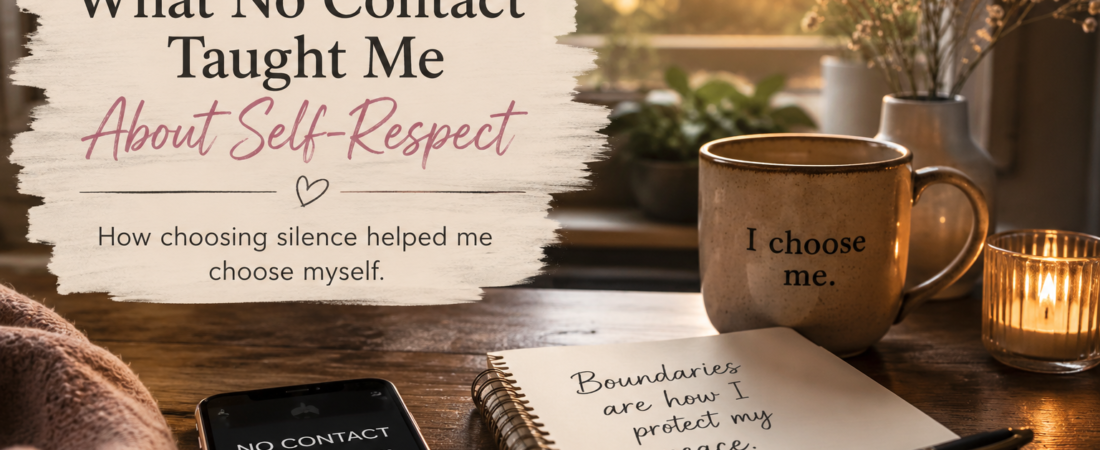
The first thing no contact takes from you is your thumb’s muscle memory. For weeks after I stopped reaching out to someone who’d spent years quietly diminishing me, my hand kept finding the phone. It did so on its own. I’d open it to nothing in particular and feel a small, automatic pull toward a conversation that no longer existed. The body remembers a habit long after the heart has decided to break it. What I didn’t understand then was how closely no contact and self-respect would become connected for me. That gap between deciding and actually being free is where almost everything I learned about self-respect actually happened.
I want to be careful here. ‘No contact’ has become a phrase people throw around, sometimes as a threat, sometimes as a trend. That’s not what I mean. I mean the specific, often agonizing decision to stop letting someone reach you because their reaching you kept costing you pieces of yourself. Not as punishment. Not to make them suffer. Simply because you finally understood that you could not keep the relationship and keep yourself at the same time.
It’s one of the loneliest things a person can do. It’s also, in my experience, one of the most clarifying. Because when you remove a voice that has been narrating your worth to you for years, you finally get to hear what your own voice has been trying to say underneath it.
The silence that’s harder than the absence
Everyone assumes the hard part of no contact is missing the person. And yes, you miss them sometimes ferociously, sometimes at the worst possible moments. But that wasn’t the hardest part for me. The hardest part was the silence inside myself: the unbearable urge to explain.
Because I didn’t just want them back. I wanted them to understand. My aim was to send the message that would finally make them see what they’d done, the perfect paragraph that would crack them open and produce the apology I’d been waiting years for. I drafted it a hundred times in my head while making dinner, in the shower, lying awake. And slowly I realized something that reorganized everything: I was still handing my peace to a person who had never once handled it gently. As long as I needed them to understand me, they still ran me. I had left the relationship but kept the leash in their hand.
Self-respect, it turned out, was not the dramatic act of cutting them off. That part was almost easy by comparison a single decision, made once. Self-respect was the quiet, daily refusal to crawl back asking to be understood by someone who had made a career of misunderstanding me on purpose. It was learning to stop auditioning for the approval of a person whose approval had only ever come with conditions I couldn’t afford.
What the relapses taught me
I broke no contact more than once. I’m telling you this because the people who write about boundaries often present a clean, victorious line, and that wasn’t my experience and probably won’t be yours.
Each time I reached back out, I learned the same lesson more deeply through my own body. I’d send the message, feel a flash of relief, and then feel the old, specific awfulness flood right back in the smallness, the bracing, the way I’d start managing my words to avoid setting them off. Within hours I’d remember exactly why I’d left. The relapse wasn’t a failure. It was research. Every time I went back and felt worse, I was learning my own worth experimentally instead of theoretically. I stopped having to convince myself the relationship was bad for me. My nervous system had filed the evidence.
This is something I’d gently offer to anyone in the thick of it: if you slip and reach out, you haven’t ruined anything. You’ve just gathered one more piece of proof. The discipline of no contact isn’t built through willpower. It’s built through the slow accumulation of remembering.
The closure I was waiting for didn’t exist
For a long time I told myself I just needed closure one last conversation, an admission, a clean ending I could file away and move on from. I think a lot of us believe we’re owed a final scene where the other person finally gets it, and the credits roll, and we’re released.
But the closure I was waiting for required them to become someone they weren’t. The whole reason the relationship had damaged me was the very reason they could never give me the ending I wanted. I was standing at a dry well demanding water, furious that it wouldn’t pour. The day I understood that closure was not something they could hand me that it was something I would have to give myself by simply deciding the door was closed was the day I actually started to heal. Closure isn’t a conversation. It’s a choice you make alone, often without ceremony, sometimes while doing the dishes.
What Helped Me Stay No Contact
I’m wary of turning this into instructions, because no contact is deeply personal and there’s no universal version. But a few practices kept me upright, and they were less about technique than about protecting a fragile new self-respect while it found its feet.
Write the message. Never send it. That paragraph I kept composing in my head? I eventually started writing it down in a notes file and not sending it. Getting it out of my body without putting it into their hands gave the urge somewhere to go. Most of the time, an hour later, I no longer needed to send anything at all.
Mute; don’t monitor. Checking on someone’s life keeps the wound open and aerated. Watching their posts, asking mutual friends how they’re doing, keeping a quiet tab open on their world I told myself it was just curiosity, but it was a way of staying in contact while pretending I wasn’t. Actual no contact meant no contact with the information too. The not-knowing was uncomfortable. The knowing was worse.
When the Urge to Break No Contact Comes Back
Name the loneliness spike. There were predictable moments a hard night, a holiday, a small triumph I had no one to tell when the urge to reach out roared back. Learning to say, plainly, this is the lonely-hour talking, not a change in the facts, let the wave pass without my obeying it. The feeling was real. The conclusion it tried to draw was not.
Let people be disappointed in your boundary. Especially if the person is family, you’ll meet a chorus but that’s your mother, but you only get one, but family is everything. I had to make peace with being seen as the cold one, the dramatic one, the one who couldn’t let it go. Their discomfort with my boundary was not evidence that the boundary was wrong. It was usually just evidence that my limitlessness had been convenient for everyone but me.
A reframe I hold onto
Somewhere in the middle of all this, I stopped thinking of no contact as turning away from someone and started thinking of it as turning toward myself. That sounds like a small semantic trick, but it changed how the silence felt. I wasn’t withholding. I was protecting. The energy I’d spent for years monitoring someone else’s moods, managing their reactions, shrinking to fit their comfort all of it came home to me, and I had no idea, until it returned, how much of myself I’d had outsourced.
I also had to learn that loving someone and choosing not to let them near you are not contradictions. You can grieve a person and still keep the door shut. Missing them is not a reason to go back; missing them is just proof you’re human and that the relationship had real things in it. Both can be true. The missing doesn’t cancel the leaving.
Reflection
What surprised me most is how undramatic self-respect turned out to be. I’d imagined it as something fierce and loud a final confrontation, a mic drop, a door slammed hard enough to be heard. It was none of that. It was the unglamorous, repeated, private act of not reaching for the phone. Of letting an unfair story about me go uncorrected because correcting it would cost me more than the lie. Of being misunderstood and surviving it.
You may not get the clean ending either. You may always, in some quiet corner, miss the person you walked away from. That’s allowed. Self-respect was never about extinguishing the feeling. It was about no longer letting the feeling make my decisions for me.
When I Stopped Waiting for Them to Understand
For a long time, part of me still hoped for one final conversation where everything would finally make sense. I wanted acknowledgment more than anything some sign that they understood why I had reached my limit.Eventually, I realized that waiting for their understanding was another way of keeping myself emotionally tied to them.
My boundary did not need their agreement to be valid. That changed something in me. No contact stopped being something I was waiting for them to understand and became something I was choosing for myself.
In Closing
No contact taught me that self-respect is often built through small decisions no one else sees. The message you don’t send. The profile you stop checking. The explanation you finally stop giving. The moment you allow someone to misunderstand you without sacrificing your peace trying to change their mind.
There may not be a dramatic moment when you suddenly feel free. Sometimes freedom arrives quietly. One ordinary morning, you reach for your phone and realize the old pull isn’t there anymore. You’re simply holding a phone. And somewhere along the way, without even noticing exactly when it happened, you came back to yourself.
Continue Your Journey
If this reflection resonated with you, explore the Healing Journals for guided exercises, self-reflection prompts, and practical tools to support your healing journey. You can also browse more articles in the Healing Library or listen to calming healing songs created to accompany you on your path toward emotional well-being.