
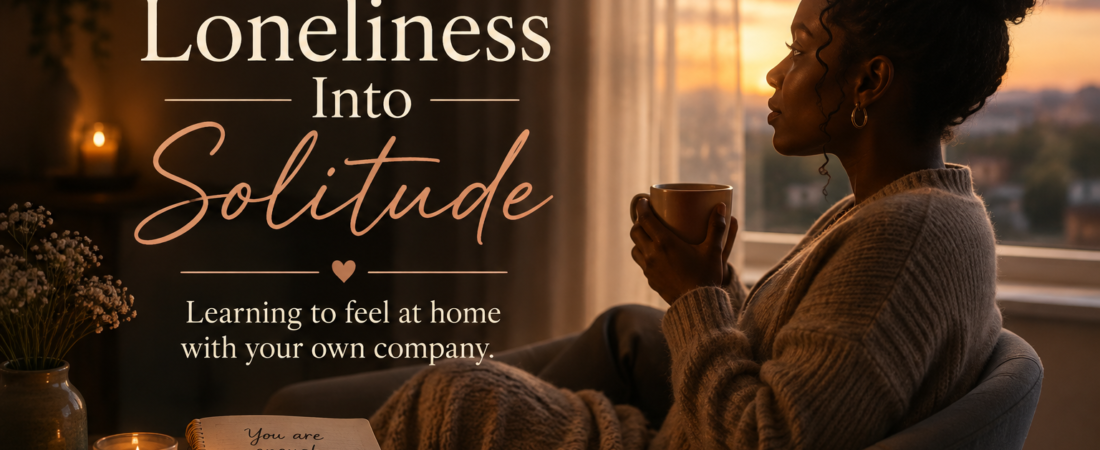
Turning loneliness into solitude can be difficult when being alone has never felt safe. If you’ve survived abandonment of any kind, solitude rarely registers as neutral. The moment the room goes quiet, something old wakes up. The silence doesn’t feel like peace; it can feel like confirmation—proof of the thing you’ve always feared: that you are someone who ends up alone, and that the emptiness around you says something about your livability rather than simply being an ordinary evening with no one around.
So you learn to never let the room go quiet. You keep the television on for company. Instantly, you text someone, anyone, the moment the feeling creeps in. You fill your calendar past the point of rest. In the worst cases, you reach back to those who hurt you, because painful company feels safer than silent loneliness. They would rather endure hurt than be alone, because alone is where the original wound lives.
This is the trap. As long as you can’t be alone without panic, you’re not actually free to choose anything. You’ll keep choosing whatever fills the quiet, and “whatever fills the quiet” is a famously low standard. Learning solitude isn’t about becoming a hermit or pretending you don’t need people. It’s about removing the gun that loneliness holds to your head so that your choices come from desire instead of dread.
The capacity no one taught us to build
Here’s something I find quietly tragic about modern life: we’ve made it nearly impossible to accidentally develop the capacity for solitude. There was a time when waiting in line, riding a bus, lying awake, or sitting in an empty house meant being alone with your own mind, and people built without trying a basic comfort with their own company. Now every one of those gaps gets filled instantly. The phone comes out before the silence can even form.
So we never build the muscle. And then life delivers the real thing a breakup, a death, a move to a new city, a slow drift apart from old friends and genuine loneliness arrives all at once, and we have no idea how to be in it, because we never practiced. We meet involuntary solitude with zero training and experience it as pure loneliness. It’s a little like being asked to swim a long distance having never been allowed in the water. Of course it feels like drowning. No one ever let you learn to float.
The encouraging part of this is that capacity can be built at any age. Comfort with your own company isn’t a personality type you either got or didn’t. It’s a skill, and like the callus a guitarist earns or any other slowly-acquired thing, it comes through gentle, repeated practice not through one heroic night alone, but through many small, survivable ones.
Turning Loneliness Into Solitude: Learning to Float
I want to be careful not to prescribe, because the line between loneliness and solitude is personal and you’ll find your own way across it. But these are the things that genuinely helped people I’ve known move from drowning toward floating.
Notice which question you’re asking. Loneliness and solitude ask different questions in the quiet. Loneliness asks, why is no one here? it’s organized around an absence. Solitude doesn’t ask anything; it’s simply present in the room. When the feeling hits, listen for the question underneath it. Just noticing “ah, I’m in the absence-question right now” creates a small gap between you and the panic, and in that gap you get a little room to choose your next move instead of bolting.
Make Your Alone Time Meaningful
Practice small, deliberate solitude on purpose. Don’t wait for life to force loneliness on you and then try to cope. Build the muscle in low-stakes doses while things are calm. Eat one meal a week alone without your phone, just you and the food and your own thoughts. Take a short walk with nothing in your ears. These tiny reps teach your nervous system, slowly, that being alone is survivable so that when the involuntary version arrives, you’re not meeting it for the first time.
Furnish the time instead of just killing it. There’s a difference between being alone and waiting to stop being alone. The second is just loneliness with a clock. Try doing something in your own company that you’d actually value playing, cooking properly, writing, listening to a whole album the way you used to. You’re not distracting yourself from the loneliness; you’re filling it with a life worth having even when no one’s watching.
Tell the difference between missing a person and needing connection. Sometimes the ache is specific you miss one person. Sometimes it’s general you just need warmth, any warmth, and a coffee with a friend would do. Confusing the two is how people end up reaching for the wrong person to solve a generic loneliness. Ask which kind it is. The general kind has many healthy answers. The specific kind usually just needs to be felt and grieved, not fixed.
A reframe from music
On a site about music, the image I keep returning to is the rest. In any piece of music, the silences are written into the score as deliberately as the notes. A rest isn’t the music failing or stopping; it’s part of the composition the space that lets the notes mean something, the breath that makes the phrase land. A song that never paused would be exhausting and somehow empty. The silence is doing real work.
Loneliness hears the quiet as the music having stopped as proof the song is over, that something has gone wrong, that the absence of sound is a failure. Solitude hears the very same silence as a rest intentional, alive, part of the piece. Nothing about the silence itself changes. What changes is whether you experience it as the song breaking down or as the song breathing.
You’re allowed to hear the quiet in your life as a rest. The pause between people, between chapters, between the love that left and the love that hasn’t arrived yet that’s not the music ending. It’s the space the next phrase will rise out of.
Reflection
What surprised me about learning to move from loneliness into solitude was how little the external situation had to change. I didn’t necessarily need more people. I needed a different relationship with the empty room.
The same quiet evening that once felt like abandonment could slowly become something closer to relief not every time and not always easily, but often enough to know another way of experiencing the silence was possible.
You may move back and forth across that line for a while. Some nights the silence will feel like rest; other nights it may still feel painfully lonely. The same room can hold both experiences within a single week. That isn’t failure. It’s part of learning that your own company can become somewhere you feel safe.
In closing
The goal isn’t to stop needing people. We’re human, and connection isn’t a weakness to outgrow. The goal is to reach a place where being alone no longer feels like a verdict about your worth.
When that begins to happen, something changes. You stop choosing company simply because you fear the silence, and you become freer to choose relationships because you genuinely want them.
So when the room goes quiet, listen to what the silence is saying. Sometimes it will be loneliness, and that deserves tenderness. But sometimes it may simply be a rest—the breath between one part of your life and whatever comes next.
You are not the emptiness around you. And being alone does not mean you have been abandoned by life.
Keep Moving Forward
Continue Your Journey
Read More Reflections
If this reflection resonated with you, explore the Healing Journals for guided exercises, self-reflection prompts, and practical tools to support your healing journey. You can also browse more articles in the Healing Library or listen to calming healing songs created to accompany you on your path toward emotional well-being.