
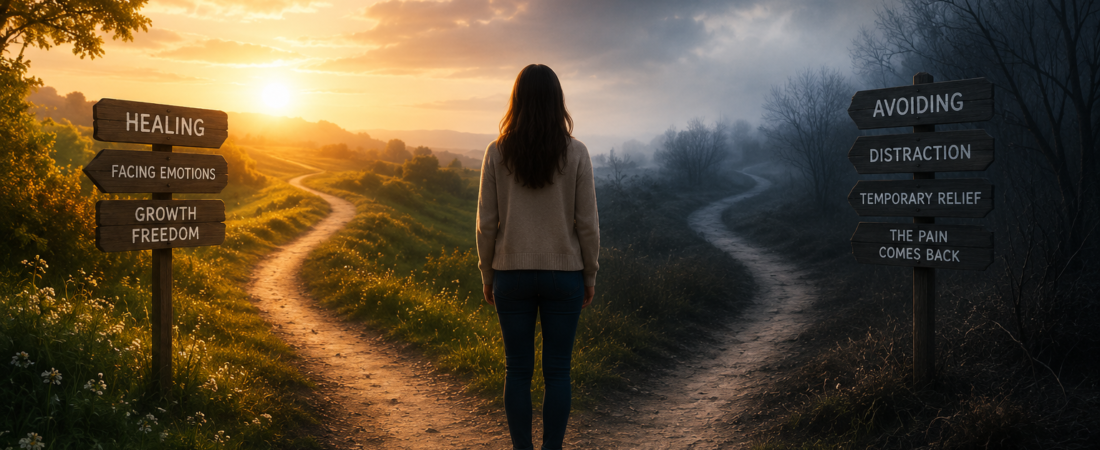
Healing and avoiding can sometimes look almost identical from the outside, but they lead to very different outcomes. You told yourself you were over it. You stayed busy. You filled the quiet. You stopped letting yourself think about it, and after a while, it seemed to work. The ache faded into the background, and you decided that meant you’d healed. Then one ordinary day, a song comes on, or a photo surfaces, or someone says a name you weren’t ready to hear, and suddenly it’s all there again, as raw as the day it happened. And you stand there, blindsided, thinking: If I really moved on, why does this still have so much power over me?
That question deserves a real answer. Because what you may have been calling healing might have been something else entirely and understanding the difference can change the way you carry everything you’ve been through.
Healing and Avoiding Can Look the Same at First
Here’s the thing almost no one tells you: avoidance and healing can look identical from the outside. Sometimes they even feel identical from the inside, at least for a while.
You stay busy, and busy feels like progress. You stop crying, and you call it strength. You throw yourself into work, or the gym, or a new project, or a new person, and the relief of not-feeling gets mistaken for the peace of having-healed. You become impressively functional. You smile. You say, I’m doing so much better, and part of you believes it.
But there’s a quiet difference underneath. Avoidance is built on distance on keeping the pain at arm’s length, on never letting it fully into the room. Healing is built on something braver: letting the pain in, sitting with it, and slowly learning it no longer needs to be feared.
The reason this matters is simple. When you avoid a wound, it doesn’t close. It just goes quiet. And anything you bury alive has a way of staying alive, waiting underground for the day something digs it back up.
Healing Asks You to Feel What You’d Rather Skip
We want healing to be clean. We want it to mean the pain simply lifts one morning and never returns. But real healing rarely works that way, and pretending otherwise only makes us feel like we’re failing at it.
Genuine healing usually involves the very things we’re trying to avoid: grief, discomfort, honesty, the vulnerability of admitting how much something hurt. It means letting yourself feel the loss instead of rushing past it. It means telling yourself the truth about what happened, even when the convenient story is easier to live with.
And here is something worth sitting with: healing was never about making the pain disappear. It was always about learning to carry it differently. The goal is not a life where the loss never happened. The goal is a life where the loss is part of you without being the whole of you where you can hold it in one hand and still keep living with the other.
That’s a quieter, less dramatic kind of healing than we’re sold. But it’s the kind that actually lasts.
What Avoidance Costs You Later
The trouble with pushing pain down is that it doesn’t stay where you put it. Emotions are not patient. The ones we refuse to feel don’t dissolve they wait, and they find other ways out.
Avoided grief has a habit of returning in disguise. It shows up as anxiety that seems to come from nowhere. As a temper that’s suddenly too short for the situation. As burnout, because staying busy enough to outrun your feelings is exhausting work. As emotional triggers that ambush you in ordinary moments. As a flat, gray numbness where your joy used to be. As relationship struggles, because the walls you built to keep the pain out also keep love from getting in.
Here’s an insight that took me a long time to understand: the emotions you never let yourself feel don’t get filed away as resolved they get filed away as urgent. Your mind keeps flagging them as unfinished business, which is why the smallest reminder can bring the whole thing roaring back. It’s not that you’re broken or backsliding. It’s that a part of you is still waiting to be heard.
Emotions ignored are not emotions healed. They’re emotions postponed and they always collect interest.
How to Tell If You’re Actually Healing
So how do you know the difference? It’s not about whether the pain is gone. It’s about your relationship to it.
You might be healing if you can talk about what happened without being swallowed by it feeling the weight of it, yes, but staying yourself while you do. You might be healing if you no longer need to flee every reminder, if a song or a place can hold sadness without flattening your whole day. You might be healing if you’re becoming gentler with yourself, less prone to blame, more able to say that was hard, and I did the best I could.
You might be healing if you’re learning from the experience instead of being defined by it if it’s becoming a chapter in your story rather than the title of the whole book. And you might be healing if the pain is still there, still part of you, but no longer the thing steering the car.
Notice the pattern: none of these signs require the pain to vanish. Healing isn’t the absence of the wound. It’s the wound no longer running your life. Avoidance wants the feeling gone. Healing simply wants the feeling to stop being in charge.
Healing Is Not a Straight Line
One of the cruelest lies we tell ourselves is that healing should be steady that if we were doing it right, each day would hurt a little less than the last. So when a hard day comes out of nowhere, we panic. We think we’ve failed, or lost all our progress, or somehow ended up back at the very beginning.
You haven’t. Healing doesn’t move in a straight line; it moves in spirals. You circle back to the same grief again and again, but each time from a slightly higher place, with a little more understanding than before. A difficult day is not a relapse. Feeling the old emotions resurface does not erase how far you’ve come.
If anything, the fact that you can feel it again and stay standing is proof of your healing, not evidence against it. You’re not back at the start. You’re just passing through familiar territory as a stronger version of who you were the last time you walked here.
Gentle Reflection
Take a slow breath, and let yourself sit honestly with this:
Is there a feeling I’ve been working very hard not to feel and what would it mean to let myself finally turn toward it, just a little, with kindness instead of fear?
You don’t have to face it all at once. You only have to stop running from it. Sometimes simply admitting yes, this still hurts is the bravest and most healing thing a person can do.
A Gentle Place to Land
If you’ve realized, reading this, that you’ve been avoiding more than healing please don’t turn that into one more thing to feel bad about. Avoidance isn’t a character flaw. It’s what a tired, overwhelmed heart does to survive when the pain feels like too much to face all at once. It protected you when you needed protecting. There is no shame in that.
But you don’t have to live in survival mode forever. You’re allowed to turn toward what hurts, slowly and gently, knowing now that feeling something is not the same as being destroyed by it. That’s the whole difference, really. Avoidance says, I don’t want to feel this. Healing says, I can feel this, and still move forward.
And you can. You’re stronger than the version of you who first got hurt strong enough now, perhaps, to stop running and start healing for real. The pain will become part of your story. It was never meant to be the end of it.