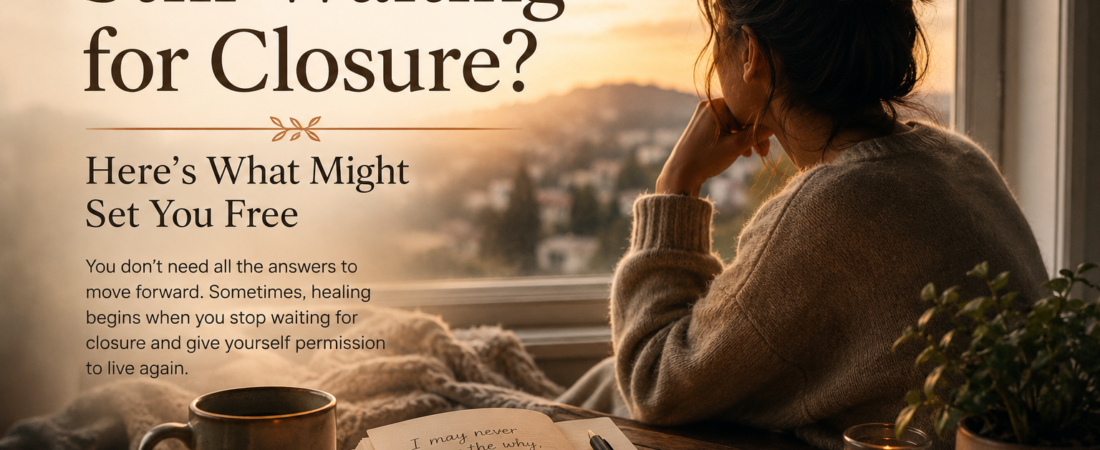
When we Still Waiting for Closure, We sign and file the closure document, then settle the matter and can leave. We imagine an office somewhere with our name on a folder, and we keep going back to the counter asking if our paperwork has come through yet. Just one conversation. Just one honest answer. Just the reason. Then I can move on.
I spent a good portion of my life standing at that counter. After relationships ended and friendships faded, fade of people I trusted began; I told myself I was stuck without closure. I replay the last conversations to find the missing piece, certain that understanding why would dissolve the ache. It felt logical. It felt fair. It was also, I eventually realized, keeping me exactly where I didn’t want to be.
Because the office doesn’t exist. No clerk hands you the resolution you’re owed, and there is no counter or folder. And the longer you wait there, the longer you postpone the only thing that actually moves you forward, which is leaving without it.
The shape the mind insists on finishing
There’s a quirk of human perception worth knowing about. Show someone three dots arranged in a rough triangle, and the mind doesn’t see three dots it sees a triangle, drawing the missing lines on its own. Show it an almost complete circle with a small gap, and it perceives a whole circle, quietly closing the opening. The brain hates an unfinished shape. It rushes in to complete what’s incomplete, because openness feels, on some deep level, like a problem demanding a solution.
I think this is what we’re really feeling when we crave closure. It isn’t only grief. The mind refuses to tolerate the loop, insisting the story end, the gap be filled, and the picture make sense. The need for closure is partly just the discomfort of an unfinished shape, dressed up as a moral entitlement.
Here is the thing nobody tells you: you do not have to complete a life to be whole. Some loops stay open. Some circles keep their gap. And you can live fully, warmly, well inside a story whose ending you never got to read.
Why the answer wouldn’t save you anyway
Underneath the wish for closure is usually a single word: why. Why did they leave. Why did it happen this way. Why wasn’t I enough to make them stay or try or care. We become convinced that the explanation is the cure that understanding the reason will finally let the wound close.
So let me say something that took me years to accept: understanding and peace are not the same thing. They don’t even reliably travel together. I have known exactly why certain things fell apart, understood the reasons in forensic detail, and still hurt for years. In other cases, I have not received a single answer and have healed completely. The why turned out to be far less important than I’d staked my recovery on.
When Closure Becomes a Reason to Hold On
And even if you got it even if the person sat across from you and explained everything would it be enough? The people I’ve known who actually received the closure conversation, the apology, the full accounting, almost always report the same surprising thing: it changed less than they expected. They thought the answer would set them free, and instead they discovered that the freedom had to come from somewhere else entirely. The closure conversation is a story we tell about a future event that will reach back and fix the past. We cannot fix the past. We carry the past differently.
There’s also an uncomfortable truth I had to face about myself: sometimes my desperate need for closure was just attachment wearing a respectable disguise. As long as there was an unanswered question, the relationship stayed open as an unfinished project and as long as it was unfinished, I had a socially acceptable reason to keep the door cracked, to keep thinking about them, to keep one foot in a place I claimed to want to leave. The hunger for closure can be a way of not letting go while telling everyone, including yourself, that you’re trying to.
The practical part: living without the final page
I won’t pretend there’s a clean technique for this, because learning to live without closure is less a method than a slow change in posture. But a few things genuinely helped me stop standing at that counter.
Trade the question for a better one. When I caught myself spiraling into why did they do this, I started asking instead what do I need now. The first question sends you backward into a locked room. The second turns you toward a door that’s actually open. The past question has no good answer; the present one always does, even if the answer is just “rest.”
Write your own ending but not to them. I recorded what the relationship had meant. I had learned, what I was grieving, and what I was relieved to put down. Not a message to send, not an argument, not a plea. A private accounting, addressed to no one but myself. It turned out I could author the ending I’d been waiting for someone else to provide. I don’t have to grant endings. They can be written.
Still Waiting for Closure? Start With What You Need Now
Notice when “closure” means “contact.” Whenever the urge for closure got loud, I learned to ask it honestly: do I want understanding, or do I just want a reason to talk to them again? More often than I’d like to admit, it was the second. Naming that took the wind out of it. You can’t get closure from the same source that opened the wound.
Let the question shrink by living, not by solving. I used to think the open loop would close the day I finally got my answer. What actually happened was quieter: I kept living, kept filling my days with people and small ordinary things, and one afternoon I noticed the question had gotten smaller not answered, just less loud, crowded out by an actual life. Time doesn’t deliver the explanation. It just gradually makes you need it less.
A reframe from music
On a site about music, the truest image I can offer is the unresolved chord. Most songs we know move toward resolution they build tension and then return home to the root note, that settled sound that tells your ear the journey is complete. It’s deeply satisfying. It’s also a convention, not a law.
Some of the most beautiful pieces of music ever written end on a chord that never resolves. The tension simply hangs there, unfinished, suspended in the air after the last note fades. At first it feels wrong your ear keeps waiting for the resolution that isn’t coming. And then, if you let it, something shifts, and the unresolved ending becomes its own kind of beauty. It says: not everything returns home. Some things end in the air. And the song was no less worth hearing for it.
Your story can end on an unresolved chord and still be music. The lack of resolution doesn’t unmake everything that came before. You’re allowed to walk away from a song that never returned to its root note and carry the whole melody with you anyway.
Reflection
Maybe closure was never meant to be something another person gives you. Maybe it begins when you realize that an unanswered question can remain unanswered without becoming the center of your life.
You may still wonder sometimes. A memory may return, or an old question may quietly surface again. That doesn’t mean you’ve gone backward. Moving forward without closure doesn’t require you to stop caring or erase what happened. It simply means the unanswered parts no longer decide where your life goes next.
There is a particular kind of peace in being able to say, I may never understand everything that happened, but I no longer need to understand it in order to keep living.
In closing
You don’t need closure to move forward. You need your own permission to stop waiting for an answer that may never come.
Let the circle keep its gap. Let the chord remain unresolved. Some stories end without the explanation, apology, or final conversation we hoped for, and they can still become part of a life that feels whole again.
You can carry what mattered, release what hurt, and continue without having every question answered.
Sometimes closure isn’t finally receiving the ending you were waiting for.
Sometimes it’s realizing that you are allowed to leave without one.
Find More Healing
Continue Your Journey
Read More Reflections
If this reflection resonated with you, explore the Healing Journals for guided exercises, self-reflection prompts, and practical tools to support your healing journey. You can also browse more articles in the Healing Library or listen to calming healing songs created to accompany you on your path toward emotional well-being.