
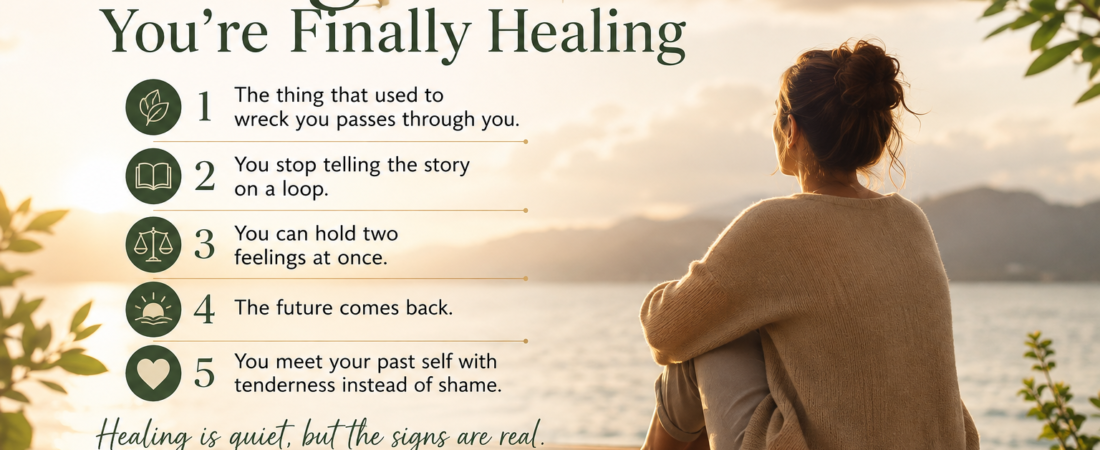
What are the signs that you are healing? This is a strange question. It is one many people quietly carry, usually late at night. Sometimes they feel embarrassment, as if they should know the answer about their own life.
The reason it’s so difficult to answer is that healing rarely announces itself. It doesn’t arrive with a clear before and after, or a single morning when you wake up restored. Signs you’re healing often appear as absence. A reaction doesn’t happen, a thought doesn’t come, a wound goes unchecked.
I think of it like the tide. If you stand on a beach and watch the water, you can’t always see it receding. The movement is too gradual. One realizes the tide has gone out only after looking back. The water then seems much farther from where you stand than before.
Healing can feel the same way. You don’t always catch it happening. One day, you simply notice how much distance has quietly opened between you and the thing that once soaked everything.
So if you’ve been wondering whether you’re getting better whether all this slow, unglamorous effort is actually working here are five quiet signs you’re healing. Not the loud, cinematic ones. The real, easy-to-miss changes that may mean the tide has been going out longer than you realized.
5 Quiet Signs You’re Healing
So if you’ve been wondering whether you’re getting better whether all this slow, unglamorous effort is actually working here are five quiet signs you’re healing. Not the loud, cinematic ones. These are the real, easy-to-miss changes that may indicate progress. They show the tide has been going out longer than you realized. They are quiet signs you’re healing.
So if you’ve been wondering whether you’re getting better whether all this slow, unglamorous effort is actually working here are five quiet signs you’re healing. Not the loud, cinematic ones. The real, easy-to-miss changes that may mean the tide has been going out longer than you realized.
1. The thing that used to wreck you passes through you
The first sign you’re healing usually arrives as a non-event, which is exactly why it’s so easy to overlook. You encounter the reminder the place, the date, the song, the name that comes up in conversation and you brace for the familiar collapse. And it doesn’t come. You feel something, yes. A pang, a flicker, a small weight. But it moves through you instead of flattening you, and a few minutes later you’re back in your day.
What’s strange is that you often notice this only in hindsight. Wait that didn’t hurt the way it used to. The absence of the spiral is the whole sign. You didn’t have to white knuckle your way through it; the trigger simply lost some of its voltage. This is healing in its most honest form: not the dramatic absence of all feeling, but the quiet return of proportion.
2. You stop telling the story on a loop
When we’re freshly wounded, the story tells itself through us compulsively. We narrate it to every new person, replay it on every walk, return to it the way a tongue returns to a sore tooth. The pain becomes our introduction the first thing we hand people, the lens we see everything through.
One sign you’re healing is realizing, almost with surprise, that you haven’t told the story in a while. Not because you’re suppressing it or pretending it didn’t happen, but because it has quietly stopped being the center of gravity in your life. It’s still true. It still mattered. It’s just no longer the headline. When the thing that hurt you moves from being your whole story to being one chapter among many, something fundamental has shifted the wound has stopped running the narration.
3. You can hold two feelings at once
Pain tends to make our emotional life all or nothing. In the thick of it, you’re either devastated or fine, the relationship was either everything or a complete lie, you either miss them desperately or you’re over it. There’s no room for the in between, and any return of sadness feels like total relapse.
Healing shows up as the return of the in-between the capacity to hold contradictory things at the same time without either one canceling the other out. You can be grateful for what you learned and still wish it had never happened. One can miss someone deeply and have no desire to return to them. You can feel a wave of grief on a Tuesday and not take it as evidence that you’ve made no progress. In music, a single note is just a note; it’s only when two or more sound together that you get a chord, something with depth and tension and richness. The return of your ability to feel two things at once is the return of harmony to an emotional life that pain had reduced to one flat note.
4. The future comes back
When you’re in real pain, the future shrinks. It contracts down to getting through today, then this hour, then the next ten minutes. Ask someone in the depths of it where they see themselves in a year and you’ll often get a blank, honest stare they genuinely cannot picture it. The imagination of a future is one of the first things suffering takes, and we rarely notice it’s gone.
So one of the surest signs of healing is the quiet day you catch yourself wanting something again. Making a plan. Picturing a trip, a project, a version of next spring. Idly imagining a life that has good things in it. Desire is one of the last things to return and one of the most reliable, because you cannot want a future while you’re still convinced you don’t have one. When the imagination of tomorrow flickers back on even faintly, even just as a small wish the tide has gone a long way out.
5. You meet your past self with tenderness instead of shame
In the aftermath, we’re often cruelest to the version of ourselves who lived through it. We cringe at who we were the one who stayed too long, who didn’t see the signs, who begged, who believed the promises, who kept hoping past all reason. The memory of that person makes us flush with embarrassment, and we distance ourselves from them as if they were a stranger we’re ashamed to have been.
A deep sign of healing is the moment that shame softens into compassion. You look back at who you were in the hardest stretch and instead of cringing, something in you aches gently for them. You see someone who was doing their best with what they understood at the time, someone who loved hard, who tried, who got hurt and kept going. When you can look at your past self the way you’d look at a struggling friend with warmth rather than contempt you’ve reclaimed something the pain stole: your own self-respect, extended backward across time to include even the version of you that fell apart.
The practical part: how to read your own signs
A gentle word of caution, because “signs of healing” can curdle into one more thing to perform. The point is not to audit yourself daily, anxiously checking which boxes you’ve ticked. That just turns recovery into another exam.
Instead, notice these things the way you’d notice the tide in occasional backward glances rather than constant monitoring. Every so often, look back a few months and ask honestly how far the water has moved. You’ll often be surprised by the distance, because forward progress is invisible up close.
And please don’t mistake a bad day for a relapse. Healing is not a straight line, and a sudden wave of grief or a hard, heavy week does not erase the signs you’ve already seen. The tide goes out, but individual waves still rush back up the sand now and then. One painful afternoon is a wave, not the ocean returning. The overall direction is what matters, and you measure direction over seasons, not over single days.
If it helps, keep some quiet record a note, a journal line here and there. Not to grade yourself, but so that on the days you feel like you’ve made no progress at all, you have evidence from your own hand that you have.
Reflection
What moves me most about these signs is how ordinary they can seem. Healing doesn’t always arrive as a breakthrough or a moment when everything suddenly feels different. Sometimes it’s simply a reaction that no longer overwhelms you, a story you haven’t needed to tell in a while, or a future you can finally imagine again.
We often expect healing to feel like victory, so we overlook the quieter evidence accumulating in our everyday lives. You may not feel completely healed, and you may still have difficult days, but that doesn’t mean nothing has changed.
Sometimes progress is easiest to see when you stop measuring where you think you should be and look back at how far you’ve already come.
In closing
If you’ve been wondering whether you’re finally healing, don’t look only for dramatic changes. Pay attention to the quieter ones: the moments that hurt less, the thoughts that no longer consume you, the plans you’re beginning to make, and the kindness you’re learning to offer yourself.
You may not notice the tide moving while you’re standing in the water. But every now and then, look back at where you started.
The distance matters. And so does every small step that brought you here.
Continue Your Journey
Read More Reflections
If this reflection resonated with you, explore the Healing Journals for guided exercises, self-reflection prompts, and practical tools to support your healing journey. You can also browse more articles in the Healing Library or listen to calming healing songs created to accompany you on your path toward emotional well-being.