
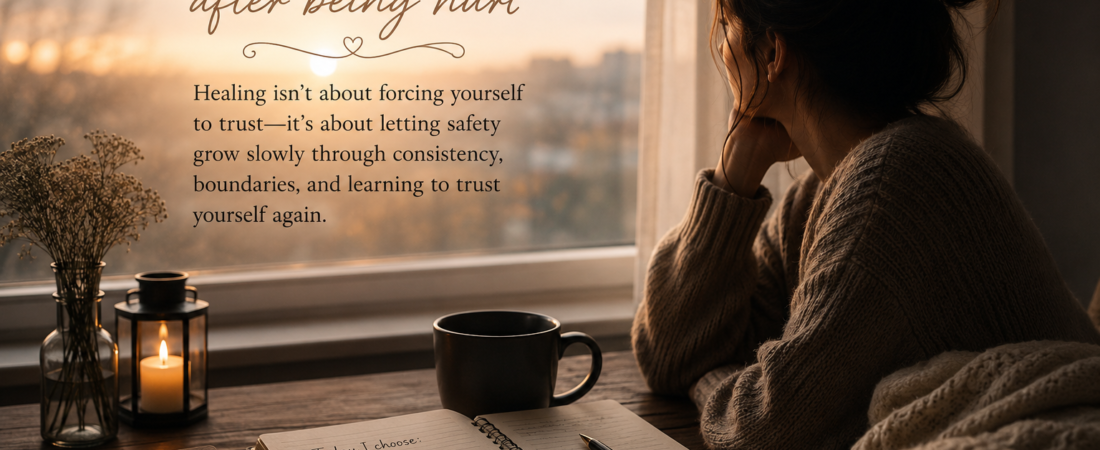
Sometimes the hardest part isn’t wanting to trust again. It’s learning how to begin trusting again after being hurt, while quietly realizing that some part of you is still waiting for something to go wrong. Answering the messages, you respond. You smile. You let people come a little closer, but not too close. Not yet.
Because somewhere beneath your hope is the fear that if you fully open your heart again, you may have to survive another goodbye.Maybe you’ve never said this out loud. Maybe you haven’t needed to. It lives in the pause before you reply, in the little things you hold back even when everything seems fine. You want to believe. You almost do. And still, a part of you stands near the door, coat already on, just in case.
If that feels familiar, perhaps the question isn’t whether you know how to trust. Perhaps it’s why trusting again asks so much of you now.
Trust Is Built, Not Decided
We often talk about trust as though it’s a decision. As if one morning you could simply choose to stop being afraid and walk into the world unguarded. But trust rarely works that way.
Trust is an experience. The slow loosening in your chest happens when someone proves, again and again, that they are who they said they were. It is noticing that their actions match their words. It is your body gradually relaxing before your mind has even realized something has changed.
And because trust lives partly in the body, it cannot be argued into existence. You can list every reason someone deserves your trust and still feel resistance. That doesn’t necessarily mean you’re cold or incapable of loving again. Sometimes it simply means something in you remembers what happened the last time safety turned out not to be safe.
Why the Heart Learns to Stay Alert
The heart isn’t naturally suspicious. It becomes alert through experience. When promises repeatedly turn into disappointment, something inside you learns that hope can be expensive. So you begin keeping a little of yourself in reserve.
You still want closeness. You may even ache for it. But you reach toward it and pull back at the same time. Then comes another wound: judging yourself for being careful.
Why can’t I just relax? Why can’t I trust like everyone else seems to? But perhaps a kinder question is: What was I protecting—and do I still need to protect myself in the same way?
The habits that once kept you emotionally safe may not be the habits you need forever.
When Independence Becomes a Shield
Many people who struggle to trust became very good at relying on themselves. Not always because independence felt empowering, but because at some point depending on other people felt uncertain. So you learned to solve your own problems, soothe your own feelings, and need as little as possible.
There is strength in that. But there can also be loneliness. When you’ve spent years being the person who holds everything together, letting someone else hold even a small part can feel strangely dangerous.
Needing people isn’t weakness. And self-reliance, however useful it once was, doesn’t have to become a life sentence. You don’t have to choose between trusting everyone and trusting no one. There is a quieter place in between.
Caution Is Not the Same as Fear
It can be difficult to tell the difference between protecting yourself wisely and letting an old wound make every new decision. Caution says: I’ll watch how this person treats me over time.
Fear says: I already know how this ends. Caution keeps its eyes open. Fear writes the ending before the story has begun. Both are trying to protect you. But only one leaves room for something different to happen.
The walls we build after being hurt can work the same way. At first, they protect us from something real. But walls don’t know when the danger has passed. Eventually they can begin keeping out the warmth along with the harm.
A wall with a gate is a boundary. A wall without one can slowly become a prison. Healing doesn’t require tearing every wall down. Sometimes it simply means building a gate and deciding carefully who has earned the right to enter.
Trust Grows Through Consistency
Trust cannot be demanded. You cannot pressure yourself into feeling safe, and another person cannot demand that you trust them before you’re ready. Trust grows through consistency. It grows when someone says they’ll call and they do.
When disagreement doesn’t automatically become disappearance. When someone’s behavior on a difficult day still resembles the person they claimed to be on an easy one.
These moments aren’t dramatic, but they’re how emotional safety is built. You don’t have to make one enormous leap into trust. You can let trust grow at the pace of the evidence. Someone who is safe for you won’t need you to ignore yourself in order to prove that you trust them.
The Courage to Trust Again
Trusting again may not look like throwing your heart wide open. It may look like staying in a conversation a little longer. Letting someone see something you would normally hide. Asking for what you need.
Allowing another person to help. And then noticing what happens. Maybe the deepest part of trusting again isn’t trusting another person first. Maybe it’s learning to trust yourself.
You can trust that you’ll notice when something feels wrong. Trust that you’ll listen to yourself rather than explaining away what you see. To trust that you can leave if you need to. To trust that even if someone disappoints you, you will not abandon yourself trying to make them stay.
When you begin trusting yourself this way, relationships stop requiring the impossible promise that another person will never hurt you. You don’t need that guarantee. You need to know that whatever happens, you will remain on your own side.
Reflection
Trust doesn’t always return in one dramatic moment. Sometimes it comes back so quietly that you barely notice. One honest conversation. One consistent action. One person who turns out to be as safe as they seemed. And perhaps one day you realize the coat is no longer on.
You’re not watching the exits. You’re simply there.Present. You don’t have to rush toward that moment. Your caution helped carry you through difficult things, and it is allowed to soften slowly as you gather new evidence that closeness can also be safe.
Trusting again was never meant to mean forgetting what happened. It means discovering that the past doesn’t have to write every relationship that comes after it.
In Closing
You don’t have to trust everyone again. You don’t even have to trust quickly. Allow people to show you who they are. Let consistency matter more than promises. Let your boundaries have gates, and let people earn their way through them.
Most importantly, learn to trust the person who will be present in every relationship you ever have: yourself. Because perhaps healing isn’t reaching a place where you know no one will ever hurt you again. Perhaps it’s reaching a place where you know that if someone does, you will not leave yourself behind.
Read More Reflections
If this reflection resonated with you, explore the Healing Journals for guided exercises, self-reflection prompts, and practical tools to support your healing journey. You can also browse more articles in the Healing Library or listen to calming healing songs created to accompany you on your path toward emotional well-being.